
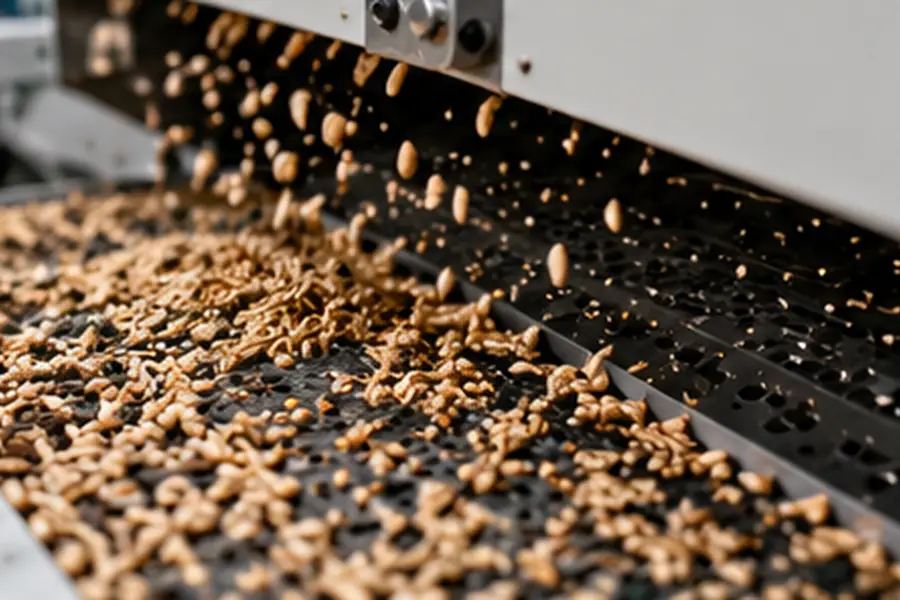
Begin every equipment evaluation by partitioning an authentic intake sample into distinct impurity fractions: coarse straw stems, weed seeds, shriveled kernels, soil clods, mineral stones, and airborne dust, while logging harvest moisture extremes across deliveries. Because aerodynamic drag, kernel width, length, and specific weight govern different separation physics, no nominal catalogue tonnage figure has meaning outside a defined contaminant matrix.
Aligning Machine Capabilities with End-Use Purity Standards
Next, specify the commercial or regulatory threshold governing the finished product leaving the conditioning plant. Certified sowing seed demands zero noxious weed tolerance, minimal mechanical pericarp micro-cracking, and high germination vigor, whereas bulk industrial grain or feed milling intake prioritizes rapid removal of gross trash and stones; documenting these exact acceptance limits ensures every vendor engineers toward the same duty.
Auditing Supplier Throughput Assumptions and Sample Trial Protocols
Require machinery manufacturers to disclose the exact engineering parameters behind their quoted capacity: test crop cultivar, bulk density, moisture percentage, incoming dockage level, sieve perforation sizes, and net clean-seed recovery. Clarify whether the stated hourly rate reflects a standalone pre-cleaner or a multi-pass fine conditioning circuit, and commission a witnessed benchtop or pilot test whenever seasonal harvest quality fluctuates sharply.
Evaluating Plant Integration, Sieve Changeover, and Service Ergonomics
Inspect how rapidly operators can unclamp sieve cassettes, clean ball trays, reach aspiration inspection hatches, and purge internal ledges between seed varieties to prevent genetic admixtures. Verify structural floor loading, bucket elevator discharge heights, cyclone air volumes, and electrical control interlocks so the selected cleaner operates reliably within your physical building envelope rather than merely boasting a high brochure rating.
Frequently Asked Questions on Selecting Seed Cleaning Equipment
What is the most reliable method for matching a seed cleaner to my crop?
Match the cleaner architecture to the physical contrast between your crop and its impurities—using air-screen decks for width, thickness, and buoyancy differences, and adding indented cylinders or gravity tables when length or density overlaps occur.
Why do rated machine capacities vary so widely between pre-cleaning and fine cleaning?
Pre-cleaning passes grain rapidly over large apertures to scalp coarse trash at high tonnage, whereas fine seed cleaning uses tight perforation tolerances and thin bed depth to maximize sizing precision, reducing throughput on the same frame.
What technical data should be shared with your engineering team for an accurate machine sizing proposal?
Compile a complete project brief listing every crop species, bulk density, harvest moisture range, incoming impurity percentages, required final purity, net hourly tonnage, shift schedule, and existing building layout drawings.
Can an initial cleaner selection be expanded into an integrated multi-stage line later?
Yes; when foundation footprints, elevator discharge heights, and aspiration duct manifolds are planned with future bypass spouts and surge bins in mind, plants can seamlessly add length graders, gravity tables, and optical sorters in phases.
Request an Engineering Review for Your Seed Cleaning Application
Send us your crop varieties, raw dockage breakdown, target hourly throughput, and final purity specifications so our application engineers can formulate a tailored machine configuration and layout recommendation.
Contact ↗