Home›Gravity Separator
Gravity Separator
Separation

Gravity Separator

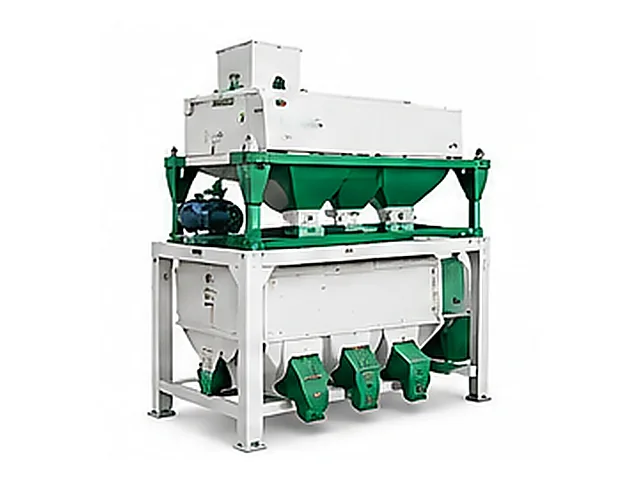
The Gravity Separator performs high-precision specific-weight grading, upgrading pre-cleaned and size-calibrated seed and commodity lots by separating plump, viable kernels from light, shriveled, insect-damaged, or frost-bitten material. It is widely applied to sunflower seeds, soybean, sesame, chickpeas, lentils, beans, hazelnuts, and pistachios.

Machines ↗

Overview

Size-graded product feeds onto an inclined, porous oscillating deck while a pressurized air plenum beneath the table forces a finely regulated upward airflow through the bed. This combination of air flotation and eccentric deck stroke stratifies the kernels vertically: lighter, low-density particles rise to the top of the fluidized layer and slide down the transverse slope toward the low side, whereas heavier, high-germination kernels remain in contact with the deck surface and walk uphill toward the elevated discharge edge. Adjustable splitter gates along the discharge lip divide the exiting curtain into heavy, middling recycle, and light reject streams.

Technical specifications

Technical ParameterGRV-05GRV-10GRV-15GRV-20
Processing Capacity (Grain / Seed / Pulses)3 – 5 t/h6 – 10 t/h11 – 15 t/h16 – 20 t/h
Deck / Screen Working Area1.5 m²2.4 m²3.4 m²4.5 m²
Vibration / Eccentric Motor Power1.1 kW1.5 kW2.2 kW3.0 kW
Pressurized Fan / Air Unit Power7.5 kW11.0 kW15.0 kW22.0 kW
Airflow Volume6,500 m³/h10,500 m³/h15,000 m³/h21,000 m³/h

The capacity and power ranges indicated in the table may vary depending on the crop type to be processed, initial foreign matter rate, moisture level, and machine configuration. Exact performance and actual measurement values are finalized following the engineering design and process detailing of the plant to be installed.

Key considerations

  • Confirm the crop, variety and incoming condition for Gravity Separator.
  • For the “Gravity Separator” unit, check the operating choices against these factors: acceptable loss between fractions, feed stability and density contrast.
  • When setting up the “Gravity Separator” unit, record acceptable loss between fractions, feed stability and density contrast and assess both accepted output and unwanted product loss during the sample trial.
  • Request written connection and maintenance details for the “Gravity Separator” unit, then check them against the site layout and cleaning access; keep acceptable loss between fractions, feed stability and density contrast tied to the next process step.

Typical applications

Operating across a 1–20 t/h envelope, the Gravity Separator upgrades planting seed and premium food-grade lots of sunflower seeds, soybean, sesame, chickpeas, lentils, dry beans, hazelnuts, and pistachios. Once upstream screens and indented cylinders have narrowed the particle size range, the gravity table isolates internal defects—such as weevil-hollowed beans, empty sunflower hulls, mold-lightened nuts, or partially filled soybean seeds—that reduce thousand-kernel weight and germination vigor.

GUIDE · TECHNICAL SELECTION

What is this machine used for?

Built to grade size-calibrated crops by bulk density at 1–20 t/h, the Gravity Separator uses a pressurized oscillating air deck to separate heavy, high-vigor kernels from light, damaged, or hollow fractions.

01

The role in the process

In certified seed conditioning and export pulse processing, dimensional grading alone cannot guarantee physiological seed quality or cooking uniformity. Kernels hollowed by field pests, shrunken by drought, or decayed internally often pass through the same sieve perforations as healthy seeds.

Placing the Gravity Separator after size grading exploits small differences in specific weight to strip out those low-density defects. The intermediate middling fraction—containing borderline kernels—is continuously routed back to the table inlet so sharp purity is achieved without sacrificing good product yield.

02

Material and application suitability

A gravity table can only separate accurately by density if the incoming feed has already been graded into a uniform size band. If large and small kernels of the same specific weight are fed together, aerodynamic drag causes large light seeds and small heavy seeds to overlap on the deck.

Oilseeds like sesame and sunflower require fine-weave deck covers and gentle air velocities, whereas heavy pulses and tree nuts such as chickpeas, beans, hazelnuts, and pistachios demand open wire decks and higher static plenum pressure. Cleanout doors simplify variety changeovers. Air and feed controls lock repeatably.

03

Selection checklist

When specifying a Gravity Separator within the 1–20 t/h range, define the target crops, whether the line is for planting seed or food-grade sorting, and how the middling fraction will be recirculated. Confirm whether a partial stone/dust hood or full aspiration canopy is preferred.

Specify deck wire mesh weave, fluidizing fan airflow capacity, and bidirectional inclination ranges for the target bulk density. Verify dust hood exhaust volumes, vibration isolation mounts, and discharge spout elevations in the floor plan. All contact zones support fast inspection. Settings remain stable across long shifts.

Integration into a processing line

Plant layout and interface planning

Position the Gravity Separator near the end of the mechanical cleaning sequence—after pre-cleaning, destoning, width/thickness screening, and length grading—just ahead of optical sorting or seed treatment. Anchor the base frame on a stiff, vibration-free foundation.

Provide a dedicated low-speed bucket elevator or gentle conveyor loop to return the middling splitter fraction back to the inlet surge bin. Leave clear operator access along the entire discharge edge so splitter blades can be visually set under working load.

Factors that affect operating performance

Five interrelated variables control table performance: feed rate, under-deck air volume, eccentric oscillation frequency, longitudinal slope (controlling travel speed), and transverse slope (controlling stratification width). Changing crop moisture or hull roughness requires slight re-balancing of deck tilt and air pressure.

Process quality and line integration

Integrating the Gravity Separator downstream of a Pre-Cleaner, Zig Zag Air Separator, and Destoner ensures that neither coarse trash nor heavy stones disturb the delicate fluidization film across the table.

Frequently asked questions

Why must seed be size-graded before entering the Gravity Separator?

On an air-fluidized oscillating deck, particle behavior depends on both weight and surface area; pre-grading by size removes dimensional variables so the table separates strictly according to specific weight and kernel fill.

What is the purpose of the middling discharge fraction on a gravity table?

The transition zone between heavy clean seed and light reject material contains a mixture of both; isolating this middle band with adjustable splitters and recycling it back to the feed inlet maximizes purity without losing sound seed.

How often should the porous deck cover be cleaned during continuous operation?

Fine seed coats, oil residue, or dust wedged into the deck weave gradually restrict upward airflow and create dead spots; operators should brush or air-lance the deck surface at regular shift intervals or lot changeovers.

REQUEST A TECHNICAL REVIEW

Gravity Separator

Tell us your crop mix, required hourly throughput in the 1–20 t/h range, and target germination or purity standards so our engineers can size the optimal Gravity Separator and deck package.