Home›Air Screen Cleaner
Air Screen Cleaner
Cleaning & Pre-Cleaning

Air Screen Cleaner

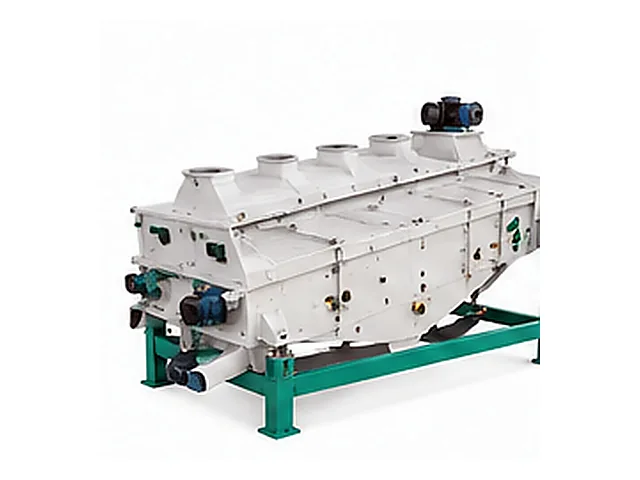
The Air Screen Cleaner combines dual-stage aerodynamic aspiration with multi-deck flat screen classification to strip light chaff, coarse trash, and undersized weed seeds from raw grain and planting lots. The machine prepares wheat, sunflower seeds, maize, rice, soybean, sesame, chickpeas, and lentils for downstream gravity or optical sorting.

Machines ↗

Overview

Inside the Air Screen Cleaner, an adjustable feed roller spreads incoming grain into a uniform curtain that first crosses a primary aspiration channel to lift hull fragments and airborne dust. The lot then flows across oscillating scalping and sifting sieve decks kept open by captive rubber balls before passing through a secondary upward air leg that extracts shriveled kernels and light dockage.

Technical specifications

Technical ParameterASC-10ASC-25ASC-50ASC-80
Pre-Cleaning Capacity (Wheat / Barley)20 – 30 t/h40 – 50 t/h60 – 75 t/h80 – 100 t/h
Fine / Seed Cleaning Capacity5 – 8 t/h10 – 12 t/h15 – 18 t/h20 – 25 t/h
Oilseeds / Pulses (Sunflower, Rapeseed, Peas, Maize)10 – 15 t/h20 – 30 t/h35 – 45 t/h50 – 60 t/h
Screening Area5 m²7.5 m²10 m²15 m²
Main Drive / Shaker Motor Power1.5 kW2.2 kW3.0 kW4.0 kW
Aspiration / Fan Power5.5 kW7.5 kW11.0 kW15.0 kW
Feed Roller Motor Power0.75 kW1.1 kW1.5 kW2.2 kW

The capacity and power ranges indicated in the table may vary depending on the crop type to be processed, initial foreign matter rate, moisture level, and machine configuration. Exact performance and actual measurement values are finalized following the engineering design and process detailing of the plant to be installed.

Key considerations

  • Confirm the crop, variety and incoming condition for Air Screen Cleaner.
  • Record cleaning access, service points and replaceable parts for the “Air Screen Cleaner” unit with the supplier; document screen choice, incoming impurity mix, the required outlet and feed uniformity with the tested operating arrangement.
  • Use a product trial to define where the “Air Screen Cleaner” unit fits; record screen choice, incoming impurity mix, the required outlet and feed uniformity and the output expected by the following stage.
  • The line drawing for the “Air Screen Cleaner” unit should identify product transfer, service space and interfaces with upstream and downstream equipment; document screen choice, incoming impurity mix, the required outlet and feed uniformity with the tested operating arrangement.

Typical applications

Because kernel geometry varies widely between spherical soybean or chickpeas, elongated paddy rice or wheat, and flat sesame or lentils, each crop requires a tailored pairing of round and oblong perforations. Operators match upper scalping apertures to drop good seed rapidly while retaining straw nodes and pods, then set lower sifting slots to pass split grains, sand, and fine weed seeds.

GUIDE · TECHNICAL SELECTION

What is this machine used for?

An Air Screen Cleaner serves as the foundational cleaning workhorse in both commercial grain terminals and certified seed conditioning plants, uniting size separation with aerodynamic density stripping in one frame. By removing oversized trash, fine sand, and hollow hulls across 3–30 t/h duties, it stabilizes product flow and prevents screen blinding or deck overloading on downstream precision separators.

01

The role in the process

Positioned after intake pre-cleaning or directly after drying, the Air Screen Cleaner establishes the baseline physical purity of the lot before length grading by indented cylinders or density upgrading on gravity tables. Removing light chaff and split kernels at this stage prevents dust accumulation and erratic bed fluidization in subsequent machinery.

Selecting the right deck arrangement depends on whether the line prioritizes high-rate commercial grain cleaning with parallel split-flow screens or sharp seed conditioning with sequential scalping, grading, and sifting passes. Airflow volume and settling chamber geometry must also match the proportion of light husks and hollow seeds in the harvest lot.

02

Material and application suitability

Crops ranging from free-flowing cereal grains and maize to oilseeds like sunflower and sesame respond differently to deck slope, oscillation stroke, and rubber-ball bounce intensity. High-moisture lots or oilseeds with fibrous pericarp fragments require generous open screen area and lively under-screen ball action to stop elongated particles from wedging in slotted perforations.

Separation efficiency hinges on maintaining a thin, even grain layer across the entire upper sieve deck so heavy seeds drop through early rather than riding over into the tailings spout. Fine-tuning the secondary aspiration damper lets operators pull out insect-damaged or partially filled kernels while keeping plump seed loss near zero.

03

Selection checklist

When specifying an Air Screen Cleaner, engineers should verify the target throughput within the 3–30 t/h span for each crop, list all required round and slotted screen apertures, and confirm whether an integral fan or central dust system will supply aspiration. Layout reviews must also reserve full pull-out space for screen frames and gravity drop angles for reject spouts.

Specify modular screen frames, ball-tray cleaning access, and viewing windows for rapid varietal changeovers without cross-contamination. Gentle feed spreading across the full deck width preserves germination vigor in fragile hybrid and certified seed lots. All contact zones support fast inspection. Air and feed controls lock repeatably.

Integration into a processing line

Plant layout and interface planning

Integrating the cleaner into a multi-story cleaning tower or single-level platform requires a surge bin above the inlet feeder to dampen elevator pulsations and keep the grain curtain steady across the entire sieve width. Clean grain and reject spouts should descend at sufficient angles so fibrous scalping trash and dusty sifting fines never bridge in the chutes.

During commissioning on wheat, sunflower seeds, maize, or pulses, technicians balance the eccentric stroke frequency against the feed gate opening until the sifting deck carries a uniform single-to-double kernel layer. Air dampers on both the inlet and outlet aspiration legs are then adjusted while inspecting the settling chamber discharge for any sound kernels.

Factors that affect operating performance

Seasonal shifts in harvest moisture, weed-seed flora, and threshing damage directly alter how quickly kernels stratify on the oscillating shoe. Keeping a dedicated library of perforated screens with incremental aperture steps allows operators to adapt rapidly when switching between small-seeded sesame, medium cereals, and large-seeded chickpeas or lentils.

Process quality and line integration

Consistent air-screen operation protects the entire processing line: indented cylinders receive grain free of long straw that would disturb pocket lifting, and gravity separators receive a narrow size band that fluidizes evenly across the deck. Routine inspection of rubber ball wear and screen frame seals preserves varietal purity between seed lots.

Frequently asked questions

Which impurity fractions does the Air Screen Cleaner separate in a single pass?

The machine isolates four distinct fractions: airborne dust and light chaff via primary aspiration, coarse straw and pods over the scalping screens, sand and weed seeds through the lower sifting screens, and shriveled or hollow kernels in the final aspiration leg.

How do operators choose between round-hole and slotted-hole screens for different crops?

Round perforations measure kernel width and are commonly fitted on scalping decks or for spherical seeds like soybean and chickpeas, whereas slotted oblong apertures sort by kernel thickness to extract thin, shriveled grains and split pulses.

What prevents the screen perforations from blinding during continuous operation?

Captive resilient rubber balls housed in partitioned trays beneath each screen deck bounce continuously against the underside of the perforated metal as the shoe oscillates, dislodging wedged kernels without bruising the crop.

REQUEST A TECHNICAL REVIEW

Air Screen Cleaner

Share your crop list, incoming dockage profile, and target hourly rate within the 3–30 t/h range with our engineering team to configure the right Air Screen Cleaner deck layout, screen perforation kit, and aspiration arrangement for your plant.