Home›Seed Grader
Seed Grader
Grading & Sizing

Seed Grader

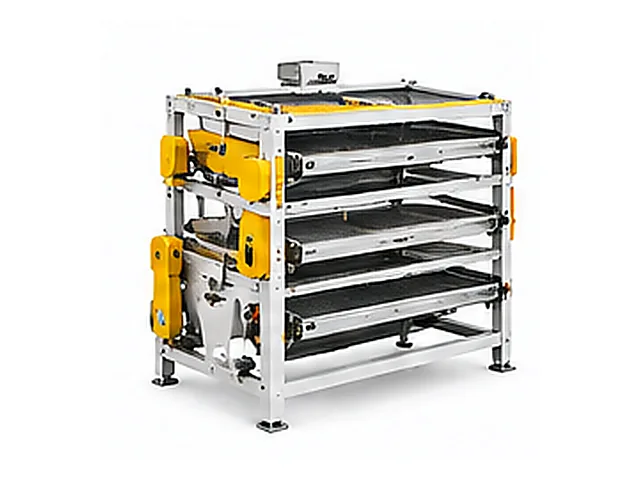
The Seed Grader is a multi-deck dimensional sizing machine built to classify cleaned seed, pulses, and specialty crops into uniform width or thickness fractions. Equipped with stacked precision screen layers and active under-deck ball cleaning, it prepares wheat, sunflower seeds, maize, rice, chickpeas, lentils, beans, and hazelnuts for downstream density separation or calibrated commercial packaging.

Machines ↗

Overview

Cleaned material enters a full-width feed distributor that lays a uniform carpet of kernels onto the top screen of the oscillating grading shoe. As the lot progresses across successive round-hole or slotted-hole decks kept clear by bouncing rubber balls, the Seed Grader divides the stream into accurately sized large, medium, and small fractions plus oversize and undersize tails.

Technical specifications

Technical ParameterSDG-03SDG-06SDG-10SDG-15
Seed & Grain Processing Capacity2 – 4 t/h5 – 7 t/h8 – 11 t/h12 – 15 t/h
Calibration Screening Area5.0 m²7.5 m²11.0 m²15.0 m²
Equivalent Drum / Screen Width600 mm700 mm800 mm900 mm
Drive Motor Power1.1 kW1.5 kW2.2 kW3.0 kW
Aspiration / Dust Extraction Power2.2 kW3.0 kW5.5 kW7.5 kW

The capacity and power ranges indicated in the table may vary depending on the crop type to be processed, initial foreign matter rate, moisture level, and machine configuration. Exact performance and actual measurement values are finalized following the engineering design and process detailing of the plant to be installed.

Key considerations

  • Confirm the crop, variety and incoming condition for Seed Grader.
  • The maintenance note for the “Seed Grader” unit should identify inspection and cleaning access at the installed position; confirm screen choice, the required outlet, incoming impurity mix and feed uniformity in a representative trial.
  • Use a product sample to set the acceptance target for the “Seed Grader” unit; factors to review: screen choice, the required outlet, incoming impurity mix and feed uniformity.
  • Show the infeed, discharge, required connections and cleaning or service access for the “Seed Grader” unit on the layout, then confirm handoff with adjacent stages; confirm screen choice, the required outlet, incoming impurity mix and feed uniformity in a representative trial.

Typical applications

Across its 2–30 t/h capacity span, the Seed Grader handles everything from cereal seeds like wheat, maize, and paddy rice to oilseeds like sunflower and large-seeded pulses or nuts including chickpeas, lentils, beans, and hazelnuts. Round perforations calibrate kernel width on spherical chickpeas, lentils, and hazelnuts, whereas slotted apertures sort flat from plump fractions in hybrid maize, sunflower seeds, and cereal grains.

GUIDE · TECHNICAL SELECTION

What is this machine used for?

In seed conditioning plants and pulse or nut sizing facilities, a Seed Grader splits pre-cleaned lots into tightly bounded commercial calibers at rates between 2 t/h and 30 t/h. Accurate size grading ensures uniform planter plate singulation for agricultural seeds and delivers consistent cooking, roasting, or shelling behavior for food-grade pulses and hazelnuts.

01

The role in the process

Positioned after primary air-screen cleaning, the Seed Grader divides a cleaned bulk lot into narrow dimensional streams before density upgrading on gravity separators or final packaging. Feeding a gravity table with a single narrow size fraction eliminates the physical overlap between large light kernels and small heavy kernels.

Depending on the number of commercial grades required, the multi-deck shoe can be arranged to split the incoming stream into several sequential calibers in a single pass. Shallow bed depth and long screen travel give borderline kernels repeated opportunities to drop through their matching aperture.

02

Material and application suitability

Each crop in the wheat, sunflower seeds, maize, rice, chickpeas, lentils, beans, and hazelnuts portfolio presents distinct surface friction, kernel shape, and fragility. Adjusting eccentric stroke frequency and deck slope keeps large beans and hazelnuts rolling smoothly without impact bruising while maintaining brisk stratification on smaller cereals.

Calibration sharpness depends on keeping the screen perforations completely free of wedged near-size kernels throughout the run. Captive resilient rubber balls rebounding inside partitioned compartments beneath every deck tap the underside of the sheets continuously, ejecting stuck seeds and preserving open area.

03

Selection checklist

When specifying a Seed Grader within the 2–30 t/h range, state the required aperture size for every fraction, confirm the number of simultaneous output streams, and verify downstream bin routing. Test sieving on representative crop samples establishes the optimal screen aperture sequence before production.

Coordinate feed buffer volume, fraction discharge chutes, and platform maintenance walkways within the grading tower. Interchangeable sieve perforations and variable cylinder speed allow precise calibration across small-seeded and large-seeded varieties. All contact zones support fast inspection. Settings remain stable across long shifts.

Integration into a processing line

Plant layout and interface planning

Install the Seed Grader beneath a surge hopper with steady level control so the inlet distributor receives a pulse-free flow across the full width of the top deck. Gravity discharge spouts for each calibrated grade should drop at clean angles toward dedicated holding bins or parallel gravity separators.

During commissioning on pulses, cereals, or hazelnuts, operators adjust the feed gate and drive speed until the upper grading screen carries an even, non-crowded layer of product. Simultaneous sampling of all fraction outlets verifies that undersize carryover into prime large calibers stays within strict market tolerances.

Factors that affect operating performance

Harvest-to-harvest shifts in kernel plumpness change the proportion of seed riding on each deck, which in turn affects where the machine operates within its 2–30 t/h window. Keeping incremental screen sizes in the plant rack lets operators adjust cut-points quickly to match seasonal crop dimensions.

Process quality and line integration

Fast lot changeovers are essential when a facility grades multiple varieties of beans, lentils, chickpeas, or hybrid seeds in the same week. Front-release clamping bars and ledge-free internal pans allow operators to pull screens, inspect ball trays, and blow down the shoe thoroughly between batches.

Frequently asked questions

How many calibrated size grades can the Seed Grader produce simultaneously?

By stacking multiple perforated decks with graduated aperture sizes in one oscillating shoe, the Seed Grader separates incoming clean product into several distinct width or thickness fractions in a single pass.

What factors determine throughput within the 2–30 t/h capacity range?

Capacity between 2 t/h and 30 t/h depends on the selected machine width, number of fraction cuts, closeness of kernel size to aperture diameter, and whether the crop is a heavy pulse/cereal or a lighter oilseed.

Can the same Seed Grader calibrate cereal seeds, pulses, and hazelnuts?

Yes, operators simply exchange the modular round-hole or slotted-hole screen frames and adjust the variable-speed shoe drive and feed gate to match wheat, maize, sunflower, chickpeas, lentils, beans, or hazelnuts.

REQUEST A TECHNICAL REVIEW

Seed Grader

Speak with our sizing specialists about your crop schedule, required millimeter caliber cuts, and hourly throughput targets within the 2–30 t/h range to configure the right Seed Grader for your facility.