Home›Pre-Cleaner
Pre-Cleaner
Cleaning & Pre-Cleaning

Pre-Cleaner

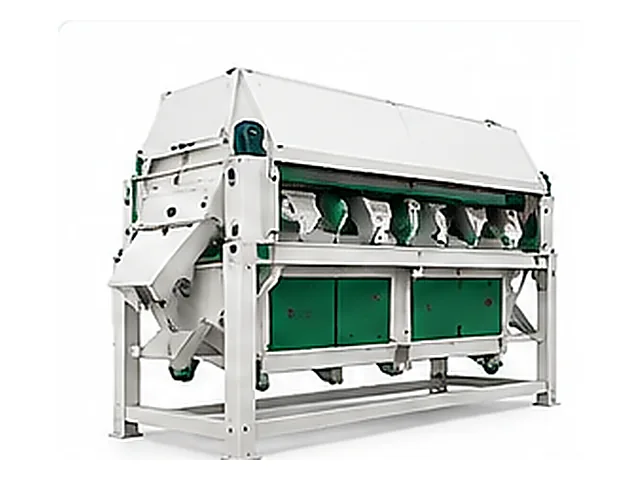
The Pre-Cleaner is a high-capacity intake conditioning unit designed to strip coarse straw, oversized rubble, fine sand, and light airborne chaff from freshly harvested grain and seed before drying or silo storage. Adapted to crop bulk density and trash content, it safeguards maize, wheat, paddy rice, sunflower seeds, lentils, chickpeas, soybean, and sesame against storage spoilage and conveyor blockages.

Machines ↗

Overview

Harvested grain entering the Pre-Cleaner passes over a full-width distribution feeder that spreads the stream across coarse scalping and fine sand-sifting screens combined with an aspiration zone. Oversized stems, pods, and stones ride over the upper screen to a trash chute, fine soil drops through the bottom sieve, and controlled airflow lifts dust and hollow husks away from the sound grain.

Technical specifications

Technical ParameterPRC-25PRC-50PRC-75PRC-100
Pre-Cleaning Capacity (Wheat / Barley)20 – 30 t/h40 – 50 t/h60 – 75 t/h80 – 100 t/h
Fine / Seed Cleaning Capacity5 – 8 t/h10 – 12 t/h15 – 18 t/h20 – 25 t/h
Oilseeds / Pulses (Sunflower, Rapeseed, Peas, Maize)10 – 15 t/h20 – 30 t/h35 – 45 t/h50 – 60 t/h
Screening Area5 m²7.5 m²10 m²15 m²
Main Drive / Shaker Motor Power1.5 kW2.2 kW3.0 kW4.0 kW
Aspiration / Fan Power5.5 kW7.5 kW11.0 kW15.0 kW
Feed Roller Motor Power0.75 kW1.1 kW1.5 kW2.2 kW

The capacity and power ranges indicated in the table may vary depending on the crop type to be processed, initial foreign matter rate, moisture level, and machine configuration. Exact performance and actual measurement values are finalized following the engineering design and process detailing of the plant to be installed.

Key considerations

  • Confirm the crop, variety and incoming condition for Pre-Cleaner.
  • Record cleaning access, service points and replaceable parts for the “Pre-Cleaner” unit with the supplier; verify incoming impurity mix, screen choice, the required outlet and feed uniformity for the intended crop and target.
  • The fit of the “Pre-Cleaner” unit should be checked on a representative sample, with incoming impurity mix, screen choice, the required outlet and feed uniformity matched to the planned line duty.
  • Request written connection and maintenance details for the “Pre-Cleaner” unit, then check them against the site layout and cleaning access; verify incoming impurity mix, screen choice, the required outlet and feed uniformity for the intended crop and target.

Typical applications

Across a diverse intake schedule — from free-flowing wheat, maize, and soybean to light, hull-rich sunflower seeds, paddy rice, sesame, chickpeas, and lentils — the Pre-Cleaner is adapted by changing screen aperture sizes and airflow velocity. Large round perforations scalp off coarse stems and pods at up to 40 t/h on heavy cereals, whereas smaller apertures and gentler airflow handle light oilseeds or specialty pulses down to 5 t/h.

GUIDE · TECHNICAL SELECTION

What is this machine used for?

Installed as the first cleaning barrier after the receiving pit, a Pre-Cleaner removes the bulk of green plant trash, long straw, clods, and field dust across 5–40 t/h intake lines. Pre-cleaning freshly harvested grain before it enters dryers or storage silos prevents bridging in bin discharge cones, reduces drying energy waste, and eliminates damp trash pockets that trigger heating.

01

The role in the process

In both commercial grain elevators and seed conditioning plants, the Pre-Cleaner protects every downstream machine by taking the brunt of field rubble and green harvest debris. Dryers run far more safely when flammable chaff and wet weed stems are removed beforehand, and fine cleaners maintain higher accuracy when relieved of heavy trash loads.

Because truck intake cannot wait on slow precision grading, the Pre-Cleaner uses generous scalping apertures that allow sound kernels to drop through the top deck almost immediately. Simultaneous under-sifting and aspiration remove sand and loose dust without restricting the 5–40 t/h flow rate.

02

Material and application suitability

Freshly combined lots of maize, sunflower seeds, paddy rice, wheat, or pulses often arrive with elevated moisture, tangled straw, and soil clods that vary from load to load. Even feed spreading across the full machine width and active rubber-ball screen cleaning prevent wet trash from matting over the perforations.

Achieving high throughput without losing sound grain into the trash spout requires balancing feed gate opening, screen perforation diameter, and aspiration damper setting. Operators verify setup by checking that coarse overs contain only straw and rubble while aspirated screenings carry dust and empty hulls rather than whole kernels.

03

Selection checklist

When specifying a Pre-Cleaner within the 5–40 t/h range, define the receiving elevator capacity, crop list, maximum incoming moisture and impurity percentage, and dust-collection layout. Ensure plant drawings provide steep, wide chutes for coarse scalped trash so long stems discharge freely.

Verify inlet chute transitions, rubble discharge elevations, and drive access clearances before finalizing plant layout drawings. Pilot tests on high-trash field lots help calibrate stroke frequency and airflow dampers prior to commissioning. Smooth internal transitions prevent straw bridging and protect seed coat integrity across diverse field crops.

Integration into a processing line

Plant layout and interface planning

Place the Pre-Cleaner directly beneath the receiving leg surge bin ahead of wet holding silos and grain dryers so all incoming product is scalped and aspirated immediately upon arrival. Provide clear walkway access around the screen doors and aspiration dampers for routine operator checks.

During harvest commissioning on wheat, corn, sunflower, or pulses, technicians adjust the inlet counterweights or feed roller until a uniform grain curtain covers the entire top screen. Air shutters are then set to pull out dust, awns, and light chaff while keeping plump kernels in the main discharge stream.

Factors that affect operating performance

Because bulk density and trash behavior shift significantly between heavy maize or chickpeas and lighter sunflower seeds or sesame, capacity naturally varies across the 5–40 t/h operating window. Keeping dedicated scalping and sifting screen sets near the machine allows operators to switch crops in minutes.

Process quality and line integration

Pre-cleaned grain flows smoothly through silo slide gates, dries evenly without air-channel blockages, and enters downstream fine cleaning at a steady, predictable rate. Regular inspection of rubber cleaning balls and inlet wear liners keeps the unit ready for continuous seasonal receiving.

Frequently asked questions

Why should grain be passed through a Pre-Cleaner before drying or silo storage?

Removing wet green stems, straw, chaff, and fine dirt before drying prevents blocked dryer air columns, lowers fire risk, and stops damp trash pockets from spoiling grain inside storage silos.

What determines whether a Pre-Cleaner operates closer to 5 t/h or 40 t/h?

Hourly throughput within the 5–40 t/h span depends on machine frame size, crop bulk density, moisture level, and incoming trash percentage; heavy, dry cereals run at the upper end while light or trash-heavy oilseeds run lower.

How are screen apertures selected for multi-crop receiving lines?

Operators fit upper scalping holes noticeably larger than the biggest sound kernel so good grain drops through immediately, paired with lower sifting slots narrow enough to pass only sand and broken fines.

REQUEST A TECHNICAL REVIEW

Pre-Cleaner

Share your receiving elevator rate, crop mix, and typical harvest impurity levels with our team to select the right Pre-Cleaner model within the 5–40 t/h range.