Overview
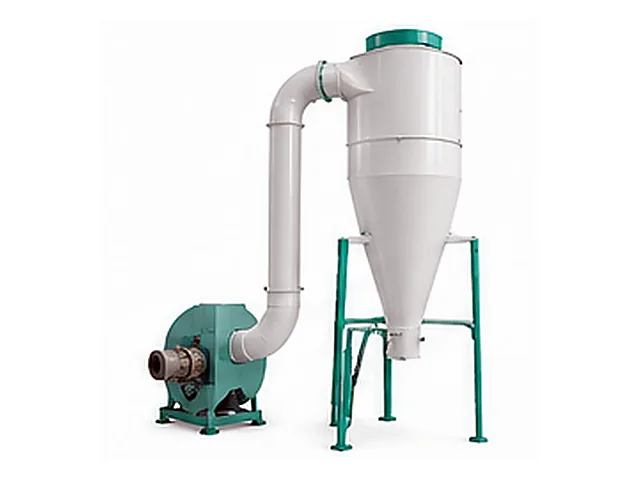
Incoming grain enters the Air Recycling Aspirator through a full-width feed spreader that forms a thin, uniform curtain across the rising air channel. Upward airflow lifts low-density impurities whose terminal velocity is lower than the regulated air speed, while plump, high-density seeds fall through the air column to the clean discharge spout. Lifted screenings pass into a wide expansion chamber where air velocity drops sharply, allowing light trash to settle into a discharge auger while the cleaned air returns to the internal fan intake.
Technical Specifications
The capacity and power ranges indicated in the table may vary depending on the crop type to be processed, initial foreign matter rate, moisture level, and machine configuration. Exact performance and actual measurement values are finalized following the engineering design and process detailing of the plant to be installed.
Selection and integration
Configuring an Air Recycling Aspirator begins with establishing the throughput rate, bulk density range, and aerodynamic difference between sound seed and light contaminants. Uniform curtain distribution across the entire channel width is essential; if grain bunches on one side, air bypasses through the thin zone and separation sharpness deteriorates. Where ultra-fine dust must be prevented from building up inside the closed loop, a minor bleed-off connection to a central filter keeps the internal housing under slight negative pressure.
Key points to specify
- Confirm the crop, variety and incoming condition for Air Recycling Aspirator.
- When setting up the “Air Recycling Aspirator” unit, record filter service access, airflow demand, duct route and dust loading and assess both accepted output and unwanted product loss during the sample trial.
- Do not assume a standard setting for the “Air Recycling Aspirator” unit; test filter service access, airflow demand, duct route and dust loading on the intended material and document the accepted result in the technical offer.
- Show the infeed, discharge, required connections and cleaning or service access for the “Air Recycling Aspirator” unit on the layout, then confirm handoff with adjacent stages; confirm filter service access, airflow demand, duct route and dust loading in a representative trial.