Home›Machines›Shell Blower Air Separator
Shell Blower Air Separator
MACHINERY CATALOGUE

Shell Blower Air Separator

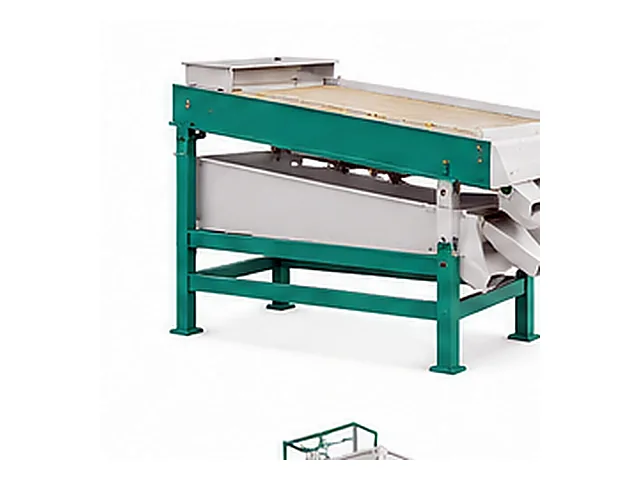
A Shell Blower Air Separator strips loose hulls, cracked shells, seed coats, and papery husks from denser kernels immediately after dehulling, decortication, or threshing. By feeding the dehulled mixture through a precisely directed cross-flow or ascending air stream, the machine exploits the pronounced aerodynamic drag difference between cupped shells and compact kernel meats. Clean, hull-free kernels discharge through the bottom spout while detached shells are blown into a collection cyclone or hull duct.

Machines ↗

Overview

Dehulled material enters the Shell Blower Air Separator through a controlled feed gate or vibratory spreader that presents a thin, disaggregated curtain to the air separation zone. Because split hulls and seed skins possess a wide surface area and low mass compared to solid kernels, the regulated airstream lifts or deflects the shell fraction cleanly across an adjustable separation baffle. Heavy whole and split kernels fall unaffected into the clean product outlet, while the air-entrained shells travel to an expansion chamber or cyclone separator.

Technical Specifications

Technical ParameterSBA-10SBA-25SBA-50SBA-80
Pre-Cleaning / Aspiration Capacity (Wheat / Barley)20 – 30 t/h40 – 50 t/h60 – 75 t/h80 – 100 t/h
Fine / Seed Cleaning Capacity5 – 8 t/h10 – 12 t/h15 – 18 t/h20 – 25 t/h
Oilseeds / Pulses (Sunflower, Rapeseed, Peas, Maize)10 – 15 t/h20 – 30 t/h35 – 45 t/h50 – 60 t/h
Aspiration / Fan Power5.5 kW7.5 kW11.0 kW15.0 kW
Feed Roller / Rotary Airlock Motor0.75 kW1.1 kW1.5 kW2.2 kW
Aspiration Channel Width800 mm1,000 mm1,250 mm1,500 mm

The capacity and power ranges indicated in the table may vary depending on the crop type to be processed, initial foreign matter rate, moisture level, and machine configuration. Exact performance and actual measurement values are finalized following the engineering design and process detailing of the plant to be installed.

Selection and integration

Configuring a Shell Blower Air Separator requires careful matching of air velocity and feed presentation to the specific dehulled crop—whether sunflower, oats, spelt, hemp, pumpkin seeds, soybeans, lentils, or tree nuts. If the incoming mixture of kernels and loose hulls is fed in clumps, shells trapped beneath heavy kernels cannot lift; disaggregating the feed into a thin veil ensures single-pass shell extraction. Fine-tuning the air damper and splitter baffle prevents small kernel fragments ('fines' or 'meats') from being blown over with the light husks.

Key points to specify

  • Confirm the crop, variety and incoming condition for Shell Blower Air Separator.
  • For the “Shell Blower Air Separator” unit, check the operating choices against these factors: filter service access, airflow demand, dust loading and duct route.
  • When setting up the “Shell Blower Air Separator” unit, record filter service access, airflow demand, dust loading and duct route and assess both accepted output and unwanted product loss during the sample trial.
  • Show the infeed, discharge, required connections and cleaning or service access for the “Shell Blower Air Separator” unit on the layout, then confirm handoff with adjacent stages; check filter service access, airflow demand, dust loading and duct route before fixing the configuration.

GUIDE · TECHNICAL SELECTION

What is this machine used for?

In oilseed decortication, oat and spelt dehulling, pulse splitting, and specialty seed shelling lines, mechanical hullers crack the outer husk but leave kernels and shells mixed together. The Shell Blower Air Separator is purpose-built to separate this bulky, high-volume hull fraction immediately after the dehuller before the stream reaches fine screens, indent cylinders, or optical sorters. Extracting loose shells right at the dehuller discharge prevents downstream screen blinding, recovers clean kernel meats, and directs dry hulls straight to biomass or byproduct storage.

01

The role in the process

Directly after an impact huller, abrasive roller huller, or disc decorticator, detached shells account for a large volume fraction of the product stream. Passing the mixture through a Shell Blower Air Separator removes the bulk of these free husks immediately so downstream graders handle only dense kernel fractions.

When processing high-oil kernels such as sunflower, hemp, or pumpkin seeds, minimizing mechanical tumbling after dehulling preserves kernel integrity and prevents oil smearing. Aerodynamic shell blowing lifts the husks gently without subjecting naked kernels to harsh screen friction. Smooth interior wall profiles prevent dust buildup and maintain consistent aerodynamic performance in continuous operation.

02

Material and application suitability

Cupped half-shells from sunflower, hemp, or soybeans have a very different aerodynamic drag coefficient than flat papery skins from peanuts, sesame, or split pulses. Adjustable baffle geometry and variable air velocity allow the Shell Blower Air Separator to adapt across diverse hull shapes and kernel densities.

Moisture content strongly influences hull separation: damp shells cling to kernels and resist lifting, whereas overly brittle kernels produce fine broken meats whose terminal velocity approaches that of thick hull pieces. Observing the separation curtain through the full-view inspection window lets operators set the exact air velocity that lifts shells while retaining valuable broken kernel meats.

03

Selection checklist

When specifying a Shell Blower Air Separator, define the upstream dehuller capacity, hull-to-kernel weight ratio, acceptable kernel loss in the hull stream, and whether an open cyclone exhaust or closed-loop air circuit is preferred. Trial testing on actual dehulled material confirms whether a single-stage or multi-stage cascade air zone is required.

Verify ductwork routing, rotary airlock discharge height, and compressed-air header requirements for pulse-jet cleaning. Specify antistatic filter sleeves, differential pressure transmitters, and explosion-relief panels for safe dust handling. Adjustable airflow velocity and balanced static pressure accommodate varying dust loads and husk densities across crop runs.

Integration into a processing line

Plant layout and interface planning

Mount the Shell Blower Air Separator directly beneath the dehuller discharge or after a gentle scalping screen so loose shells are extracted before any bucket elevator transfer. Keep the hull exhaust duct short and smooth with wide-radius bends to prevent fibrous husks from snagging or plugging the pipe.

Provide unobstructed floor access in front of the viewing window, air throttle lever, and splitter tongue handwheel so operators can sample both the clean kernel spout and the hull reject stream easily. Rotary airlocks on the hull discharge preserve constant pressure inside the blowing chamber.

Factors that affect operating performance

Uneven feeding from an upstream huller creates thick surges in the air channel that allow shells to ride down with the heavy kernels. Using a vibratory feeder pan or counterweighted spreader plate at the separator inlet guarantees a uniform curtain across the full air slot.

Process quality and line integration

Sampling ports on both the clean kernel outlet and the cyclone hull discharge allow rapid verification of shell-removal efficiency and oilseed meat recovery. Lockable damper and baffle scales let shift teams reproduce validated settings immediately when switching seed varieties.

Frequently asked questions

Where in a processing line is a Shell Blower Air Separator installed?

It is installed immediately downstream of dehullers, decorticators, seed crackers, or threshers where cracked outer hulls and inner kernels exit as a commingled stream. Removing the loose shells at this stage prevents bulky husks from overloading downstream screens, gravity tables, and optical sorters.

How do operators prevent small broken kernel pieces from blowing out with the shells?

Operators fine-tune the blower fan speed or air damper while adjusting the angle of the internal splitter baffle and watching the product curtain through the viewing window. This sets a precise aerodynamic cut point that lifts high-drag shells while allowing dense kernel fragments to drop into the product spout.

How are the separated shells collected after leaving the Shell Blower Air Separator?

The air-entrained hull stream is routed into an expansion settling chamber or a tangential cyclone collector equipped with a bottom rotary airlock. Heavy shells drop out through the airlock into a hull bin or screw conveyor, while dusty air passes to a secondary bag filter.

REQUEST A TECHNICAL REVIEW

Shell Blower Air Separator

Tell our engineering team which crop you are dehulling and your target throughput to configure the right Shell Blower Air Separator. We help integrate the separator, blower fan, and hull collection cyclone directly into your decortication or seed cleaning line.