Home›Aspiration Channel
Aspiration Channel
Cleaning & Pre-Cleaning

Aspiration Channel

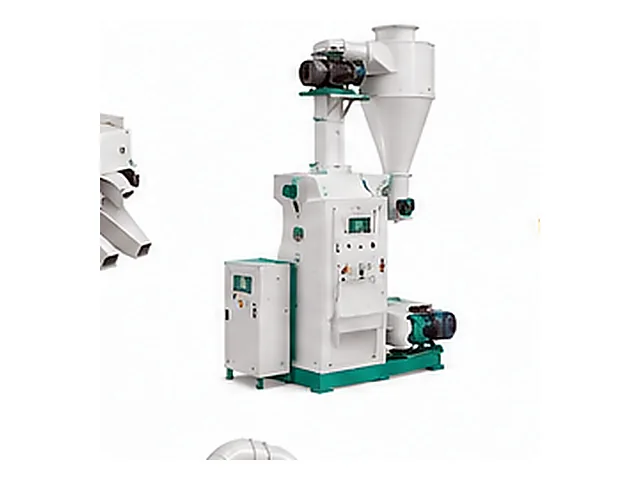
An Aspiration Channel uses a precisely regulated rising airstream to strip dust, chaff, straw fragments, empty husks, and shriveled kernels from free-flowing grain streams. The unit subjects every kernel to uniform aerodynamic drag. Sound, high-density grains fall counter-currently through the air leg while lighter impurities are lifted into an expansion chamber or exhaust duct.

Machines ↗

Overview

As wheat or other grain enters the Aspiration Channel, an adjustable feed gate and spreader plate distribute the product into a thin, even veil across the entire width of the vertical sorting leg. An external fan or central aspiration network draws air upward through this falling curtain, creating a sharp velocity threshold based on terminal settling speed. Heavy, well-filled kernels overcome the upward air current and exit through the bottom discharge spout, whereas light screenings are carried overhead into a settling chamber or cyclone collector.

Technical specifications

Technical ParameterAPC-10APC-25APC-50APC-80
Pre-Cleaning / Aspiration Capacity (Wheat / Barley)20 – 30 t/h40 – 50 t/h60 – 75 t/h80 – 100 t/h
Fine / Seed Cleaning Capacity5 – 8 t/h10 – 12 t/h15 – 18 t/h20 – 25 t/h
Oilseeds / Pulses (Sunflower, Rapeseed, Peas, Maize)10 – 15 t/h20 – 30 t/h35 – 45 t/h50 – 60 t/h
Aspiration / Fan Power5.5 kW7.5 kW11.0 kW15.0 kW
Feed Roller / Rotary Airlock Motor0.75 kW1.1 kW1.5 kW2.2 kW
Aspiration Channel Width800 mm1,000 mm1,250 mm1,500 mm

The capacity and power ranges indicated in the table may vary depending on the crop type to be processed, initial foreign matter rate, moisture level, and machine configuration. Exact performance and actual measurement values are finalized following the engineering design and process detailing of the plant to be installed.

Key considerations

  • Confirm the crop, variety and incoming condition for Aspiration Channel.
  • When setting up the “Aspiration Channel” unit, record duct route, dust loading, airflow demand and filter service access and assess both accepted output and unwanted product loss during the sample trial.
  • Do not assume a standard setting for the “Aspiration Channel” unit; test duct route, dust loading, airflow demand and filter service access on the intended material and document the accepted result in the technical offer.
  • The line drawing for the “Aspiration Channel” unit should identify product transfer, service space and interfaces with upstream and downstream equipment; align duct route, dust loading, airflow demand and filter service access with the agreed output criterion.

Typical applications

In wheat cleaning, flour milling preparation, and certified seed conditioning lines operating around 3–40 t/h, the Aspiration Channel is deployed either at intake, ahead of indent cylinders, or as a final polishing pass before optical sorting. Removing low-density insect-bored kernels, empty glumes, and loose pericarp beeswing early improves bulk test weight and relieves the load on downstream gravity separators.

GUIDE · TECHNICAL SELECTION

What is this machine used for?

The Aspiration Channel provides a straightforward, highly visible method for separating light aerodynamic impurities that share the same width or thickness as good grain and therefore pass through flat screens. By spreading incoming wheat or seed across a full-width vertical air column, the machine isolates hollow, sprouted, or husked particles solely by their drag-to-weight ratio. Whether connected directly to a dedicated cyclone and fan or tied into a central baghouse manifold, it delivers reliable test-weight improvement across capacities of 3–40 t/h.

01

The role in the process

Screen cleaners sort particles by geometric aperture size, leaving behind shriveled or weevil-hollowed kernels that match the cross-section of sound wheat. Passing the screened stream through an Aspiration Channel extracts those lightweight defects along with residual dust and chaff.

When equipped with an integrated expansion chamber, the Aspiration Channel separates lifted material into two streams: heavy light-screenings discharged via a cross-screw and fine airborne dust carried out to the filter. This pre-settling step reduces abrasive loading on the downstream ductwork and baghouse. Adjustable airflow velocity and balanced static pressure accommodate varying dust loads and husk densities across crop runs.

02

Material and application suitability

Although widely used on wheat across 3–40 t/h lines, the same aerodynamic principle applies to barley, rye, oats, maize, pulses, and oilseeds when channel velocity is tuned to kernel density. Dry, free-flowing lots spread effortlessly across the inlet baffle, whereas high-moisture or trash-heavy lots require careful feed gate setting to prevent bridging.

Separation sharpness depends on three operating variables: uniform feed distribution across the channel width, steady upward air velocity, and effective airlock sealing at the discharge spouts. Through the full-width transparent front panel, the operator can observe the suspension zone and adjust the air damper until no sound grain lifts into the expansion hood.

03

Selection checklist

Project planning for an Aspiration Channel should specify whether the unit requires an onboard settling chamber, which side the screenings outlet must face, and the static pressure required at the upper air spigot. Confirming the exact throughput within the 3–40 t/h envelope ensures the selected channel width maintains an optimal curtain thickness.

Verify ductwork routing, rotary airlock discharge height, and compressed-air header requirements for pulse-jet cleaning. Specify antistatic filter sleeves, differential pressure transmitters, and explosion-relief panels for safe dust handling. Smooth interior wall profiles prevent dust buildup and maintain consistent aerodynamic performance in continuous operation.

Integration into a processing line

Plant layout and interface planning

Gravity spouting feeding the Aspiration Channel must include a vertical calming section or cushion box so grain enters the feed gate across its full width rather than surging down one side. Mounting the channel directly above or below a screen cleaner or bucket elevator discharge minimizes floor space and extra conveying legs.

Exhaust ductwork leaving the top of the Aspiration Channel should rise smoothly into the cyclone or aspiration header without sharp elbows immediately after the damper. Weighted flap valves or rotary airlocks on the screenings spout prevent ambient air from being sucked backward into the settling zone.

Factors that affect operating performance

An overloaded channel with an overly thick grain curtain prevents upward air from penetrating evenly, allowing light chaff to ride down with the heavy wheat fraction. Matching channel width to the actual line flow rate keeps the falling veil thin enough for every particle to separate cleanly on its first pass.

Process quality and line integration

Lockable damper quadrants with clear position indicators enable shift operators to switch rapidly between gentle de-dusting and aggressive test-weight upgrading. Routine checks of the viewing window and airlock flaps ensure separation quality remains constant throughout continuous milling or seed runs.

Frequently asked questions

What impurities does an Aspiration Channel remove from wheat and cereal grains?

It extracts free dust, glumes, straw nodes, empty husks, beeswing bran flakes, and shriveled or insect-hollowed kernels whose terminal velocity is lower than that of sound wheat. This aerodynamic cut directly raises the hectolitre test weight and cleanliness of the outgoing grain stream.

How is the correct Aspiration Channel width selected within the 3–40 t/h range?

Channel width is sized so the incoming grain forms a thin, single-to-double kernel curtain across the sorting zone at the maximum planned tonnage. If a narrow channel is forced to handle excessive flow, curtain density increases and light impurities become trapped inside the falling stream.

Does an Aspiration Channel require its own external fan and dust collector?

Yes, because it operates on an open-air pass-through principle, the upper exhaust hood must connect either to a dedicated centrifugal fan and cyclone or to a central plant baghouse trunk. Units fitted with an internal expansion chamber drop out heavier chaff locally via an auger so only fine dust travels to the filter.

REQUEST A TECHNICAL REVIEW

Aspiration Channel

Discuss your wheat or seed cleaning flow rate, target hectolitre weight, and aspiration layout with our specialists to configure the right Aspiration Channel. We help size the channel width, expansion chamber, and fan duty across the 3–40 t/h operating range for seamless line integration.