Home›Destoner
Destoner
Separation

Destoner

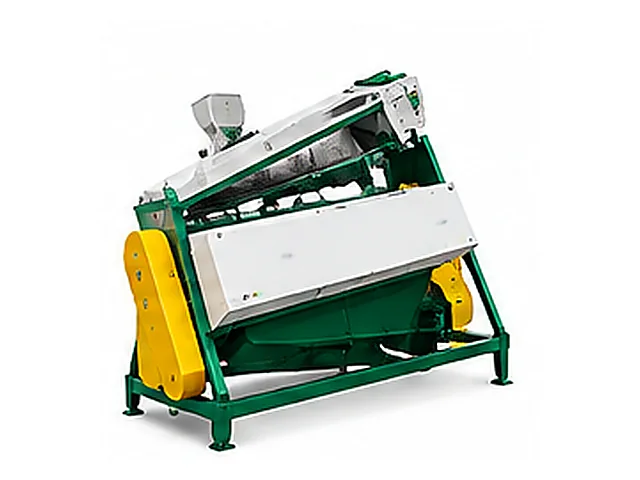
The Destoner is a core density-separation machine that extracts stones, gravel, glass, bone fragments, and slag from pre-cleaned grain, pulse, and spice streams. Across wheat, sunflower seeds, rice, sesame, chickpeas, lentils, cumin seeds, and coriander seeds, it safeguards downstream processing machinery and guarantees mineral-free food and seed lots.

Machines ↗

Overview

Pre-cleaned crop flows through a metered feed curtain onto an inclined, bi-directionally supported vibrating deck covered with fine aperture mesh. Simultaneously, a controlled upward airstream passes through the perforated surface to stratify the material by specific weight: lighter agricultural kernels float slightly above the deck and slide downward toward the clean product outlet, while high-density stones remain pinned against the oscillating wire surface and travel upward against gravity to the stone discharge chute.

Technical specifications

Technical ParameterDSR-05DSR-10DSR-15DSR-20
Processing Capacity (Grain / Seed / Pulses)3 – 5 t/h6 – 10 t/h11 – 15 t/h16 – 20 t/h
Deck / Screen Working Area1.5 m²2.4 m²3.4 m²4.5 m²
Vibration / Eccentric Motor Power1.1 kW1.5 kW2.2 kW3.0 kW
Pressurized Fan / Air Unit Power7.5 kW11.0 kW15.0 kW22.0 kW
Airflow Volume6,500 m³/h10,500 m³/h15,000 m³/h21,000 m³/h

The capacity and power ranges indicated in the table may vary depending on the crop type to be processed, initial foreign matter rate, moisture level, and machine configuration. Exact performance and actual measurement values are finalized following the engineering design and process detailing of the plant to be installed.

Key considerations

  • Confirm the crop, variety and incoming condition for Destoner.
  • Document the intended result for the “Destoner” unit against actual feed and line conditions; review: acceptable loss between fractions, density contrast and feed stability.
  • For the “Destoner” unit, check the operating choices against these factors: acceptable loss between fractions, density contrast and feed stability.
  • The line drawing for the “Destoner” unit should identify product transfer, service space and interfaces with upstream and downstream equipment; document acceptable loss between fractions, density contrast and feed stability with the tested operating arrangement.

Typical applications

Processing lines operating between 2–25 t/h rely on the Destoner for cereal grains like wheat and paddy or milled rice, oilseeds such as sunflower seeds and sesame, large pulses including chickpeas and lentils, and aromatic spice crops like cumin seeds and coriander seeds. Because soil pebbles harvested alongside low-growing pulses and spices share the exact screen diameter of the crop, specific-gravity stratification on the destoner deck is the only reliable mechanical way to remove them.

GUIDE · TECHNICAL SELECTION

What is this machine used for?

Capable of handling 2–25 t/h across cereals, pulses, oilseeds, and spices, the Destoner combines controlled airflow and directional deck vibration to strip stones and heavy foreign matter from the product stream.

01

The role in the process

Positioned directly after screen pre-cleaning, the Destoner acts as both a product purifier and an equipment protection barrier. Even a small fraction of field stones entering a huller, roller mill, or high-speed packaging line can cause severe mechanical wear, spark hazards, and costly downtime.

By isolating contaminants that have a significantly higher specific weight than agricultural seeds, the unit delivers a stone-free stream to subsequent gravity tables, indented cylinders, or color sorters. Enclosed aspiration hoods also capture residual light dust lifted during bed fluidization, improving overall plant hygiene.

02

Material and application suitability

Achieving clean stone rejection across diverse crops—from tiny sesame and cumin seeds to heavy chickpeas—requires matching the deck mesh opening and air volume to the kernel's terminal velocity. Excessive moisture or sticky mud coatings can alter surface friction on the wire deck, requiring periodic brush cleaning.

When switching from heavy cereal grains like wheat to light oilseeds or hollow-fruited coriander seeds, operators reduce the aspiration damper opening and adjust the vibratory throw angle so the lighter bed does not blow unevenly toward the lower spout. Cleanout doors simplify variety changeovers.

03

Selection checklist

Before finalizing a Destoner offer for a 2–25 t/h line, confirm whether the installation will use a self-contained fan or connect to a central aspiration manifold with cyclone and filter baghouse. Specify spare deck frames if the facility alternates between fine seeds and coarse pulses.

Specify deck wire mesh weave, fluidizing fan airflow capacity, and bidirectional inclination ranges for the target bulk density. Stable fluidization across the deck surface separates stones, sclerotia, and insect-damaged grains without seed loss. All contact zones support fast inspection. Settings remain stable across long shifts.

Integration into a processing line

Plant layout and interface planning

Install the Destoner after a Pre-Cleaner so coarse straw, pods, and oversized cob fragments cannot mat over the wire deck and block upward air passage. Provide a steady, non-pulsating feed via a surge hopper or vibratory feeder across the full inlet width.

Route the overhead air exhaust duct with smooth bends to the cyclone or dust filter to prevent static pressure fluctuations. Position the stone collection bin or screw conveyor beneath the upper discharge spout where operators can easily sample the rejected material.

Factors that affect operating performance

Separation accuracy depends on maintaining a continuous, even layer of grain across the deck; if the feed rate drops too low, bare patches appear on the screen, causing air to bypass the stone zone and allowing good kernels to creep uphill.

Process quality and line integration

In an integrated cleaning tower, the Destoner works in tandem with a Pre-Cleaner upstream and a Gravity Separator or Zig Zag Air Separator downstream, ensuring that stones are removed first before finer density grading begins.

Frequently asked questions

Can the same Destoner process both large pulses like chickpeas and small seeds like sesame?

Yes, provided the machine is equipped with interchangeable deck frames featuring finer woven mesh for sesame or cumin and adjustable damper/VFD controls to scale down the fluidizing airflow.

What happens if the incoming grain feed rate fluctuates during operation?

Sudden drops in feed rate thin out the product bed, reducing air resistance across the deck and disrupting stratification; installing an inlet buffer hopper with a modulated feed gate keeps the bed depth constant.

Does the Destoner remove light impurities or hollow kernels as well as stones?

While the aspiration hood extracts airborne dust and loose husks, separating hollow, sprouted, or insect-damaged kernels from plump seeds requires a dedicated Gravity Separator downstream.

REQUEST A TECHNICAL REVIEW

Destoner

Let our application engineers know your target capacity within 2–25 t/h, crop portfolio, and dust-collection setup so we can configure the ideal Destoner for your facility.