Home›Machines›Fine Seed Cleaners
Fine Seed Cleaners
MACHINERY CATALOGUE

Fine Seed Cleaners

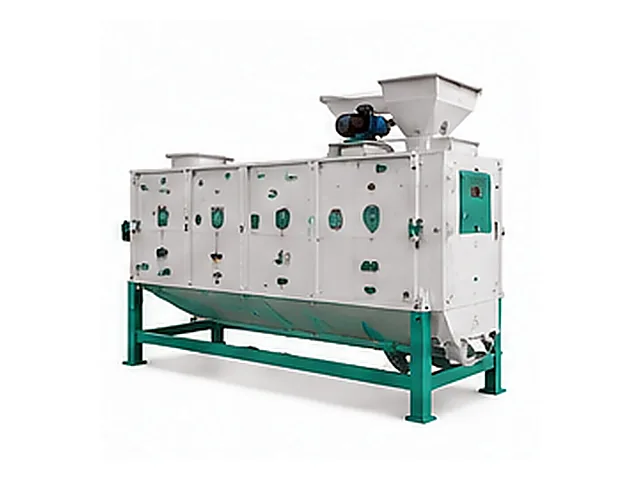
Fine Seed Cleaners perform high-precision multi-deck screen classification and dual-stage aerodynamic aspiration to bring pre-cleaned seed and specialty grain lots up to strict certification and export purity standards. Designed with extended screen travel and sensitive air-velocity control, they isolate near-size weed seeds, cracked kernels, pin-sized dockage, and partially filled grains while preserving maximum sound seed recovery.

Machines ↗

Overview

A precision fluted feed roller meters pre-cleaned seed evenly into an inlet aspiration leg where light hulls and residual dust are lifted out of the stream. The seed then traverses multiple counterbalanced sieve shoes fitted with scalping, grading, and sifting decks cleaned by resilient rubber balls before entering a final high-column aspiration channel that separates light or insect-hollowed seeds.

Technical Specifications

Technical ParameterFSC-10FSC-25FSC-50FSC-80
Pre-Cleaning Capacity (Wheat / Barley)20 – 30 t/h40 – 50 t/h60 – 75 t/h80 – 100 t/h
Fine / Seed Cleaning Capacity5 – 8 t/h10 – 12 t/h15 – 18 t/h20 – 25 t/h
Oilseeds / Pulses (Sunflower, Rapeseed, Peas, Maize)10 – 15 t/h20 – 30 t/h35 – 45 t/h50 – 60 t/h
Screening Area5 m²7.5 m²10 m²15 m²
Main Drive / Shaker Motor Power1.5 kW2.2 kW3.0 kW4.0 kW
Aspiration / Fan Power5.5 kW7.5 kW11.0 kW15.0 kW
Feed Roller Motor Power0.75 kW1.1 kW1.5 kW2.2 kW

The capacity and power ranges indicated in the table may vary depending on the crop type to be processed, initial foreign matter rate, moisture level, and machine configuration. Exact performance and actual measurement values are finalized following the engineering design and process detailing of the plant to be installed.

Selection and integration

Configuring Fine Seed Cleaners involves matching total screen area, deck flow routing, and aspiration column cross-section to the target seed purity and hourly conditioning rate. Operators can arrange the multi-deck shoes for serial scalping and double sifting on small-seeded crops or split-flow grading on high-volume cereal and legume seed lots.

Key points to specify

  • Confirm the crop, variety and incoming condition for Fine Seed Cleaners.
  • The maintenance note for the “Fine Seed Cleaners” unit should identify inspection and cleaning access at the installed position; use feed uniformity, the required outlet, incoming impurity mix and screen choice to define the sample review.

  • For the “Fine Seed Cleaners” unit, check the operating choices against these factors: feed uniformity, the required outlet, incoming impurity mix and screen choice.
  • Place the “Fine Seed Cleaners” unit in the line drawing with its handoff elevations and cleaning access; use feed uniformity, the required outlet, incoming impurity mix and screen choice to define the sample review.
GUIDE · TECHNICAL SELECTION

What is this machine used for?

In certified seed conditioning plants and food-grade grain lines, Fine Seed Cleaners execute the critical dimensional and aerodynamic cuts that separate commercial bulk grain from planting-grade seed. By combining long residence time on precision perforations with finely tuned pre- and post-aspiration, they remove foreign seeds and broken fragments that closely resemble the main crop.

01

The role in the process

Installed after coarse pre-cleaning and huller/de-awner stages, Fine Seed Cleaners establish accurate width and thickness boundaries before length sorting in indented cylinders or density separation on gravity tables. Delivering a tightly sized, dust-free lot to downstream separators dramatically sharpens their cut accuracy.

Because certified seed lots tolerate virtually zero noxious weed seeds or inert matter, the machine prioritizes thin-layer screening across multiple sequential decks rather than deep-bed bulk throughput. Independent air shutters on the inlet and outlet aspiration chambers let operators dial in exact terminal velocity cut-points. All contact zones support fast inspection. Air and feed controls lock repeatably.

02

Material and application suitability

Whether conditioning cereal seeds, pulses, oilseeds, or small forage and vegetable seeds, small differences in kernel plumpness and surface friction affect how seeds travel across perforated metal. Selecting the exact combination of round holes for width scalping, oblong slots for thin-seed sifting, and triangular openings for wild buckwheat or polygonum weed removal is essential.

Fine cleaning performance depends on keeping the seed layer thin enough that every particle contacts the screen surface multiple times along the deck length. Variable feed-roll speed, adjustable shoe oscillation frequency, and active under-screen ball bounce work together to maintain sharp separation without losing prime seed into the screenings.

03

Selection checklist

Before ordering Fine Seed Cleaners, review the full crop schedule, required certification purity tolerances, screen perforation inventory, and aspiration dust-collection interfaces. Commissioning trials on representative uncleaned seed samples verify the exact screen sequence and airflow settings needed for each variety.

Match upper scalping and lower sifting aperture sets, deck inclination, and dual aspiration airflow to target seed purity. Specify modular screen frames, ball-tray cleaning access, and viewing windows for rapid varietal changeovers without cross-contamination. Laboratory sieve analysis of raw seed samples establishes the optimal deck split and air velocity profile. Cleanout doors simplify variety changeovers.

Integration into a processing line

Plant layout and interface planning

Plant layouts should place Fine Seed Cleaners beneath a dedicated surge hopper with level sensors so the feed roller always operates under a constant head of seed. Discharge spouts for prime seed, second-grade seed, coarse overs, fine sifting unders, and light aspiration fractions must be routed with smooth, self-emptying transitions.

When setting up a new seed lot, technicians select scalping apertures just large enough to pass the plumpest kernels and sifting slots just narrow enough to retain sound seeds while dropping splits and shriveled grains. Observing the discharge through the illuminated aspiration window allows precise damper adjustment until only light, low-germination kernels are lifted out.

Factors that affect operating performance

Lot-to-lot variations in thousand-kernel weight, harvest moisture, and weed-seed species require quick adjustments to feed rate, oscillation speed, and screen selection. Maintaining well-organized racks of interchangeable screen frames next to the machine minimizes downtime during seasonal variety changes.

Process quality and line integration

Strict varietal hygiene is vital in seed multiplication facilities: smooth internal ledges, removable ball trays, and accessible aspiration augers ensure that no stray kernels remain trapped inside the cleaner between batches. Well-conditioned output from the fine cleaner directly boosts germination figures and visual uniformity at final bagging.

Frequently asked questions

How do Fine Seed Cleaners differ from intake pre-cleaners in a seed plant?

While pre-cleaners rapidly scalp coarse trash at high tonnage using wide perforations, Fine Seed Cleaners use thinner bed depth, longer screen travel, and finer aperture steps to achieve strict seed certification purity.

How are the primary and secondary aspiration channels adjusted for delicate seeds?

Operators regulate calibrated air dampers while watching the illuminated expansion chamber, setting the inlet leg to strip dust and hulls and the outlet leg to lift shriveled or low-viability seeds without losing plump kernels.

What features support fast varietal cleanout between certified seed lots?

Quick-release screen clamping bars, slide-out ball trays, drop-bottom aspiration settling augers, and ledge-free internal chutes allow operators to inspect and blow down all product zones rapidly.

REQUEST A TECHNICAL REVIEW

Fine Seed Cleaners

Contact our seed processing specialists with your crop varieties, weed-seed challenges, and purity specifications to configure the ideal Fine Seed Cleaners deck layout and screen library.