
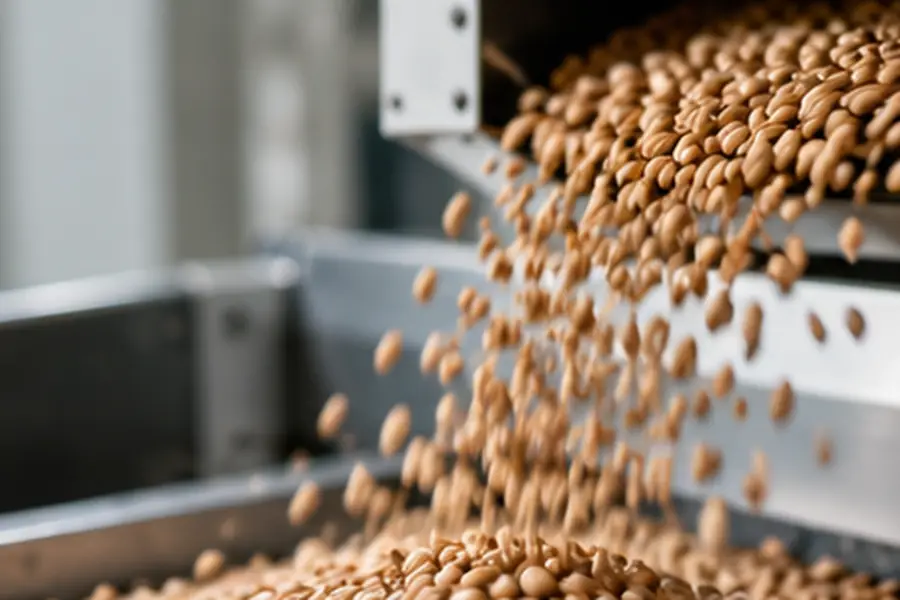
Intake pre-cleaning protects downstream storage silos, grain dryers, and elevators by rapidly stripping away green straw stems, large pod fragments, cob pieces, and heavy field dust immediately upon harvest arrival. Because the goal is stabilizing bulk flowability and preventing conveyor blockages or dryer hotspots rather than achieving final certification purity, pre-cleaners utilize generous screen apertures and high bed depths to maximize hourly intake tonnage.
How Fine Cleaning Achieves Certified Seed Purity and Calibration
Fine cleaning takes over after bulk field trash and excess moisture have been managed, applying closely spaced round and slotted perforations alongside precision dual-stage aspiration to isolate weed seeds, broken splits, and shriveled kernels that closely resemble good grain. Flow rate across the sieve decks is deliberately throttled so every kernel contacts the screen perforations multiple times, ensuring sharp dimensional calibration without mechanical seed coat damage.
Quantifying Separation Efficiency Across Sequential Cleaning Stages
An effective process flow sheet assigns a measurable extraction target to each stage rather than assuming a single cleaner pass will resolve every defect. By sampling the inlet, clean product outlet, scalpings, fines, and aspiration discharges at both pre-cleaning and fine-cleaning stations, engineers prevent redundant screen setups and verify that valuable sound kernels are not inadvertently rejected with the waste streams.
Managing Good-Seed Recovery, Dust Extraction, and Varietal Changeovers
Balancing high impurity rejection against minimal good-product loss requires coordinating screen inclination, eccentric stroke frequency, air damper settings, and centralized dust collector static pressure across all seasonal crop conditions. Designing accessible inspection ports, self-cleaning ball decks, and rapid-release screen clamps ensures operators can sanitize the machine thoroughly between pedigree seed lots and sustain peak separation accuracy throughout the campaign.
Frequently Asked Questions on Pre-Cleaning vs. Fine Cleaning
Can one air-screen cleaner perform both intake pre-cleaning and fine seed dressing?
Yes; smaller or seasonal plants frequently use the same multi-deck air-screen machine for both duties by installing wide-aperture scalping screens and running high feed rates during harvest intake, then swapping to tight grading screens at lower feed rates for fine conditioning.
Why does fine cleaning operate at a fraction of the machine's pre-cleaning tonnage?
Fine cleaning requires a thin, uniform grain layer so every individual seed can drop through or ride over perforations differing by fractions of a millimeter, whereas pre-cleaning moves a thick blanket of grain that only removes gross oversize and fines.
When should a plant invest in dedicated separate pre-cleaning and fine-cleaning machines?
Separate machines are justified whenever harvest intake trucks must be unloaded rapidly into buffer bins or dryers at high hourly tonnage while the downstream conditioning line runs continuously at a steadier, precision-controlled pace.
How do aspiration settings differ between pre-cleaning and fine conditioning passes?
Pre-cleaning aspiration targets buoyant dust clouds, loose husks, and hollow straw nodes to keep silos and dryers clean, whereas fine-cleaning aspiration is tuned more aggressively to lift lightweight, immature, or partially shriveled seeds.
Optimize Your Pre-Cleaning and Fine Conditioning Flow Sheet
Share your harvest intake rates, dryer or silo buffer capacities, and final seed quality tolerances so our engineering team can size and sequence your pre-cleaning and fine-cleaning stages effectively.
Contact ↗