Home›Machines›De-Stoner Pressure Type
De-Stoner Pressure Type
MACHINERY CATALOGUE

De-Stoner Pressure Type

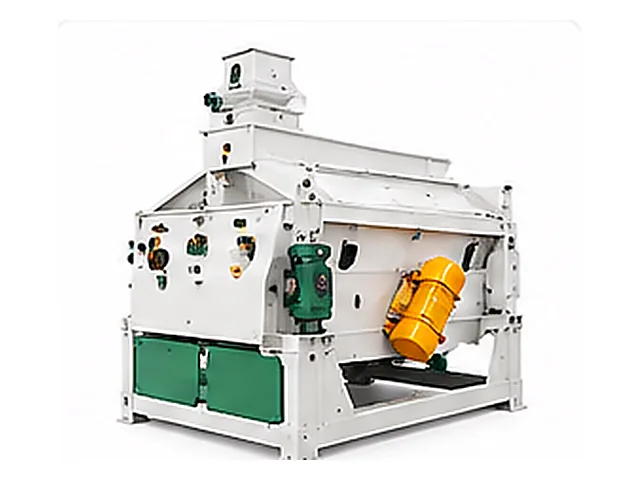
The De-Stoner Pressure Type removes stones, pebbles, glass shards, soil clods, and dense mineral inclusions from grain and pulse streams using a positive-pressure upward airflow combined with an inclined oscillating deck. By fluidizing the lighter seed bed with a dedicated bottom-mounted fan, the unit achieves sharp density stratification that protects downstream hullers, rollers, and optical sorters from abrasive impact.

Machines ↗

Overview

Material enters onto a reciprocating wire-mesh separation table while a built-in centrifugal fan forces a uniform cushion of air upward through the deck apertures. This positive-pressure airstream lifts the lighter kernels into a fluidized layer that flows smoothly downhill toward the clean-grain discharge spout. Heavy mineral particles such as stones and metallic fragments cannot be suspended by the air cushion; they remain in direct contact with the high-friction mesh surface and are driven uphill by the eccentric deck motion to the stone outlet.

Technical Specifications

Technical ParameterDST-05DST-10DST-15DST-20
Processing Capacity (Grain / Seed / Pulses)3 – 5 t/h6 – 10 t/h11 – 15 t/h16 – 20 t/h
Deck / Screen Working Area1.5 m²2.4 m²3.4 m²4.5 m²
Vibration / Eccentric Motor Power1.1 kW1.5 kW2.2 kW3.0 kW
Pressurized Fan / Air Unit Power7.5 kW11.0 kW15.0 kW22.0 kW
Airflow Volume6,500 m³/h10,500 m³/h15,000 m³/h21,000 m³/h

The capacity and power ranges indicated in the table may vary depending on the crop type to be processed, initial foreign matter rate, moisture level, and machine configuration. Exact performance and actual measurement values are finalized following the engineering design and process detailing of the plant to be installed.

Selection and integration

Selecting a De-Stoner Pressure Type requires matching the wire-mesh aperture, deck inclination range, and blower pressure curve to the bulk density and kernel size of the crop. Because positive-pressure units push ambient air from beneath the bed rather than pulling air through a full top hood, they offer direct visual observation of the stone discharge boundary and straightforward fan damper adjustment.

Key points to specify

  • Confirm the crop, variety and incoming condition for De-Stoner Pressure Type.
  • Document the intended result for the “De-Stoner Pressure Type” unit against actual feed and line conditions; review: feed stability, acceptable loss between fractions and density contrast.
  • For the “De-Stoner Pressure Type” unit, check the operating choices against these factors: feed stability, acceptable loss between fractions and density contrast.
  • Show the infeed, discharge, required connections and cleaning or service access for the “De-Stoner Pressure Type” unit on the layout, then confirm handoff with adjacent stages; check feed stability, acceptable loss between fractions and density contrast before fixing the configuration.

GUIDE · TECHNICAL SELECTION

What is this machine used for?

Engineered for positive-pressure density separation, the De-Stoner Pressure Type suspends seed and grain on an upward air cushion while vibrating heavy stones uphill to a dedicated reject chute.

01

The role in the process

Harvested grain and leguminous crops frequently carry field stones and hardened earth balls that pass through rotary drums and flat sieve cleaners because their diameter matches the prime kernels. Left in the stream, these dense contaminants spark inside bucket elevators, nick indent pockets, and shatter camera glass.

Installing a pressure-type destoner immediately after primary screening eliminates heavy minerals early in the flowsheet. The combination of upward air pressure and directional deck throw creates a clear separation zone at the upper lip where stones exit with minimal carryover of sound grain.

02

Material and application suitability

Effective pressure destoning relies on a reasonably narrow particle-size distribution and steady feed coverage across the entire deck width. If uncleaned lot mixtures containing long straw, fine sand, and wide size variations enter the table at once, the air cushion will channel through thin spots and collapse fluidization elsewhere.

Coarse pulses require higher upward static pressure and a coarser wire weave than small cereal grains or oilseeds. Adjusting the counter-air baffle at the upper stone discharge gate prevents individual plump kernels from climbing out with the pebbles.

03

Selection checklist

Project engineers evaluating a De-Stoner Pressure Type should confirm the range of crops to be processed, the expected stone contamination level, and whether local dust aspiration is required above the open deck area. Check that the fan intake has clean ambient air free of chaff so the under-deck diffuser remains unobstructed.

Verify dust hood exhaust volumes, vibration isolation mounts, and discharge spout elevations in the floor plan. Include air-damper manometers, removable deck frames, and stone trap inspection hatches for repeatable density cuts. All contact zones support fast inspection.

Integration into a processing line

Plant layout and interface planning

Mount the machine on a rigid floor slab or reinforced steel platform capable of absorbing low-frequency reciprocating forces without transmitting resonance to adjacent weighing or optical equipment. Fit flexible fabric sleeves on both the feed chute and the two outlet hoppers so the vibrating body moves freely.

Ensure the inlet spout delivers grain centrally onto the rear distribution plate rather than dumping unevenly to one side of the table. Leave unobstructed floor space at the discharge end so operators can inspect the stone boundary and pull out the deck frame during screen swaps.

Factors that affect operating performance

Four interactive adjustments govern separation sharpness: feed gate opening, under-deck fan airflow, longitudinal table tilt angle, and eccentric stroke frequency. If the upward airflow is set too high, small stones may float down with the grain; if set too low, heavy kernels will ride uphill into the stone box.

Process quality and line integration

Pairing the pressure destoner with an upstream Zig Zag Air Separator or screen pre-cleaner stabilizes incoming bulk density, while a downstream Gravity Separator can then focus purely on separating hollow or insect-damaged kernels from sound seed.

Frequently asked questions

How does a De-Stoner Pressure Type differ from a suction-type stone separator?

A pressure-type machine uses an integrated bottom fan to blow air upward through the oscillating deck, whereas a suction destoner draws air through the bed into a full overhead hood connected to a remote fan and cyclone.

How do operators prevent good grain from escaping through the stone outlet?

By fine-tuning the counter-air flow at the upper stone lip and slightly increasing the deck tilt angle, operators create a reverse air barrier that pushes sound kernels back into the fluidized bed while allowing denser stones to crest the weir.

Why must the fan intake filter and under-deck screen be inspected regularly?

If dust or husks partially block the blower intake or clog the fine wire mesh, upward air velocity drops across parts of the table, creating dead zones where grain fails to fluidize and migrates into the stone discharge.

REQUEST A TECHNICAL REVIEW

De-Stoner Pressure Type

Contact our technical team with your crop varieties, bulk density range, and plant floor plan to specify a De-Stoner Pressure Type tailored to your cleaning line.