Overview
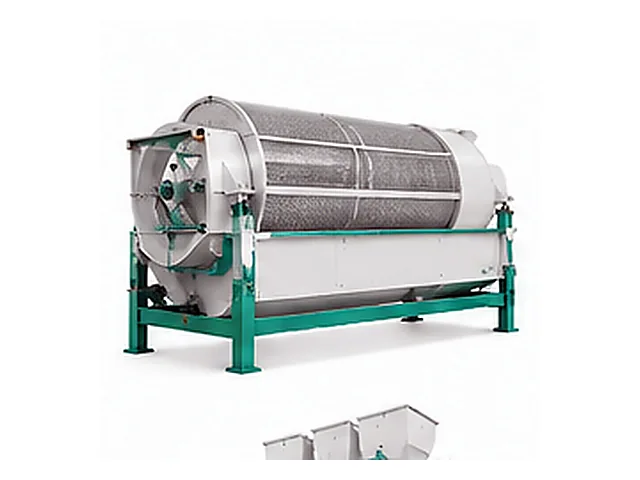
Pre-cleaned grain enters the head end of a slowly rotating horizontal cylinder whose inner wall is stamped with thousands of precision hemispherical or teardrop indents. Short particles—such as half-kernels, cockle, or vetch—fit completely inside the recessed pockets and are carried upward by centrifugal and gravitational balance until they tumble out near the top of the arc into a stationary internal trough equipped with a discharge auger. Longer whole kernels cannot seat fully inside the indents; they slide back down the rising wall and travel axially along the bottom of the cylinder to the tail outlet.
Technical Specifications
The capacity and power ranges indicated in the table may vary depending on the crop type to be processed, initial foreign matter rate, moisture level, and machine configuration. Exact performance and actual measurement values are finalized following the engineering design and process detailing of the plant to be installed.
Selection and integration
Specifying an Indented Cylinder Separator for Seeds & Grain involves two primary decisions: choosing the pocket diameter in millimeters to match the target length cut, and deciding whether the cylinder operates in 'short-removal' mode (lifting broken grains and round weeds while good seed tails over) or 'long-removal' mode (lifting good seed into the trough while long wild oats and stalks tail out).
Key points to specify
- Confirm the crop, variety and incoming condition for Indented Cylinder Separator for Seeds & Grain.
- Define the target output and the acceptance criteria for the length separation stage.
- The fit of the “Indented Cylinder Separator for Seeds & Grain” unit should be checked on a representative sample, with required outlet fractions, the physical difference used and incoming mixture matched to the planned line duty.
- Place the “Indented Cylinder Separator for Seeds & Grain” unit in the line drawing with its handoff elevations and cleaning access; use required outlet fractions, the physical difference used and incoming mixture to define the sample review.