Home›Machines›Magnetic Belt Separator
Magnetic Belt Separator
MACHINERY CATALOGUE

Magnetic Belt Separator

A Magnetic Belt Separator provides continuous, automated extraction of ferrous tramp metal or magnetic soil clods from moving seed, pulse, and grain streams without stopping production for manual magnet wiping. Whether configured as a precision thin-layer high-intensity magnetic roll belt for seed purification or as an overband self-cleaning cross-belt magnet above a transfer conveyor, it discharges captured magnetic fractions automatically. This continuous self-cleaning action maintains peak magnetic gradient throughout long, unattended processing runs.

Machines ↗

Overview

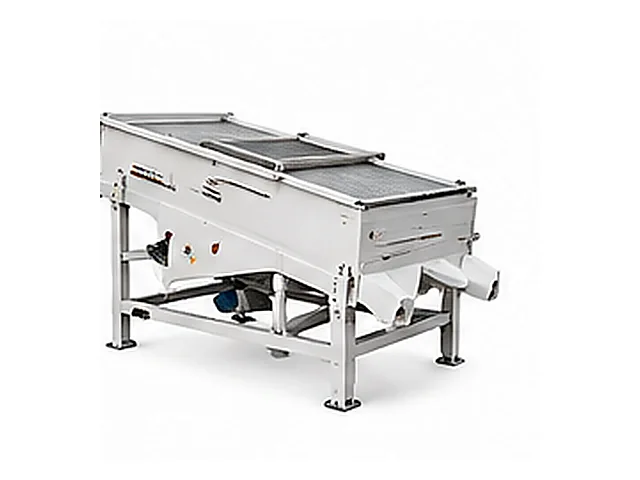
In a thin-layer Magnetic Belt Separator, an electromagnetic or motorized vibratory feeder spreads incoming seed into a uniform monolayer across an antistatic endless belt travelling over a high-gradient rare-earth magnetic head roller. Non-magnetic sound seeds follow a natural parabolic trajectory off the head pulley into the clean outlet, whereas ferrous particles, magnetic volcanic soil balls, and iron-stained weed seeds are pinned momentarily to the belt arc and deflected past an adjustable splitter blade. In overband cross-belt configurations, a cleated belt running around a stationary magnet block lifts tramp iron out of a deep conveyor bed and carries it sideways into a reject chute.

Technical Specifications

Technical ParameterMBS-25MBS-50MBS-100MBS-150
Product Flow / Conveying Capacity10 – 25 t/h30 – 50 t/h60 – 100 t/h110 – 150 t/h
Magnetic Flux Density (NdFeB)8,000 – 10,000 Gauss10,000 Gauss10,000 – 12,000 Gauss12,000 Gauss
Drive Motor Power (Belt / Drum Units)1.5 kW2.2 kW3.0 kW4.0 kW
Inlet / Flow Cross-Section200 × 200 mm300 × 300 mm400 × 400 mm500 × 500 mm

The capacity and power ranges indicated in the table may vary depending on the crop type to be processed, initial foreign matter rate, moisture level, and machine configuration. Exact performance and actual measurement values are finalized following the engineering design and process detailing of the plant to be installed.

Selection and integration

Selecting the right Magnetic Belt Separator architecture depends on whether the goal is heavy tramp-iron protection on a bulk intake conveyor or high-precision removal of weakly magnetic soil clods and stained seeds. When separating volcanic earth balls from pulses, sesame, or small seeds, the belt must be ultra-thin and the feed strictly monolayer so every particle touches the rare-earth magnetic roller surface. Adjustable belt speed and micrometer splitter-blade positioning let the operator balance maximum clod removal against minimal loss of good seed.

Key points to specify

  • Confirm the crop, variety and incoming condition for Magnetic Belt Separator.
  • Do not assume a standard setting for the “Magnetic Belt Separator” unit; test the metal-contamination risk, product path and cleaning access on the intended material and document the accepted result in the technical offer.
  • The fit of the “Magnetic Belt Separator” unit should be checked on a representative sample, with the metal-contamination risk, product path and cleaning access matched to the planned line duty.
  • Show the infeed, discharge, required connections and cleaning or service access for the “Magnetic Belt Separator” unit on the layout, then confirm handoff with adjacent stages; check the metal-contamination risk, product path and cleaning access before fixing the configuration.

GUIDE · TECHNICAL SELECTION

What is this machine used for?

The Magnetic Belt Separator solves two demanding challenges in modern seed and grain plants: continuous self-cleaning tramp iron removal where manual grate wiping is impractical, and high-gradient dry separation of magnetic soil particles that match the size and density of good seed. Because dark basaltic or iron-rich soil balls often share the exact screen size and specific gravity of lentils, chickpeas, beans, or cumin, screeners and gravity tables cannot always isolate them. Passing the pre-cleaned crop over a high-intensity rare-earth magnetic belt deflects those paramagnetically active soil clods cleanly into the reject stream.

01

The role in the process

Static grate and plate magnets require periodic manual cleaning; if a batch contains heavy iron contamination or magnetic soil, static bars quickly saturate and begin dropping captured particles. A Magnetic Belt Separator discharges captured magnetic material continuously into a dedicated reject chute, keeping the magnetic zone clean at all times.

Placed ahead of an optical sorter or final packaging line, a high-gradient magnetic roll belt strips out magnetic dirt clods, rust-stained kernels, and metallic fines. Reducing this defect load upfront improves optical sorter throughput and prevents hard soil stones from reaching consumer packs. All contact zones support fast inspection. Air and feed controls lock repeatably.

02

Material and application suitability

Pulses (lentils, chickpeas, dry beans, peas), oilseeds (sesame, flax, sunflower), spices (cumin, coriander, fennel), and small forage seeds respond exceptionally well to thin-belt rare-earth roll separation. Dry, dust-free feed conditions prevent fine powder from coating the thin conveyor belt and cushioning magnetic contact.

Separation accuracy on a magnetic roll belt is governed by four adjustable parameters: feeder monolayer thickness, belt linear speed, magnetic roller pole pitch, and splitter knife angle. Running a higher belt speed throws non-magnetic seeds further forward by centrifugal force, while slowing the belt allows weakly magnetic soil balls to stay pinned longer around the roller arc.

03

Selection checklist

When specifying a Magnetic Belt Separator, define the target hourly throughput, whether the contaminant is ferromagnetic tramp metal or weakly magnetic soil/stained seed, and whether single-deck or multi-deck pass-through is required. Sample testing on actual field lots establishes the optimal pole width and belt speed range.

Select magnetic flux density in Gauss, stainless tube arrangement, and cross-sectional flow area for the hourly tonnage. Confirm chute mounting angles, drawer pull-out clearance, and food-grade surface finishes in the product contact zone. Include quick-clean stripper sleeves, dust-tight gaskets, and inspection access for scheduled metal audits. Settings remain stable across long shifts.

Integration into a processing line

Plant layout and interface planning

Mount the Magnetic Belt Separator on a rigid, vibration-isolated floor frame so external building tremors do not disturb the vibratory feeder tray or splitter trajectory. A small buffer hopper above the feeder inlet ensures a constant head of product so the vibratory pan maintains a steady monolayer across the full belt width.

Provide clear side access along the cantilevered frame so maintenance personnel can slide a replacement endless belt over the rollers without dismantling adjacent spouting. Connecting a light aspiration hood above the head-pulley discharge zone removes airborne dust that could otherwise build up on the magnetic roll.

Factors that affect operating performance

If feed rate surges and seeds pile two or three layers deep on the belt, upper particles are shielded from the short-range rare-earth magnetic gradient and fail to deflect. Maintaining strict monolayer feeding and proper belt tension ensures uniform magnetic attraction across the entire working width.

Process quality and line integration

Graduated handwheels on the splitter knife and digital frequency readouts on the belt drive allow operators to log and recall exact separation settings for each crop lot. Inspecting the reject fraction during startup confirms that soil clods and metallic fragments are captured with negligible good-seed carryover.

Frequently asked questions

Can a Magnetic Belt Separator remove non-metallic impurities such as soil clods?

Yes, when equipped with an ultra-high-gradient rare-earth magnetic head roller and a thin conveyor belt, the machine deflects paramagnetic iron-bearing soil balls, basaltic stones, and mud-coated seeds. This makes it highly effective for cleaning pulses, sesame, and spices harvested from iron-rich soils.

Why must seed be fed in a single layer onto a high-intensity Magnetic Belt Separator?

Rare-earth magnetic rollers generate intense magnetic gradients that decay rapidly within a few millimetres of the roller surface. Spreading the crop into a strict monolayer via a vibratory feeder ensures every particle rides directly against the thin belt and experiences the full magnetic pull.

How do operators adjust the cut between clean seed and magnetic rejects?

Operators tune the belt speed using the variable frequency drive and pivot the apex of the stainless steel splitter blade closer to or further from the head pulley. Observing the divided streams through the side inspection window allows immediate optimization of purity and yield.

REQUEST A TECHNICAL REVIEW

Magnetic Belt Separator

Send us details of your crop, target throughput, and whether you need tramp-iron extraction or paramagnetic soil-clod removal to configure the right Magnetic Belt Separator. Our specialists can run representative sample trials to confirm deck width, roller intensity, and feeder setup.