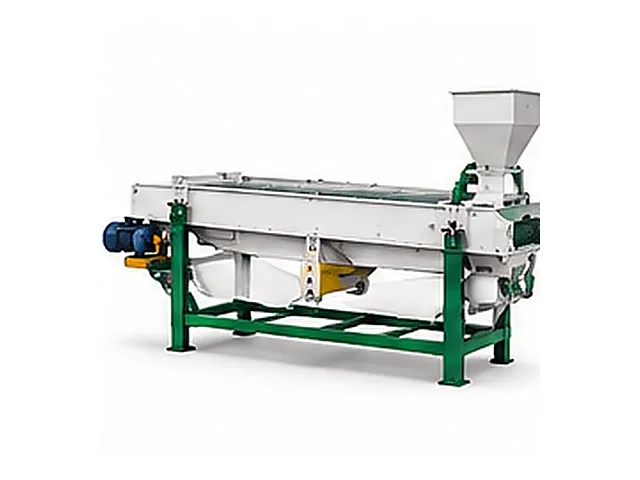
Overview
As size-calibrated seed enters the rear corner of the inclined vibrating deck, it travels across consecutive under-deck air compartments, each pressurized by its own dedicated fan and air-control damper. In the initial feed zone, higher air volume rapidly fluidizes the deep incoming bed and floats light chaff or hollow husks to the surface; across the middle transport zones, balanced airflow maintains smooth stratification; and at the upper heavy-seed discharge zone, fine-tuned upward pressure holds back borderline kernels while allowing only the densest, highest-vigor seeds to crest the upper edge.
Technical Specifications
The capacity and power ranges indicated in the table may vary depending on the crop type to be processed, initial foreign matter rate, moisture level, and machine configuration. Exact performance and actual measurement values are finalized following the engineering design and process detailing of the plant to be installed.
Selection and integration
Selecting a Multi-Fan Gravity Separator for Seeds & Grain is advantageous whenever high hourly throughputs require a long, wide deck surface where a single blower cannot maintain uniform static pressure from end to end. Independent fan zones prevent air starvation under the heavy seed bank while avoiding blow-through under the thinner light-fraction side.
Key points to specify
- Confirm the crop, variety and incoming condition for Multi-Fan Gravity Separator for Seeds & Grain.
- Do not assume a standard setting for the “Multi-Fan Gravity Separator for Seeds & Grain” unit; test density contrast, feed stability and acceptable loss between fractions on the intended material and document the accepted result in the technical offer.
- Use a product trial to define where the “Multi-Fan Gravity Separator for Seeds & Grain” unit fits; record density contrast, feed stability and acceptable loss between fractions and the output expected by the following stage.
- Show the infeed, discharge, transfer points and service clearances for the “Multi-Fan Gravity Separator for Seeds & Grain” unit on the plant layout; compare density contrast, feed stability and acceptable loss between fractions with the planned line duty.