
Grain Cleaning & Grading Plant
An integrated cereal conditioning facility combining high-capacity scalping, multi-deck screening, controlled air aspiration, and dimensional calibration for commercial wheat, malting barley, and yellow maize.
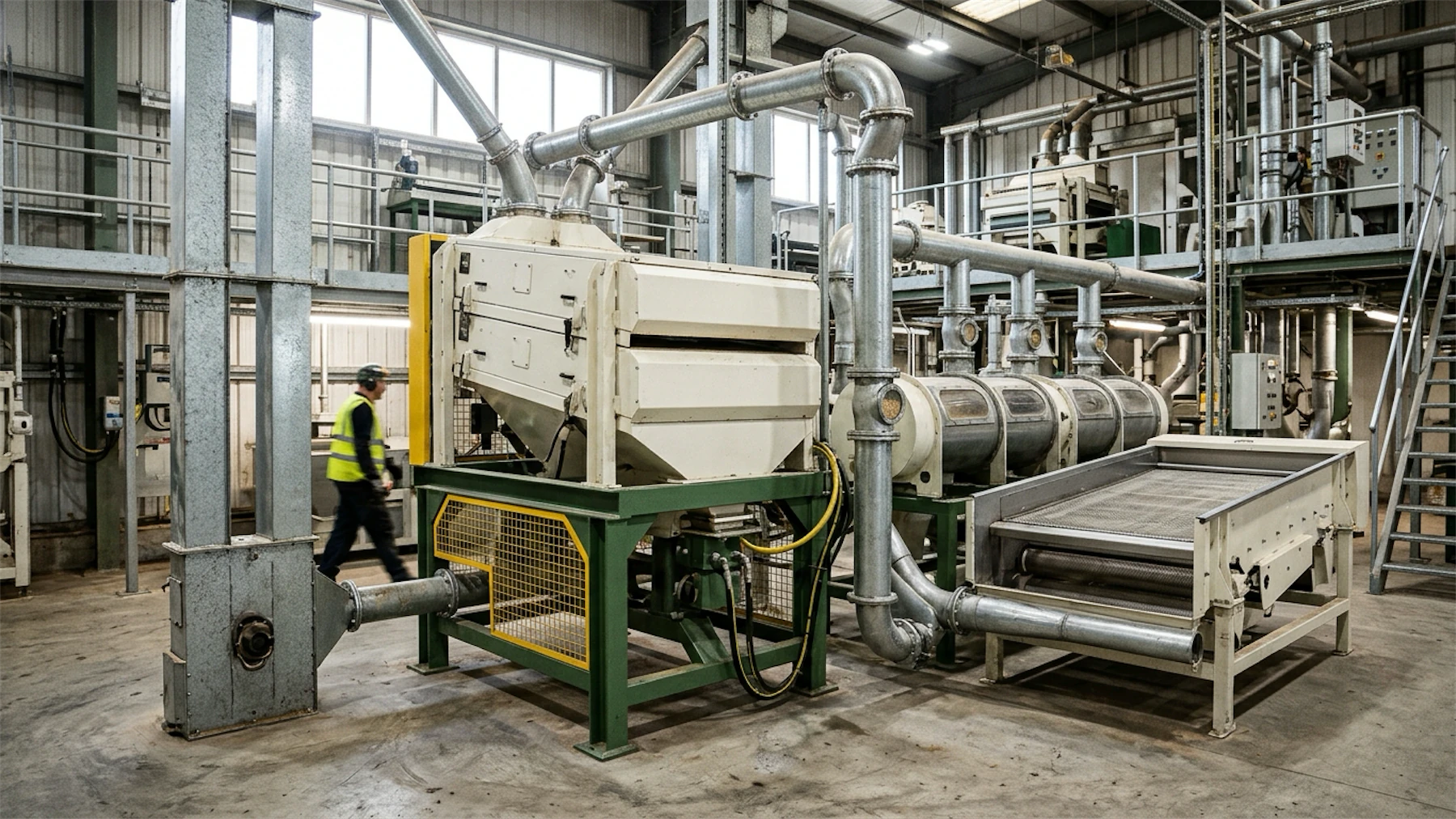
Cereal Cleaning & Calibration Plant Overview
Designing a dedicated cereal cleaning and grading facility requires balancing hourly intake volume against strict commercial test-weight and purity targets for wheat, barley, and corn. Engineers configure pre-cleaning, precision screening, aerodynamic aspiration, and gentle mechanical transport around real harvest moisture levels and downstream milling or seed-lot requirements.
Core Machinery Selection Criteria for Cereal Lines
- Laboratory sieve analysis of incoming wheat, barley, or maize batches to quantify straw, chaff, shriveled kernels, and weed seeds
- Matching scalping, air-screen, and indented cylinder or rotary grading stages to hourly tonnage and commercial grade tolerances
- Verifying bucket elevator discharge heights, chute wear-liner angles, and walkway clearances for rapid screen deck changeovers
Request a Technical Review of Your Cereal Line
Provide your primary cereal varieties, required hourly intake rate, and existing building dimensions so our process engineers can configure a balanced cleaning and calibration flow.
Send project enquiry ↗Cereal-Specific Process Flow Architecture
An effective cereal conditioning sequence is engineered around harvest impurity loads, kernel breakage sensitivity, and target hectoliter weight. A complete line typically links dust-controlled intake, coarse scalping, dual-channel aspiration, multi-layer reciprocating screens, and length or thickness graders, with the exact machine order verified through physical sample trials.
Wheat, barley, and maize workflows prioritize rapid removal of coarse straw and husks at intake, followed by multi-deck air-screen separation and uniform kernel sizing.
Engineering Scope & Plant Integration Checks
- Evaluating harvest moisture fluctuations, bulk density variations, and trash percentages across incoming cereal truckloads
- Sizing pre-cleaners, closed-loop aspirators, and multi-deck graders to achieve consistent seed calibration or milling purity
- Harmonizing surge bin volumes, elevator leg capacities, and dust collection ductwork with safe maintenance platforms
Facility Engineering & Specification Guidelines
Prior to locking in machine models, project planners must document grain varieties, harvest moisture spans, initial dockage percentages, target screen fractions, daily shift schedules, eave height limits, three-phase power availability, central baghouse sizing, and clean-grain silo or bagging connections. Capturing these site parameters early prevents bottlenecked elevators and redundant separation decks.
Any throughput figure cited for this cereal plant serves strictly as a preliminary engineering baseline rather than a fixed performance guarantee. Real-world hourly output fluctuates with grain moisture, straw content, perforation geometry, and operator settings, so final sizing must rely on laboratory sample testing and a formal process specification.
Configure a Cereal Conditioning Plant for Your Facility
Submit your cereal crop list, target hourly tonnage, and commercial purity standards to initiate a detailed layout and equipment consultation.
Frequently Asked Questions: Cereal Cleaning & Grading Plants
How is preliminary hourly capacity determined for cereal lines?
Bulk density, initial chaff and broken-kernel percentages, target calibration accuracy, and desired hourly tonnage dictate the screen surface area, aspiration airflow, and conveying capacities selected during preliminary design.
Which cereal crops can run on this cleaning and grading plant?
With interchangeable perforated sieve sheets and adjustable airflow dampers, the installation processes bread wheat, durum wheat, malting barley, feed barley, maize, rye, oats, and triticale across seasonal campaigns.
What site data do engineers need to prepare a cereal plant proposal?
Please supply the cereal species, target tons per hour, typical harvest dockage breakdown, required clean-grain specifications, building footprint and clear height, plus drawings of any existing pits or bins.
Does the nominal line capacity apply across all grain conditions?
No; nominal ratings reflect clean, dry free-flowing wheat at standard test weight, whereas high-moisture maize or heavily awned barley requires derated feed rates verified through physical sample trials.
Can new cereal cleaners and graders tie into existing grain elevators?
Yes, provided existing receiving pits, bucket legs, garner bins, and control panels are audited for surge capacity, discharge head height, flange geometry, and electrical interlock compatibility.