
Seed Treatment & Bagging Line
An integrated certified-seed finishing project coordinating precision liquid chemical or biological dosing, homogeneous seed coating, net-weight bagging, and automated bag closing in one continuous flow.
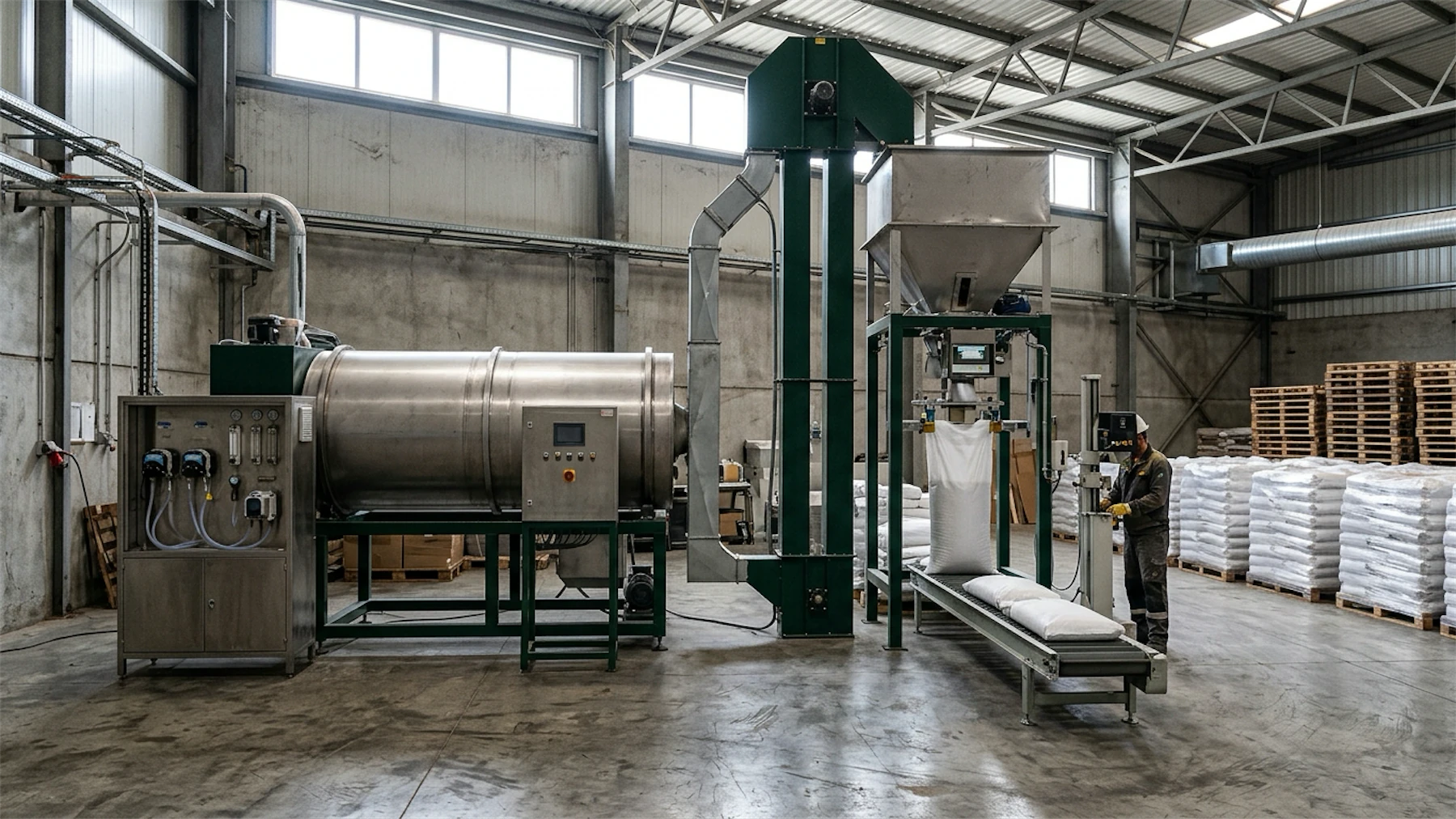
Certified Seed Coating & Packaging Architecture
Finishing conditioned planting seed requires accurate application of fungicides, insecticides, micronutrients, or biological inoculants without mechanical abrasion, followed immediately by accurate weighing and secure packaging. This turnkey project synchronizes mass-flow seed metering, peristaltic or flowmeter liquid dosing, gentle coating mixing, and automated bagging to protect germination vigour and operator safety.
Equipment Selection Criteria for Seed Coating & Packaging
- Evaluating cleaned seed bulk density, thousand-kernel weight, surface absorption rate, and slurry viscosity across planting seed lots
- Selecting continuous or batch seed treaters, peristaltic liquid dosing pumps, powder feeders, and net-weight electronic bagging scales
- Verifying surge bin anti-bridging design, self-cleaning mixer chambers, local vapour extraction hoods, and bag sewing or heat-sealing conveyors
Review Your Seed Treatment & Packaging Project With Us
Share your seed crops, slurry recipe rates, target bags per hour, and packaging room dimensions so we can engineer a safe, accurate finishing line.
Send project enquiry ↗Process Concept for Seed Coating, Weighing & Bagging
Because treated seed must not contaminate untreated bins or suffer pericarp damage, the finishing line is isolated at the end of the seed plant with dedicated surge hoppers, closed-loop liquid metering, low-shear mixing paddles or spinning discs, and direct gravity discharge into net weighers. Every transfer point is designed for rapid lot-to-lot cleanout and zero chemical build-up.
Seed finishing lines integrate calibrated seed and liquid metering, gentle coating application, accurate weighing, and automated bag closing.
Engineering Scope & Hygiene Checkpoints
- Assessing cleaned seed flowability, treatment slurry application rates (mL per 100 kg), and drying or film-coating dwell times
- Matching seed treater capacity, liquid dosing loops, holding bins, and electronic bagging scales to required bags or big-bags per hour
- Checking zero-retention cleanout hatches, chemical fume extraction connections, and ergonomic bag handling or palletizing access
Planning Notes for Seed Treatment & Packaging Rooms
Before specifying seed treatment and bagging machinery, define the seed species (cereals, maize, pulses, cotton, or oilseeds), slurry recipes and number of simultaneous liquid streams, target bag weights (e.g., 25 kg, 50 kg, or 1000 kg big-bags), hourly packaging rate, room ceiling height, compressed air and power utilities, chemical ventilation standards, and palletizing interface. Clarifying these details early prevents caking in holding bins and dosing inaccuracies.
Any capacity bracket cited for seed finishing acts strictly as a preliminary design reference rather than a fixed output guarantee. Real-world bagging throughput varies with seed bulk density, slurry viscosity, multi-liquid recipe complexity, bag weight format, and lot-changeover frequency, which must be confirmed against a documented process specification.
Configure a Precision Seed Treatment & Bagging Line
Send us your seed varieties, slurry application parameters, and target bag formats to start a practical engineering discussion.
Answers to Certified Seed Coating & Bagging Questions
What determines the hourly throughput of a seed treatment and bagging line?
Seed bulk density, slurry dosing volume per ton, required mixing dwell time for uniform coverage, individual bag weight, and bag-closing speed govern the synchronized line rating.
Which planting seeds can be treated and bagged on this line?
With adjustable seed weighers, multi-pump dosing skids, and gentle mixing elements, the line handles wheat, barley, hybrid maize, soybeans, sunflower, chickpeas, lentils, and delinted cottonseed.
What project data is needed to engineer a seed finishing line?
Share the seed species, hourly tonnage or bags-per-hour target, liquid/powder chemical recipes, bag sizes and material types (woven PP, paper, PE), available room height, and upstream bin layout.
Is the listed bagging and coating capacity guaranteed for every recipe?
No; listed figures are preliminary benchmarks, while final capacity must be verified against your actual seed bulk density, polymer or slurry drying characteristics, and bag weight tolerances.
Can this treatment and bagging module connect to an existing seed cleaning plant?
Yes; we evaluate existing clean-seed holding bins, discharge elevations, gentle belt or bucket elevators, and PLC interlocks to integrate the treater and packer smoothly.