
Sunflower Seed Cleaning Line
A dedicated conditioning concept engineered for extracting light hulls, head fragments, and fibrous stalks, followed by multi-deck size calibration and gravity separation for confectionery and oilseed sunflower.
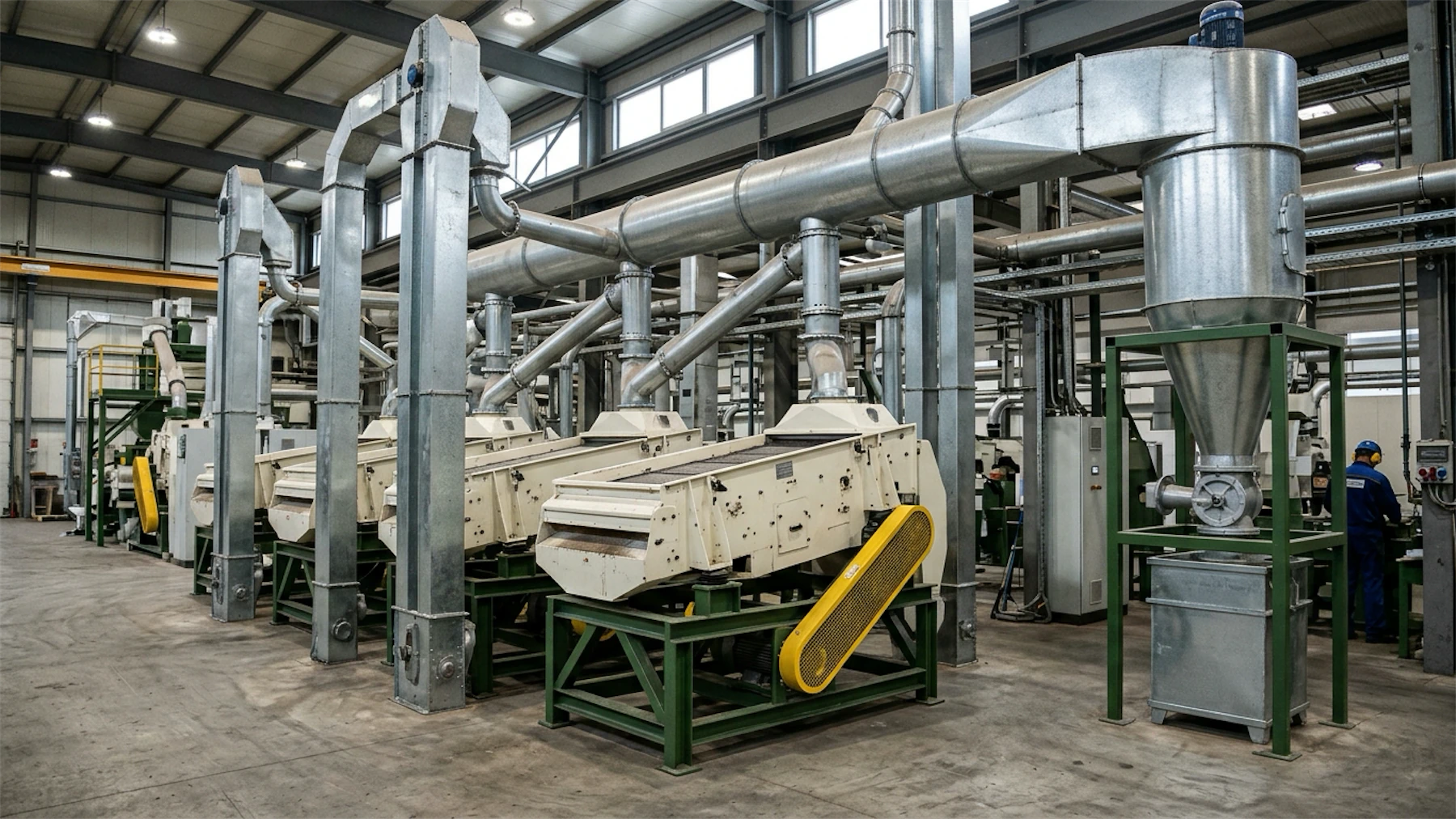
Confectionery & Oilseed Sunflower Conditioning Scope
Conditioning harvested sunflower achenes presents distinct aerodynamic and mechanical challenges due to low bulk density, elongated wedge-shaped kernels, woody stalk pieces, and high proportions of empty or insect-damaged hulls. This project architecture coordinates high-volume aspiration, non-blinding screen cleaning, width/thickness grading, and specific-gravity separation to deliver uniform roasting, dehulling, or planting grades.
Equipment Selection Criteria for Sunflower Conditioning
- Laboratory testing of raw sunflower samples to measure stalk length, receptacle head fragments, sclerotia, and empty-hull percentages
- Selecting scalping drums, air-screen cleaners, rotary or flat caliber graders, and gravity separators matched to low-density achene flow
- Verifying steep gravity-spout angles (minimum 45–50 degrees), oversized elevator buckets, and high-capacity cyclone dust collectors
Review Your Sunflower Cleaning Line With Our Engineers
Share your sunflower type (confectionery, bakery, or oilseed), target hourly tonnage, and building dimensions so we can engineer a non-bridging process flow.
Send project enquiry ↗Sunflower-Specific Process Flow Concept
Because sunflower seeds bridge easily in narrow hoppers and carry bulky pith and stalk trash, the process flow starts with positive-discharge intake and coarse scalping before moving to multi-deck air-screen cleaning. For confectionery and hybrid seed lines, precision slot/round-hole grading and gravity table separation follow so that hollow achenes and same-size sclerotia are reliably removed.
Sunflower conditioning flows combine stalk and head-fragment scalping, intensive hull aspiration, screen calibration, and gravity table upgrading.
Engineering Scope & Flow-Design Checkpoints
- Assessing bulk density (typically 0.32–0.45 t/m³), harvest moisture, stalk length, and hollow-seed percentage in incoming sunflower lots
- Sizing air-screen cleaners, caliber graders, and gravity separators to separate light hulls, woody sticks, and undersized achenes
- Checking volumetric bucket-elevator sizing, steep anti-choke spouting, wear liners, and maintenance platforms across the line
Engineering Planning Notes for Sunflower Facilities
Before specifying sunflower cleaning equipment, define whether the plant processes striped confectionery varieties, black oilseed types, or hybrid planting seed, along with moisture spans, trash and sclerotia loads, required millimeter caliber fractions, daily operating hours, building eave height, electrical power, high-volume dust filtration, and downstream dehulling, roasting, or bagging interfaces. Establishing these inputs early prevents choked chutes and undersized elevators.
Published tonnage figures on this page serve as initial planning brackets for sunflower rather than guaranteed output rates. Given the low test weight of in-shell achenes and their high volumetric screen load per ton, actual throughput must be verified using physical crop samples and a documented engineering specification.
Configure a Sunflower Cleaning Line Around Your Caliber & Purity Goals
Send us your sunflower variety details, desired hourly capacity, and grading targets to begin a focused engineering consultation.
Engineering Questions on Sunflower Cleaning Lines
How does sunflower's low bulk density affect line capacity planning?
At 0.35–0.42 t/m³, sunflower occupies nearly twice the volume per ton of cereal grain, requiring larger elevator buckets, wider screen decks, steeper spouts, and higher aspiration airflow.
Can this line handle both confectionery and oil-type sunflower seeds?
Yes; by exchanging oblong and round-hole screen decks and tuning gravity table airflow, the plant processes large striped confectionery achenes, bakery grades, and high-oil black sunflower.
What data is required to engineer a sunflower cleaning proposal?
Provide the sunflower type, target hourly input rate, bulk density, incoming stalk and empty-seed percentages, required millimeter size grades, building height, and any existing equipment.
Is the preliminary hourly capacity guaranteed without sample testing?
No; published capacity brackets are initial planning references, while guaranteed hourly performance is confirmed after testing representative sunflower samples against your grade specifications.
Can this sunflower cleaning line tie into an existing dehulling or optical sorting plant?
Yes; our engineers audit existing surge bins, bucket elevators, dehullers, and optical sorters to ensure volumetric throughput balance, proper chute angles, and synchronized controls.