Equipment Guides
Air Screen Cleaner / Seed Cleaner
Examine multi-deck sieve perforation sizing, dual-channel aspiration airflow control, and coarse versus fine impurity extraction across cereal, pulse, and oilseed cleaning applications.

Explore engineering selection guides covering industrial air-screen cleaners, dimensional seed graders, specific gravity tables, optical color sorters, and size-reduction mills to design balanced, high-recovery processing lines.
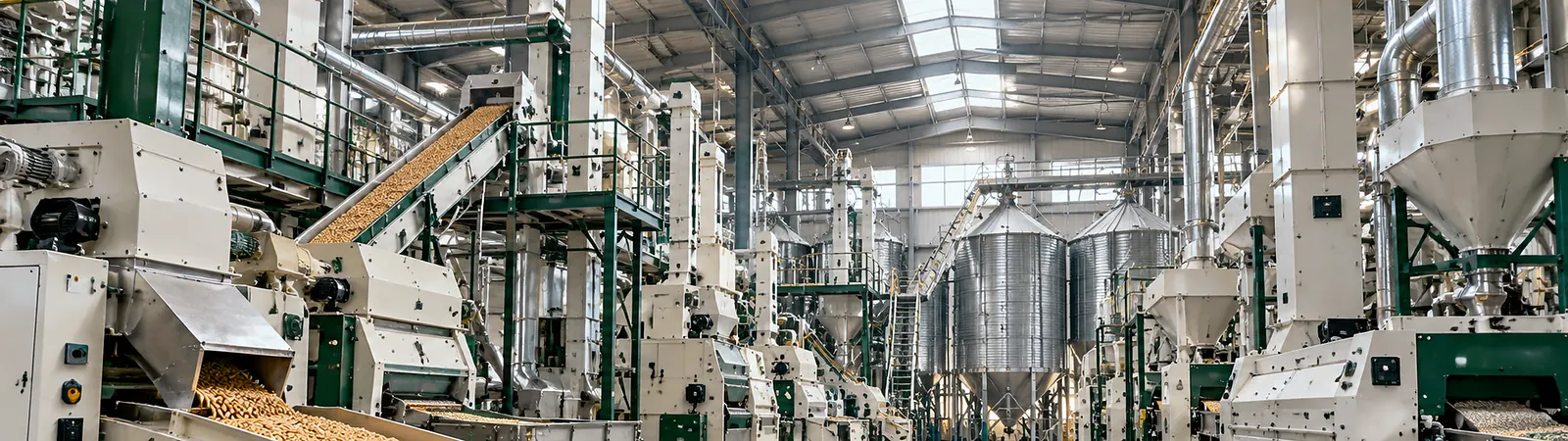
Examine multi-deck sieve perforation sizing, dual-channel aspiration airflow control, and coarse versus fine impurity extraction across cereal, pulse, and oilseed cleaning applications.
Evaluate slotted and round-hole screen configurations, multi-fraction calibration accuracy, and deck oscillation mechanics for uniform planting seed and commercial grain sizing.
Review high-resolution chromatic camera inspection, pneumatic ejector valve timing, and chute feed presentation needed to isolate discolored kernels and foreign bodies.
Analyze impact and attrition grinding dynamics, target particle-size distribution curves, thermal load management, and explosion-safe dust aspiration in seed milling installations.
Study fluidized-bed air stratification, deck longitudinal and transverse inclination tuning, and specific-weight cut points that partition low-density or weevil-damaged grains from vigorous planting seed.
Process design starts by mapping raw harvest contaminants against final commercial or certification tolerances, then sequencing scalping, aspiration, dimensional grading, density separation, and optical sorting so each unit prepares feed for the next.
Project engineers require the exact botanical varieties, thousand-kernel weight, moisture range at intake, percentage and nature of foreign trash, target outlet purity, and net hourly capacity requirements.
Because kernel geometry, aerodynamic terminal velocity, and specific weight differ widely across crops, operators must exchange screen perforations, recalibrate airflow dampers, and retune deck inclination or camera recipes between species.
Running benchtop or pilot-scale trials on actual uncleaned harvest material quantifies achievable purity, good-seed recovery rate, and realistic mass flow per square meter of screen or deck surface.
Lines begin with intake scalping and air-screen cleaning to strip bulk trash and dust, followed by length or width grading and gravity separation, leaving optical sorters at the end to polish pre-sized, dust-free product.
Our engineering team calculates net hourly capacity based on your exact crop species, bulk density, intake moisture level, incoming foreign matter percentage, and required outlet purity standard rather than relying on nominal wheat pre-cleaning figures.
Modern modular plants incorporate variable-frequency drives, quick-clamp sieve cassettes, adjustable air gates, and stored digital sorting recipes to minimize downtime and prevent varietal cross-contamination during changeovers.
Automated level sensors, interlocked vibratory feeders, and synchronized bucket elevators maintain a steady, non-pulsing curtain of grain across every separator deck, preventing surge overloads that degrade separation sharpness.
Site engineering must confirm three-phase electrical load capacity, dry oil-free compressed air for optical ejectors, centralized dust aspiration duct routing, floor dynamic load ratings, and overhead clearance for elevator heads.
Provide a detailed raw material specification sheet, close-up photographs or physical bags of uncleaned and target product, required hourly tonnage, shift schedule, and CAD drawings of existing building constraints.