Home›Machines›Big Bag Filling & Weighing-On Ground
Big Bag Filling & Weighing-On Ground
MACHINERY CATALOGUE

Big Bag Filling & Weighing-On Ground

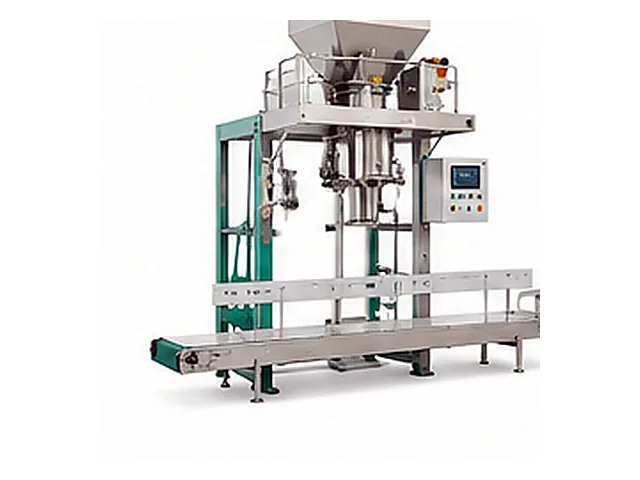
The Big Bag Filling & Weighing-On Ground station provides a rugged, floor-supported bulk packaging solution for filling flexible intermediate bulk containers (FIBCs) with cleaned seed, commercial grain, pulses, or granular agricultural products. By supporting the pallet and bulk bag directly on a floor-mounted load-cell platform deck, the unit simplifies pallet-truck or forklift handling while achieving reliable gravimetric batch control.

Machines ↗

Overview

In a Big Bag Filling & Weighing-On Ground system, an empty FIBC is placed onto a wooden or plastic pallet resting atop a heavy-duty U-shaped or full-deck floor scale, and its corner loops are hooked to the overhead support frame. The operator secures the bag inlet cuff over a double-walled filling spout where an inflatable or mechanical neck seal clamps the fabric tightly while an inner coaxial vent pipe extracts displaced dusty air. A two-position dosing gate or motorized feeder above the spout delivers a rapid bulk fill followed by a controlled dribble stream until the floor platform load cells register the exact target net weight.

Technical Specifications

Technical ParameterBBF-25BBF-50BBF-100BBF-150
Filling / Weighing Capacity10 – 25 t/h30 – 50 t/h60 – 100 t/h110 – 150 t/h
Bagging Output (10 – 50 kg Bags)150 – 240 bags/hour250 – 360 bags/hour380 – 480 bags/hour500 – 600 bags/hour
Drive Motor Power1.5 kW4.0 kW11.0 kW18.5 kW
Weighing Accuracy (Load Cell)± 0.1% – 0.2%± 0.1% – 0.2%± 0.1% – 0.2%± 0.1% – 0.2%
Compressed Air Supply0.5 – 0.6 MPa0.5 – 0.6 MPa0.6 – 0.7 MPa0.6 – 0.7 MPa

The capacity and power ranges indicated in the table may vary depending on the crop type to be processed, initial foreign matter rate, moisture level, and machine configuration. Exact performance and actual measurement values are finalized following the engineering design and process detailing of the plant to be installed.

Selection and integration

Selecting a Big Bag Filling & Weighing-On Ground unit is ideal when plant headroom is constrained or when operators move filled bulk bags away using standard hand pallet jacks or warehouse forklifts. Engineering review focuses on FIBC loop geometry, inlet skirt diameter, bulk density variations across crops, and the coarse/fine valve sizing needed to hit cycle-time targets without overfilling.

Key points to specify

  • Confirm the crop, variety and incoming condition for Big Bag Filling & Weighing-On Ground.
  • When setting up the “Big Bag Filling & Weighing-On Ground” unit, record product flow, target weight, discharge arrangement and package format and assess both accepted output and unwanted product loss during the sample trial.
  • Do not assume a standard setting for the “Big Bag Filling & Weighing-On Ground” unit; test product flow, target weight, discharge arrangement and package format on the intended material and document the accepted result in the technical offer.
  • The line drawing for the “Big Bag Filling & Weighing-On Ground” unit should identify product transfer, service space and interfaces with upstream and downstream equipment; record the product conditions summarized by product flow, target weight, discharge arrangement and package format.

GUIDE · TECHNICAL SELECTION

What is this machine used for?

Designed for wholesale seed lots, inter-plant transfers, and industrial grain dispatch, the Big Bag Filling & Weighing-On Ground station portions bulk commodities directly into palletized FIBCs resting on a floor-level weighing platform. Its enclosed coaxial spout vents displaced air and dust back to the filter network, ensuring stable weighing readings and clean working conditions around the filling bay.

01

The role in the process

Within a seed or pulse processing plant, the Big Bag Filling & Weighing-On Ground unit serves high-volume dispatch lanes and intermediate semi-finished holding workflows. Because the bag bottom remains supported by the pallet throughout the entire filling cycle, tensile stress on the corner lifting loops is minimized and the bag forms a flat, stable base on the pallet.

Coordinating the upstream surge bin capacity with the floor-scale dosing cycle allows continuous upstream cleaning or optical sorting without frequent line stops. High-and-low level probes inside the buffer hopper above the filling head prevent product starvation during the fine-weighing phase, preserving consistent in-flight cut-off accuracy. Cleanout doors simplify variety changeovers.

02

Material and application suitability

Free-flowing cereal grains, corn, soybeans, peas, and pelleted seeds fill rapidly through a two-position slide or sector gate, requiring only an aspirated double-wall spout to evacuate displaced air. For fragile large-seeded legumes such as kidney beans or chickpeas, the drop distance between the dosing valve and the pallet deck should be minimized and fitted with a decelerating chute liner.

Lighter or dusty materials—such as grass seeds, sunflower, or spice seeds—benefit from pre-filling bag inflation so the FIBC fabric expands fully before product enters, preventing corner folds that trap seed or skew the center of gravity. Where chemically treated seeds are loaded into bulk bags, sealed inflatable neck collars prevent operator exposure to coating dust.

03

Selection checklist

To configure the Big Bag Filling & Weighing-On Ground station, specify the pallet footprint, minimum and maximum FIBC heights, inlet spout diameter, target bulk-bag weight, and hourly filling rate. Also confirm whether bags will be removed by forklift tines, a low-profile hand pallet truck using a U-shaped weigh frame, or a motorized roller conveyor.

Include coarse-and-fine dribble feed control, dust extraction collars, and checkweigher feedback for certified weight accuracy. Adjustable feed gate openings and programmable dribble cutoffs handle both free-flowing cereals and dusty یا chaffy grass seeds. Smooth hopper walls and dust-tight bag clamps maintain clean, accurate filling across paper, woven, and film bags. Air and feed controls lock repeatably.

Integration into a processing line

Plant layout and interface planning

When laying out a Big Bag Filling & Weighing-On Ground bay, ensure unobstructed forklift maneuvering room in front of the weighing deck and adequate vertical clearance for hooking the rear bag loops safely. The floor beneath the platform frame must be level, rigid, and isolated from structural vibrations transmitted by nearby screening machines or hammer mills.

Flexible fabric or silicone sleeve connections between the fixed overhead garner bin and the filling head prevent structural pipe forces from bearing down on the weighed bag during filling. Similarly, routing the dust-venting hose with a flexible loop ensures that negative pressure from the central aspiration fan does not introduce vertical tare drift.

Factors that affect operating performance

Final weight repeatability on a floor-supported FIBC filler is governed by uniform product flow into the dosing valve, rapid pneumatic actuator closure during dribble cut-off, and effective air evacuation from the bag interior. If displaced air cannot escape freely through the outer annulus of the filling spout, internal bag ballooning will disturb the load-cell reading at the moment of gate closure.

Process quality and line integration

Integrating the ground-level big-bag weigher with barcode label printers and plant inventory software enables each filled FIBC to receive a serialized lot tag showing net weight, crop variety, and timestamp. Interlocked neck-clamp pressure switches prevent the feed gate from opening until the bag cuff is positively sealed around the spout.

Frequently asked questions

Can a standard hand pallet jack load and unload pallets on the Big Bag Filling & Weighing-On Ground unit?

Yes, when specified with a low-profile U-shaped weigh frame or a ramped platform deck, operators can wheel pallets directly into the weighing zone using a manual pallet truck. Where counterbalanced forklifts or automated pallet conveyors are used, a heavy-duty closed-deck platform or integrated powered roller bed is supplied instead.

How is airborne dust controlled while filling bulk bags at floor level?

The station uses a coaxial double-wall filling spout with an inflatable elastomer collar that seals the FIBC inlet sleeve tightly around the inner product tube. As grain or seed displaces air inside the bag, the outer annular passage vents the dusty air directly into the plant aspiration system rather than into the workroom.

What happens when the facility needs to fill bulk bags of different heights?

The four-column support frame features telescopic upper crossbeams or multi-position loop hanger arms that can be raised or lowered to match short, medium, or tall FIBC specifications. This adjustment keeps the bag walls properly tensioned while ensuring the bottom of the bag rests squarely on the weighed pallet deck.

REQUEST A TECHNICAL REVIEW

Big Bag Filling & Weighing-On Ground

Contact our engineering team with your FIBC dimensions, pallet handling method, and crop bulk density to receive a tailored layout and technical quotation for a Big Bag Filling & Weighing-On Ground station.