Home›Bucket Elevator
Bucket Elevator
Conveying & Elevation

Bucket Elevator

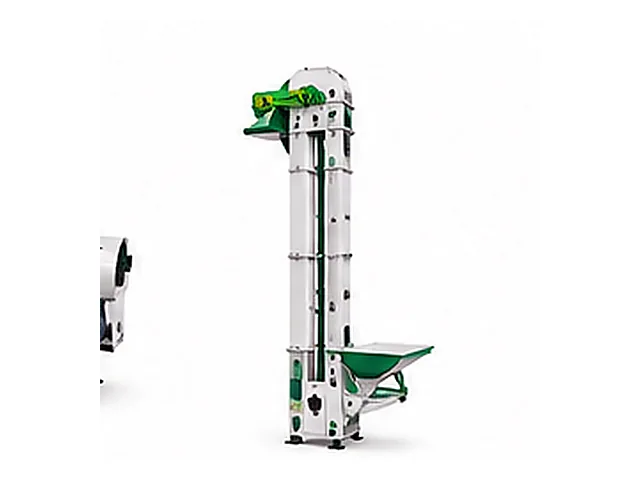
The Bucket Elevator is the workhorse vertical lifting unit in grain terminals, seed conditioning towers, and oilseed preparation plants. Using a series of closely calculated polymer or pressed-steel buckets fastened to a high-tensile rubber belt, it raises bulk crops from pit or floor level to elevated cleaners, silos, and scales. Standard industrial configurations handle wheat, sunflower seeds, maize, and paddy or milled rice.

Machines ↗

Overview

Material enters the bottom boot section through a controlled infeed hopper and fills the ascending buckets as they pass around the tail pulley. Inside rigid, self-supporting twin leg trunks, the loaded belt travels vertically to the head hood, where rotational velocity and pulley diameter govern a clean centrifugal or mixed-gravity discharge into the outlet spout. Back-legging—where kernels fall back down the return trunk—is prevented through adjustable throat plates (lip baffles) in the head housing and precise belt speed calibration.

Technical specifications

Technical ParameterBEL-25BEL-50BEL-100BEL-150
Conveying Capacity10 – 25 t/h30 – 50 t/h60 – 100 t/h110 – 150 t/h
Drive Motor Power1.5 – 3.0 kW4.0 – 7.5 kW7.5 – 11.0 kW15.0 – 18.5 kW
Operating / Conveying Speed0.6 – 1.2 m/s0.8 – 1.5 m/s1.0 – 1.8 m/s1.2 – 2.2 m/s
Trough / Trunking Section Width200 mm300 mm400 mm500 mm

The capacity and power ranges indicated in the table may vary depending on the crop type to be processed, initial foreign matter rate, moisture level, and machine configuration. Exact performance and actual measurement values are finalized following the engineering design and process detailing of the plant to be installed.

Key considerations

  • Confirm the crop, variety and incoming condition for Bucket Elevator.
  • Do not assume a standard setting for the “Bucket Elevator” unit; test transfer elevations, product fragility, inlet/discharge alignment and the route on the intended material and document the accepted result in the technical offer.
  • The fit of the “Bucket Elevator” unit should be checked on a representative sample, with transfer elevations, product fragility, inlet/discharge alignment and the route matched to the planned line duty.
  • Place the “Bucket Elevator” unit in the line drawing with its handoff elevations and cleaning access; record transfer elevations, product fragility, inlet/discharge alignment and the route against the intended product.

Typical applications

Cereal and oilseed processors use this elevator across intake pits, pre-cleaning towers, dryer loading legs, and bin-filling systems for wheat, maize, rice, and sunflower seeds. By adjusting bucket profile, spacing, and linear belt speed, the same structural family serves both high-rate commercial grain intake and gentler conditioned-seed elevation.

GUIDE · TECHNICAL SELECTION

What is this machine used for?

A Bucket Elevator provides compact, energy-efficient vertical transport wherever bulk grain or seed must be raised to overhead processing machines or storage bins. Engineered for continuous duty across 5–100 t/h line rates, the unit controls product pickup in the boot and trajectory release at the head hood to minimize kernel cracking and back-legging. Proper matching of bucket volume, belt velocity, and inlet orientation ensures reliable performance on wheat, sunflower seeds, maize, and rice.

01

The role in the process

In multi-story cleaning towers and single-floor plants alike, vertical bucket legs dictate the overall gravity flow path by lifting product high enough to feed screen cleaners, indented cylinders, or gravity tables via gravity spouting. Because they occupy a minimal floor footprint, multiple elevators can be grouped side by side around a central service tower.

Selecting the right boot feeding geometry is critical: free-flowing grains with low damage sensitivity can enter on the down-leg for high volumetric fill, whereas fragile seeds or light oilseeds are fed directly into rising buckets on the up-leg to avoid dredging through the boot bottom.

02

Material and application suitability

Different crops impose distinct demands on bucket and liner selection: paddy rice and sunflower seeds are highly abrasive and benefit from replaceable polyurethane or hardened steel wear plates inside the head hood. Large-kernel maize requires careful regulation of linear belt speed and head pulley diameter so kernels do not shatter against the discharge throat.

Low bulk density crops like sunflower seeds require deeper projection buckets and vented bucket bottoms to release trapped air during rapid filling and prevent dust blow-back at the boot inlet. High-moisture intake lots demand non-stick polymer buckets with rounded corners that shed damp chaff cleanly at the head turn.

03

Selection checklist

When specifying a Bucket Elevator, define the required 5–100 t/h throughput for each crop, bulk density in kg per cubic meter, exact inlet-to-outlet vertical distance, indoor or outdoor wind-load exposure, and explosion-venting requirements.

Determine belt or chain speed, bucket or trough fill factor, and drive torque for the maximum hourly tonnage and bulk density. Specify zero-speed motion sensors, belt alignment switches, and bottom cleanout slides for zero-admixture seed handling. Food-grade contact surfaces and low-velocity transfer points suit fragile pulses, coated seeds, and high-purity parent lines. Cleanout doors simplify variety changeovers.

Integration into a processing line

Plant layout and interface planning

Layout planning must reconcile boot inlet height with upstream pit conveyors or cleaners: if the boot sits in a concrete pit, sufficient clearance around the tensioning screws and clean-out slides is vital for operator access. At the top of the leg, structural steel platforms must support the drive weight and give technicians safe footing to service the gearmotor and head bearings.

Vertical trunking must be erected plumb and braced laterally at regular floor intervals so the ascending and descending belt strands never rub against the sheet-metal casings. Outdoor legs should include weatherproof motor covers, sealed flange gaskets, and lightning protection bonding.

Factors that affect operating performance

Elevator performance hinges on the interplay between pulley rotational speed and discharge trajectory: running too fast throws grain violently against the top hood, while running too slowly causes product to spill prematurely down the return leg. Maintaining correct belt tension via the boot take-up prevents slippage on the head pulley lagging and keeps bucket tip clearance uniform against the throat baffle.

Process quality and line integration

Integrating boot level sensors and zero-speed switches into the plant PLC protects against catastrophic belt stalling if a downstream cleaner or silo gate closes unexpectedly. Upstream Belt Conveyor or Screw Conveyor feeders should be electrically interlocked to stop instantaneously whenever the elevator trips or decelerates.

Frequently asked questions

What is the difference between up-leg and down-leg boot feeding on a Bucket Elevator?

Up-leg feeding introduces grain above the boot pulley centerline directly into rising buckets, minimizing scooping friction and kernel breakage on sensitive seeds. Down-leg feeding introduces material on the descending side so buckets scoop through the boot reservoir, maximizing fill factor on hardy commercial grains.

Why does back-legging occur and how is it corrected during commissioning?

Back-legging happens when grain fails to clear the head outlet spout and falls back down the vertical leg casings, causing mechanical damage and reduced capacity. Technicians correct it by fine-tuning the VFD drive speed to optimize centrifugal throw and adjusting the sliding throat lip plate close to the bucket tips.

How are dust and static electricity managed inside tall grain elevator legs?

Anti-static, flame-resistant elevator belting is paired with grounded steel leg trunks and dedicated aspiration take-off vents on the boot and head hoods. Where combustible grain dust is present, vented explosion relief panels and belt rub-temperature monitors are fitted to satisfy plant safety codes.

REQUEST A TECHNICAL REVIEW

Bucket Elevator

Contact our application engineers with your crop list, required 5–100 t/h capacity, and exact inlet-to-discharge elevation to specify the right Bucket Elevator configuration. We supply detailed leg drawings, foundation loads, and safety sensor packages matched to your facility.