Home›Belt Conveyor
Belt Conveyor
Conveying & Elevation

Belt Conveyor

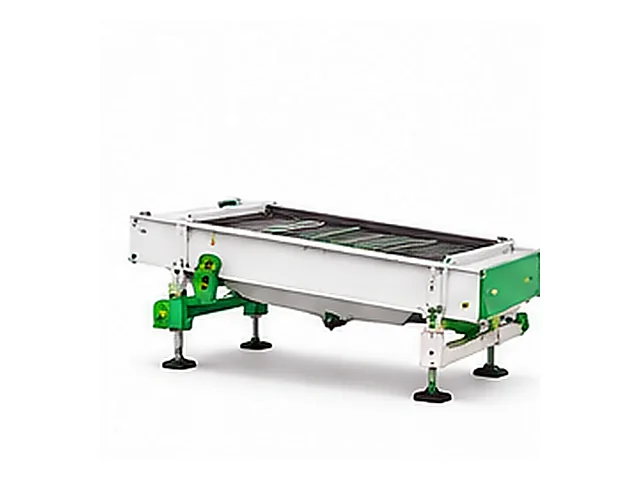
A Belt Conveyor provides calm, horizontal or slightly inclined transport for delicate kernels, tree nuts, and conditioned seeds across processing halls. Because the product rests statically upon a traveling elastomer or fabric-reinforced belt rather than sliding against metal walls, mechanical shear and seed-coat abrasion remain virtually nonexistent. Typical installations link hullers, optical sorters, roasting lines, and storage bins with minimal breakage.

Machines ↗

Overview

The machine operates by carrying bulk material on an endless loop supported by precision-aligned troughing or flat idler rollers between a tail loading station and a head drive drum. Variable-frequency motor control allows operators to match linear belt speed to upstream discharge rates, maintaining a consistent bed depth without surging. Vulcanized or mechanical belt splices, adjustable skirtboards at the infeed chute, and spring-loaded or gravity take-up assemblies keep tracking centered under fluctuating loads.

Technical specifications

Technical ParameterBLC-25BLC-50BLC-100BLC-150
Conveying Capacity10 – 25 t/h30 – 50 t/h60 – 100 t/h110 – 150 t/h
Drive Motor Power1.5 – 3.0 kW4.0 – 7.5 kW7.5 – 11.0 kW15.0 – 18.5 kW
Operating / Conveying Speed0.6 – 1.2 m/s0.8 – 1.5 m/s1.0 – 1.8 m/s1.2 – 2.2 m/s
Trough / Trunking Section Width200 mm300 mm400 mm500 mm

The capacity and power ranges indicated in the table may vary depending on the crop type to be processed, initial foreign matter rate, moisture level, and machine configuration. Exact performance and actual measurement values are finalized following the engineering design and process detailing of the plant to be installed.

Key considerations

  • Confirm the crop, variety and incoming condition for Belt Conveyor.
  • When setting up the “Belt Conveyor” unit, record product fragility, transfer elevations, the route and inlet/discharge alignment and assess both accepted output and unwanted product loss during the sample trial.
  • Do not assume a standard setting for the “Belt Conveyor” unit; test product fragility, transfer elevations, the route and inlet/discharge alignment on the intended material and document the accepted result in the technical offer.
  • Show the infeed, discharge, transfer points and service clearances for the “Belt Conveyor” unit on the plant layout; ensure product fragility, transfer elevations, the route and inlet/discharge alignment appear in the technical acceptance note.

Typical applications

Tree nut facilities handling hazelnuts and pistachios rely on open or hooded belt conveyors to move roasted, blanched, or raw kernels without chipping fragile cotyledons. Seed conditioning plants likewise deploy flat picking belts for visual inspection and troughed gallery belts for distributing cleaned lots into holding silos.

GUIDE · TECHNICAL SELECTION

What is this machine used for?

In industrial nut and seed plants, a Belt Conveyor serves as the primary gentle transport link over medium and long horizontal spans where preserving kernel integrity is paramount. By eliminating flight-to-trough friction, the traveling belt carries fragile hazelnuts, pistachios, pulses, and coated seeds smoothly between elevation and grading stages. Engineers select belt width, troughing angle, and roller spacing to match bulk density and target throughput across the 5–120 t/h operating envelope.

01

The role in the process

Within the process flowsheet, the belt unit bridges widely separated stations—such as intake pre-cleaning, shell cracking, drying tunnels, and packaging hoppers—without introducing intermediate vertical lifts. Its low power consumption per meter of horizontal travel makes it ideal for overhead bin-filling galleries and under-silo reclaim tunnels.

Where multi-point distribution is needed, the conveyor can be configured with a traveling tripper or a reversible shuttle carriage that indexes directly above individual storage cells. Low-speed flat configurations also double as manual sorting tables where operators inspect moving monolayers of nuts or large seeds prior to final packing.

02

Material and application suitability

Oily crops such as hazelnuts and pistachios require fat-resistant, food-safe belt covers that resist swelling, surface cracking, and rancid residue buildup over extended campaigns. Fine or free-flowing seeds benefit from multi-roll troughing idlers that cradle the material bed and prevent lateral spillage along the carrying run.

Incline angles must be kept conservative based on kernel roundness and surface friction; smooth spherical seeds roll backward if the slope exceeds their natural angle of repose unless cleated or chevron profiles are specified. Infeed chute geometry should accelerate incoming material in the direction of belt travel to prevent localized cover wear and kernel bouncing.

03

Selection checklist

Technical specifications for procurement should define the required 5–120 t/h mass flow, bulk density range, horizontal center-to-center distance, net lift, belt cover compound, and whether enclosed dust hooding or open inspection access is required.

Verify inlet boot feed height, head discharge trajectory, and service platform clearances along the transport path. Specify zero-speed motion sensors, belt alignment switches, and bottom cleanout slides for zero-admixture seed handling. Gentle transfer chute geometry and low-impact discharge profiles protect brittle kernels from mechanical damage. Self-cleaning profiles and tight clearances prevent residual kernel holdover between different crop varieties.

Integration into a processing line

Plant layout and interface planning

Integrating a belt conveyor into an existing or new facility begins with mapping transfer trajectories at both the tail loading zone and the head pulley discharge. Adequate vertical headroom at the infeed allows a sloped rock-box or decelerating chute to lay product gently onto the belt center without impact damage.

Structural supports must account for live belt load, walkway catwalks, and maintenance access around the drive assembly and gravity or screw take-up unit. Dust collection ports at the tail and head enclosures should connect to the central aspiration network so fine husks do not settle on return rollers.

Factors that affect operating performance

Consistent belt tension and accurate idler alignment govern long-term mechanical reliability and prevent edge fraying against the steel stringers. Variations in ambient temperature, product oiliness, and moisture content alter friction against the drive lagging, making lagged head drums and snub pulleys essential for slip-free traction.

Process quality and line integration

Synchronizing the belt drive with upstream feeders and downstream bucket elevators prevents overfilling at transfer chutes during emergency stops. Automated sequence control ensures the belt starts before upstream equipment begins discharging and runs until the carrying strand is completely empty before shutting down.

Frequently asked questions

Why is a Belt Conveyor preferred for fragile crops like hazelnuts and pistachios?

Unlike auger flights or drag chains that push kernels along a stationary trough, a conveyor belt carries the product at the exact speed of the supporting surface. This static support eliminates rubbing, pinching, and skinning of delicate nut kernels and seed coats throughout horizontal transfers.

What determines the maximum incline angle on a troughed or flat belt unit?

The permissible slope depends on kernel shape, surface texture, moisture level, and belt cover friction; round seeds tend to roll back on steep inclines. When layout constraints force a steeper climb, engineers specify textured covers, chevron ribs, or transverse cleats to hold the bed stable.

How is fine residue prevented from building up on the return strand and rollers?

A primary polyurethane blade scraper mounted against the head pulley removes adherent dust and oil film immediately after product discharge. Additionally, a diagonal vee-plow positioned just ahead of the tail pulley deflects any stray kernels from the inner belt surface before they can wedge between the belt and drum.

REQUEST A TECHNICAL REVIEW

Belt Conveyor

Share your plant layout, target 5–120 t/h throughput, crop bulk density, and transfer elevations with our engineering team to configure a Belt Conveyor tailored to your processing line. We provide complete dimensional drawings, belt compound recommendations, and utility schedules to ensure seamless installation.