Home›Machines›Cylindrical Screening Seed Graders CS 300/500/700
Cylindrical Screening Seed Graders CS 300/500/700
MACHINERY CATALOGUE

Cylindrical Screening Seed Graders CS 300/500/700

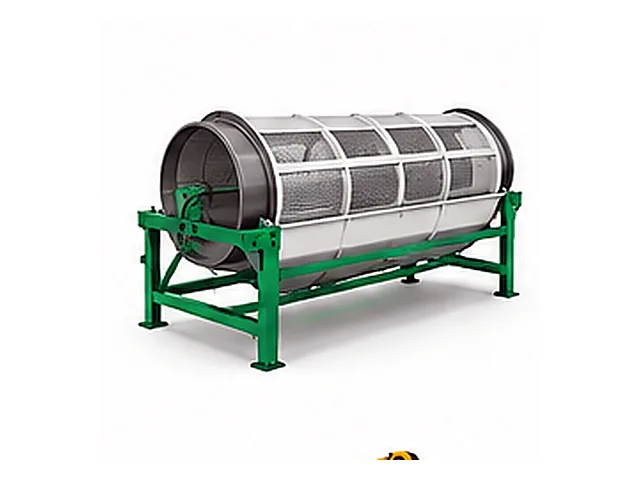
The Cylindrical Screening Seed Graders CS 300/500/700 classify seed and grain by width or thickness inside rotating perforated drums that gently tumble every kernel against precision apertures. Because rotary screening continually turns seeds on end and along their axis without harsh reciprocating shock, the CS 300/500/700 series achieves sharp dimensional calibration on hybrid maize, sunflower, pulses, and cereal seeds.

Machines ↗

Overview

Material enters the head of the rotating cylinder and travels helically toward the discharge end as drum rotation lifts and rolls the seed bed against interchangeable perforated shells. Undersized particles drop through the initial screen section, prime calibrated fractions pass through subsequent aperture zones, and oversized kernels exit from the tail of the cylinder while external driven brushes keep every hole clear.

Technical Specifications

Technical ParameterCSS-03CSS-06CSS-10CSS-15
Seed & Grain Processing Capacity2 – 4 t/h5 – 7 t/h8 – 11 t/h12 – 15 t/h
Cylinder / Drum Diameter600 mm700 mm800 mm900 mm
Effective Cylinder Length2,000 mm2,500 mm3,000 mm3,000 mm (Dual Unit)
Drive Motor Power1.1 kW1.5 kW2.2 kW3.0 kW
Drum Speed Range (VFD)28 – 42 rpm26 – 40 rpm24 – 38 rpm22 – 36 rpm

The capacity and power ranges indicated in the table may vary depending on the crop type to be processed, initial foreign matter rate, moisture level, and machine configuration. Exact performance and actual measurement values are finalized following the engineering design and process detailing of the plant to be installed.

Selection and integration

Choosing between the CS 300, CS 500, and CS 700 models depends on hourly seed volume, the number of sequential screen compartments required along the drum axis, and how closely the target width and thickness grades sit together. Variable drum rotational speed and adjustable cylinder slope let operators control residence time so every kernel has ample opportunity to present itself to the screen openings.

Key points to specify

  • Confirm the crop, variety and incoming condition for Cylindrical Screening Seed Graders CS 300/500/700.
  • The maintenance note for the “Cylindrical Screening Seed Graders CS” unit should identify inspection and cleaning access at the installed position; keep incoming impurity mix, feed uniformity, screen choice and the required outlet tied to the next process step.

  • Use a product sample to set the acceptance target for the “Cylindrical Screening Seed Graders CS” unit; factors to review: incoming impurity mix, feed uniformity, screen choice and the required outlet.
  • The line drawing for the “Cylindrical Screening Seed Graders CS” unit should identify product transfer, service space and interfaces with upstream and downstream equipment; keep incoming impurity mix, feed uniformity, screen choice and the required outlet tied to the next process step.
GUIDE · TECHNICAL SELECTION

What is this machine used for?

Cylindrical Screening Seed Graders CS 300/500/700 provide rotary dimensional sizing for seed conditioning plants where flat vibrating sieves struggle to upend elongated or flat kernels. By rolling the crop continuously over curved round or slotted perforations, the rotating reel delivers accurate width and thickness separation with minimal noise and structural vibration.

01

The role in the process

In a seed conditioning line, the rotary grader typically follows primary air-screen cleaning to divide bulk seed into narrow flat and round thickness or width fractions. Uniformly sized fractions emerging from the cylinder ensure that planter plates singulate seeds accurately in the field and that downstream gravity separators operate on particles of equal aerodynamic drag.

Each cylindrical compartment along the CS 300/500/700 reel can be fitted with a distinct aperture size or shape, enabling multi-grade splitting or combined scalping and sifting in a single machine footprint. Gentle tumbling action avoids impact cracking on dry pulses, large-seeded legumes, and delicate hybrid seed lots. Cleanout doors simplify variety changeovers.

02

Material and application suitability

Hybrid corn, confectionery sunflower, soybeans, peas, and cereal seeds often contain mixed flat and round kernels that require presentation at multiple angles to pass through a calibration slot. As the cylindrical shell turns, seeds slide and roll across the curved inner wall, naturally aligning their narrowest cross-section with slotted apertures or tipping endwise into round holes.

Grading sharpness on the CS 300/500/700 series is governed by three operator variables: perforated shell aperture geometry, drum rotational speed, and longitudinal tilt angle. Running the drum too fast centrifugally pins kernels against the wall, whereas optimal speed produces a cascading kidney-shaped bed that maximizes contact with the open perforations.

03

Selection checklist

Before finalizing a CS 300, CS 500, or CS 700 specification, define the exact millimeter cut-points for each fraction, confirm whether round or oblong shells are needed per compartment, and verify floor loading and chute routing to downstream bins. Sample trials on actual harvest lots establish the ideal drum speed and brush contact pressure.

Define round-hole or slotted aperture steps, cylinder pocket geometry, and rotational speed according to calibration tolerances. Select self-cleaning brush or ball mechanisms, quick-lock sieve cassettes, and sampling ports for fast lot transitions. Trial grading runs on representative kernel distributions verify fraction yield and dimensional uniformity. All contact zones support fast inspection.

Integration into a processing line

Plant layout and interface planning

Because the rotating drum generates virtually no reciprocating dynamic forces, the Cylindrical Screening Seed Graders CS 300/500/700 can be mounted on elevated steel mezzanines above storage silos or gravity tables without heavy vibration isolation. Layout planning should provide unobstructed side swing clearance so operators can unbolt and swap curved screen segments.

During setup, operators adjust the inlet feed gate to maintain a steady fill level inside the first cylinder ring and tune the variable-speed drive until kernels cascade smoothly up the rising side of the drum. Each discharge hopper is sampled simultaneously to confirm clean cut-points between small, medium, and large seed calibers.

Factors that affect operating performance

Full-length rotating brush rollers mounted along the outside of the cylinder press bristles through the perforations from the clean side, pushing wedged seeds back into the drum interior on every revolution. This positive external brushing prevents progressive aperture blinding even when sizing irregular or slightly rough-coated seeds.

Process quality and line integration

Delivering tightly calibrated size fractions from the CS 300/500/700 directly improves the accuracy of subsequent seed treatment, pelleting, and precision packaging. Segmented shell construction also allows rapid thorough compressed-air and brush-down cleaning when certified seed plants switch between registered varieties.

Frequently asked questions

How many size fractions can the Cylindrical Screening Seed Graders CS 300/500/700 produce?

Each screen ring along the rotating drum discharges into its own bottom hopper while oversized material exits the tail end, allowing the machine to split incoming seed into multiple calibrated through-fractions plus an overtail fraction.

Why is a rotating cylindrical screen preferred over flat sieves for thickness grading?

The curved tumbling motion inside the revolving cylinder continually rolls and upends kernels so flat seeds turn on edge and slide through slotted apertures, achieving higher accuracy than flat horizontal oscillation.

How are wedged seeds cleared from the cylindrical drum perforations?

External full-length cylindrical brushes rotate continuously against the outside of the perforated drum, gently pushing any lodged kernels back into the tumbling seed stream without damaging the seed coat.

REQUEST A TECHNICAL REVIEW

Cylindrical Screening Seed Graders CS 300/500/700

Contact our process engineers with your crop varieties, target caliber cut-points, and hourly capacity needs to select the right CS 300, CS 500, or CS 700 cylindrical grader and perforated shell set.