Home›Machines›Fluid Bed Air Cooler
Fluid Bed Air Cooler
MACHINERY CATALOGUE

Fluid Bed Air Cooler

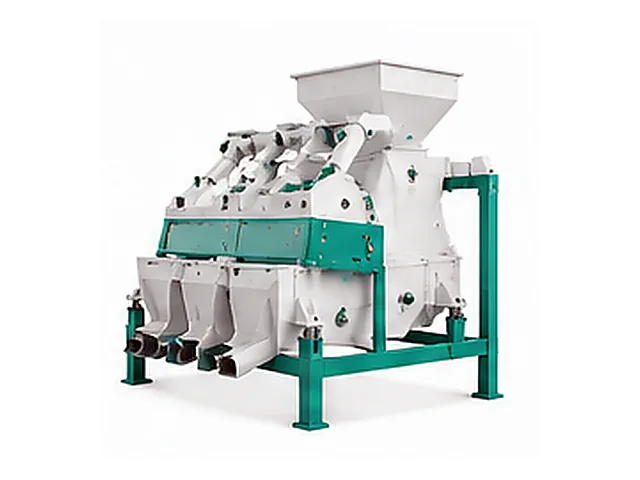
The Fluid Bed Air Cooler rapidly lowers the temperature of hot seeds, grains, roasted oilseeds, and parboiled bulgur by suspending the moving product layer on an upward cushion of ambient or conditioned air. Immediate thermal stabilization after drying or roasting halts residual moisture migration, prevents storage condensation, and locks in kernel colour and aroma.

Machines ↗

Overview

Hot product enters the Fluid Bed Air Cooler through a spreader transition and forms a uniform permeable bed across a perforated or wedge-wire distribution deck. High-efficiency centrifugal fans force cooling air through the lower plenum and upward through the deck apertures, fluidizing the kernels for intimate convective heat transfer before a discharge weir releases the cooled stream.

Technical Specifications

Technical ParameterFBA-25FBA-50FBA-100FBA-150
Drying / Cooling / Processing Capacity10 – 25 t/h30 – 50 t/h60 – 100 t/h110 – 150 t/h
Drive & Fan Motor Power1.5 – 4.0 kW5.5 – 7.5 kW11.0 – 15.0 kW15.0 – 18.5 kW
Operating Temperature Control (PID)35 – 110 °C (Seed ≤ 42 °C)35 – 110 °C (Seed ≤ 42 °C)35 – 110 °C (Seed ≤ 42 °C)35 – 110 °C (Seed ≤ 42 °C)
Active Airflow Volume8,000 m³/h18,000 m³/h32,000 m³/h48,000 m³/h

The capacity and power ranges indicated in the table may vary depending on the crop type to be processed, initial foreign matter rate, moisture level, and machine configuration. Exact performance and actual measurement values are finalized following the engineering design and process detailing of the plant to be installed.

Selection and integration

Engineering a Fluid Bed Air Cooler requires matching air velocity to the terminal settling velocity of the specific grain or seed, alongside calculating sensible heat load from inlet temperature down to safe storage temperature. Adjustable weir plates at the discharge end regulate bed thickness so light sesame seeds and heavy corn kernels alike fluidize without blow-out.

Key points to specify

  • Confirm the crop, variety and incoming condition for Fluid Bed Air Cooler.
  • Define the target output and the acceptance criteria for the fluid-bed cooling stage.
  • The fit of the “Fluid Bed Air Cooler” unit should be checked on a representative sample, with heat or air services, target condition, initial product condition and residence needs matched to the planned line duty.
  • The line drawing for the “Fluid Bed Air Cooler” unit should identify product transfer, service space and interfaces with upstream and downstream equipment; align heat or air services, target condition, initial product condition and residence needs with the agreed output criterion.

GUIDE · TECHNICAL SELECTION

What is this machine used for?

A Fluid Bed Air Cooler extracts sensible heat from thermally processed grain, seed, bulgur, and roasted sesame by floating the product stream on a turbulent upward airflow. Fast, uniform cooling stops post-process over-roasting, prevents silo sweating, and prepares free-flowing product for immediate milling or packaging.

01

The role in the process

Positioned directly at the discharge of a thermal dryer, cooking tower, or seed roaster, the Fluid Bed Air Cooler acts as the thermal brake of the processing line. If hot grain or roasted sesame is conveyed straight into storage bins or plastic big-bags without cooling, trapped heat drives vapour condensation on bin walls and causes caking or rancidity.

Because every individual kernel is surrounded by moving air inside the fluidized layer, heat extraction finishes far more rapidly than in static tempering bins. Once product temperature drops within a narrow margin of ambient air, the cooled stream discharges continuously to downstream polishers, graders, or packing scales.

02

Material and application suitability

Cooked and dried bulgur, roasted sesame seeds, thermally dried hybrid seeds, pulses, oilseeds, and specialty grains all benefit from non-mechanical pneumatic suspension during cooling. Gentle vibratory or aerodynamic transport across the smooth perforated deck prevents kernel cracking when pericarps are warm and brittle.

Ambient relative humidity and seasonal air temperature determine the lowest achievable outlet product temperature when using untreated outside air. Where summer humidity or strict cold-packing specs demand lower outlet temperatures, the intake plenum can be paired with chilled-water coils or conditioned plant air. All contact zones support fast inspection.

03

Selection checklist

To size a Fluid Bed Air Cooler accurately, define the incoming product temperature, target outlet temperature, hourly mass flow rate, bulk density, and kernel size distribution. Confirm dust collection requirements on the exhaust air stream, as fluidization lifts loose chaff and brittle hull fragments out of the product bed.

Calculate burner thermal output, drying air volume, and bed retention time from initial harvest moisture and maximum safe kernel temperature. Psychrometric commissioning checks verify uniform moisture reduction and preserve seed germination vigor. Uniform airflow distribution across the grain column prevents localized overheating and stress cracking.

Integration into a processing line

Plant layout and interface planning

Install the Fluid Bed Air Cooler close to the outlet of the upstream dryer or roaster so hot material transfers by short gravity chute without losing heat into indoor work areas. Route the supply fan intake to a clean, shaded outdoor air source away from boiler stacks or dusty receiving pits.

Connect the tapered upper exhaust hood via smooth sheet-metal ducting to a cyclone collector or bag filter before venting warm air outdoors. Provide walk-around clearance on both sides of the trough so maintenance crews can unlatch inspection doors and slide out perforated deck panels.

Factors that affect operating performance

Maintaining an even bed depth across the full width of the perforated plate is vital: bare spots allow cooling air to short-circuit through the path of least resistance, leaving thicker product zones warm. Differential pressure sensors across the deck alert operators or automatically adjust fan dampers if bed resistance shifts.

Process quality and line integration

In addition to thermal stabilization, upward air fluidization performs a secondary dedusting function by stripping loose skin fragments and micro-fines into the overhead exhaust hood. The resulting cooled stream arrives at downstream optical sorters or packaging hoppers clean, dry, and dimensionally stable.

Frequently asked questions

Why is immediate fluid-bed cooling necessary after grain drying or seed roasting?

Hot kernels leaving a dryer or roaster continue to undergo internal chemical reactions and release water vapour as they sit. Rapid fluid-bed cooling arrests thermal colour drift in roasted seeds and prevents moisture from condensing inside downstream silos or sealed packaging bags.

How is airflow adjusted to prevent blowing light seeds into the exhaust hood?

Variable-frequency fan drives and modulating plenum dampers let operators set the upward air velocity just above the minimum fluidization point of the specific crop. Expanded freeboard geometry in the upper hood slows the air stream before the exhaust duct so suspended kernels drop back onto the deck.

How are fine particles that fall through the perforated cooling deck removed?

The lower air distribution plenum is equipped with sloped collection hoppers and quick-open cleanout drawers along the side of the machine frame. Operators can empty sifted dust and broken husks during routine shift checks without disassembling the upper fluidizing deck.

REQUEST A TECHNICAL REVIEW

Fluid Bed Air Cooler

Share your product type, incoming and target temperatures, hourly tonnage, and ambient site conditions with our engineers to specify the right Fluid Bed Air Cooler.