Home›Machines›Fluid Bed Dryer for Seeds & Grain
Fluid Bed Dryer for Seeds & Grain
MACHINERY CATALOGUE

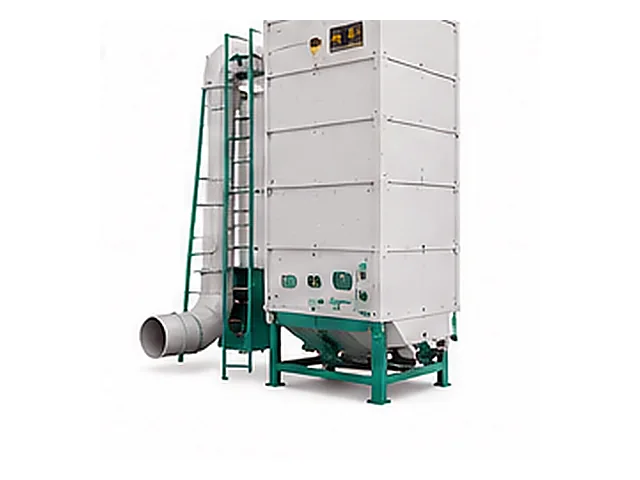
Fluid Bed Dryer for Seeds & Grain

The Fluid Bed Dryer for Seeds & Grain removes surface and internal moisture rapidly by floating wet kernels on a precisely heated upward air stream across a perforated deck. High convective heat-and-mass transfer coefficients ensure every suspended seed experiences identical thermal exposure without hot spots or mechanical augering damage.

Machines ↗

Overview

Wet grain, parboiled bulgur, or freshly coated seed enters the Fluid Bed Dryer for Seeds & Grain through a rotary airlock or vibratory spreader that establishes a level product layer over the distribution plate. Heated air from the burner or steam heat exchanger passes through the sub-deck plenum to fluidize the bed, evaporating moisture into the exhaust hood while product advances steadily toward the discharge weir.

Technical Specifications

Technical ParameterFBD-25FBD-50FBD-100FBD-150
Drying / Cooling / Processing Capacity10 – 25 t/h30 – 50 t/h60 – 100 t/h110 – 150 t/h
Drive & Fan Motor Power1.5 – 4.0 kW5.5 – 7.5 kW11.0 – 15.0 kW15.0 – 18.5 kW
Operating Temperature Control (PID)35 – 110 °C (Seed ≤ 42 °C)35 – 110 °C (Seed ≤ 42 °C)35 – 110 °C (Seed ≤ 42 °C)35 – 110 °C (Seed ≤ 42 °C)
Active Airflow Volume8,000 m³/h18,000 m³/h32,000 m³/h48,000 m³/h

The capacity and power ranges indicated in the table may vary depending on the crop type to be processed, initial foreign matter rate, moisture level, and machine configuration. Exact performance and actual measurement values are finalized following the engineering design and process detailing of the plant to be installed.

Selection and integration

Selecting a Fluid Bed Dryer for Seeds & Grain requires matching thermal input, bed residence time, and air velocity to the moisture diffusion rate of the kernel. While free surface water on washed grain or film-coated seeds evaporates in seconds, bound internal moisture in parboiled bulgur or high-moisture harvest grain requires staged temperature zones.

Key points to specify

  • Confirm the crop, variety and incoming condition for Fluid Bed Dryer for Seeds & Grain.
  • Use a product trial to define where the “Fluid Bed Dryer for Seeds & Grain” unit fits; record target condition, heat or air services, residence needs and initial product condition and the output expected by the following stage.
  • Agree the crop condition and target for the “Fluid Bed Dryer for Seeds & Grain” unit before installation, then verify target condition, heat or air services, residence needs and initial product condition against the actual sample.
  • Request written connection and maintenance details for the “Fluid Bed Dryer for Seeds & Grain” unit, then check them against the site layout and cleaning access; include target condition, heat or air services, residence needs and initial product condition in the selection record.

GUIDE · TECHNICAL SELECTION

What is this machine used for?

A Fluid Bed Dryer for Seeds & Grain uses upward-flowing heated air to suspend and dry cereal grains, pulses, cooked bulgur, and coated seeds in a continuous, thoroughly mixed layer. Because kernels float on an air cushion rather than sliding against hot metal walls, moisture reduction is fast, even, and gentle.

01

The role in the process

In continuous processing plants—such as industrial bulgur lines, wet-washed sesame plants, or film-coated seed facilities—the Fluid Bed Dryer for Seeds & Grain provides inline moisture removal without batch bottlenecks. Its short, controllable residence time bridges wet preparation stages directly with dry tempering, milling, or packaging.

By dividing the under-deck plenum into independent thermal zones, operators can apply higher air temperatures at the wet inlet where evaporative cooling keeps kernel temperature low, followed by milder air in the finishing zone and ambient air in the discharge cooling section.

02

Material and application suitability

Parboiled wheat for bulgur, washed pulses, coated or encrusted planting seeds, oilseeds, and free-flowing cereal grains fluidize smoothly when particle size is reasonably uniform. For reproductive planting seeds, indirect heat exchangers and strict bed-temperature caps protect embryo viability while stripping excess coating moisture.

Inlet moisture percentage, ambient air humidity, and kernel pericarp permeability dictate the maximum safe drying rate without inducing case-hardening or surface fissures. Commissioning tests establish the weir height, vibratory transport speed, and zone damper positions that hit target outlet moisture cleanly.

03

Selection checklist

When specifying a Fluid Bed Dryer for Seeds & Grain, document initial and target moisture percentages, hourly wet intake tonnage, maximum permissible kernel temperature, and preferred heating fuel or steam pressure. Verify whether an integrated cooling zone on the same deck or a separate downstream cooler best fits your building layout.

Psychrometric commissioning checks verify uniform moisture reduction and preserve seed germination vigor. Uniform airflow distribution across the grain column prevents localized overheating and stress cracking. Cleanout doors simplify variety changeovers. Air and feed controls lock repeatably.

Integration into a processing line

Plant layout and interface planning

Arrange the Fluid Bed Dryer for Seeds & Grain in a ventilated hall with straight gravity feed from the wet surge hopper, cooking tower, or seed coater so wet material cannot bridge in long chutes. Locate the burner or steam heat exchanger skid with clear service space for tube bundle inspection and filter maintenance.

Insulate all hot-air supply ducts and upper exhaust hoods to minimize radiant heat load inside the plant and prevent moisture condensation on internal hood ceilings. Route moisture-laden exhaust air through high-efficiency stainless cyclones to capture entrained chaff before discharging outside.

Factors that affect operating performance

Consistent feed spreading across the inlet width is essential so the fluidized bed maintains uniform static pressure from side to side. Automated modulating dampers linked to bed differential-pressure transmitters compensate for minor feed fluctuations and prevent air channelling.

Process quality and line integration

Continuous inline moisture and temperature monitoring at the discharge weir allows the PLC to trim burner output or adjust deck residence time automatically. Smooth stainless-steel interior surfaces and under-deck cleanout doors ensure zero wet-product accumulation between production runs.

Frequently asked questions

Why does fluid-bed drying achieve faster and more uniform moisture removal than static beds?

In a fluidized bed, upward air velocity suspends and gently agitates every kernel so warm air contacts the entire surface area of each seed simultaneously. Constant vertical mixing eliminates the wet top layers and over-dried bottom layers common in stationary bin dryers.

How is kernel overheating prevented when drying heat-sensitive seeds?

Multi-zone temperature sensors monitor both the incoming plenum air and the actual suspended seed bed, modulating burner or steam valves via fast PID loops. As evaporative cooling diminishes toward the dry end of the deck, subsequent plenum zones operate at lower temperatures to keep kernels safely below biological damage limits.

Can the dryer handle wet parboiled bulgur or freshly coated seeds without sticking?

Yes, a vibratory deck drive combined with higher air velocity in the primary inlet zone agitates wet kernels immediately upon entry so they cannot mat together on the perforated plate. Within moments, surface moisture flashes off and the grain flows freely down the remainder of the drying bed.

REQUEST A TECHNICAL REVIEW

Fluid Bed Dryer for Seeds & Grain

Provide your crop type, initial and final moisture targets, hourly capacity, and available heating utility so our engineers can size your Fluid Bed Dryer for Seeds & Grain.