Overview
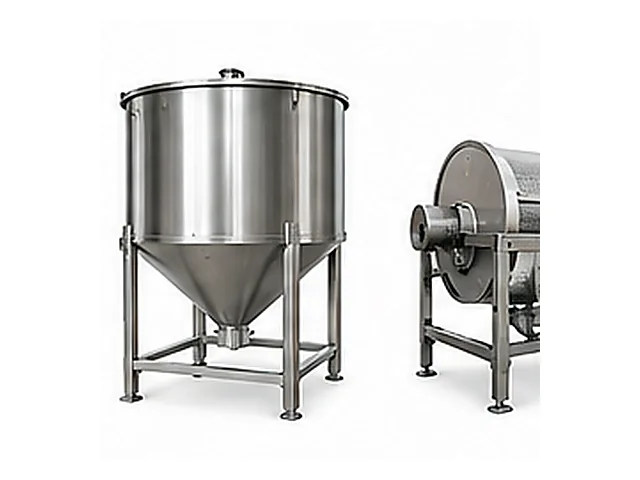
A Hopper Scale assembly consists of three vertically stacked chambers: an upper inlet garner bin that buffers incoming continuous flow, a middle weigh hopper supported on precision load cells, and a lower discharge surge hopper that feeds downstream conveyors smoothly. During operation, the upper feed gate opens to fill the weigh vessel to its preset batch weight, closes to allow a brief static settling reading, and records the exact mass. The bottom clam-shell or slide gate then dumps the weighed charge rapidly into the lower garner, recloses, records the empty tare weight, and immediately initiates the next weighing cycle.
Technical Specifications
The capacity and power ranges indicated in the table may vary depending on the crop type to be processed, initial foreign matter rate, moisture level, and machine configuration. Exact performance and actual measurement values are finalized following the engineering design and process detailing of the plant to be installed.
Selection and integration
Selecting a Hopper Scale is the preferred engineering choice whenever custody-transfer accuracy, silo inventory auditing, or exact process-line yield accounting is required on free-flowing bulk commodities. Because every draft is weighed at rest on calibrated load cells and automatically re-tared after discharge, accuracy remains unaffected by belt tracking, material temperature, or dust buildup.
Key points to specify
- Confirm the crop, variety and incoming condition for Hopper Scale.
- Define the target output and the acceptance criteria for the bulk material transfer stage.
- Use a product trial to define where the “Hopper Scale” unit fits; record target weight, discharge arrangement, package format and product flow and the output expected by the following stage.
- Show the infeed, discharge, transfer points and service clearances for the “Hopper Scale” unit on the plant layout; ensure target weight, discharge arrangement, package format and product flow appear in the technical acceptance note.