Home›Machines›Weighing Belt Conveyor
Weighing Belt Conveyor
MACHINERY CATALOGUE

Weighing Belt Conveyor

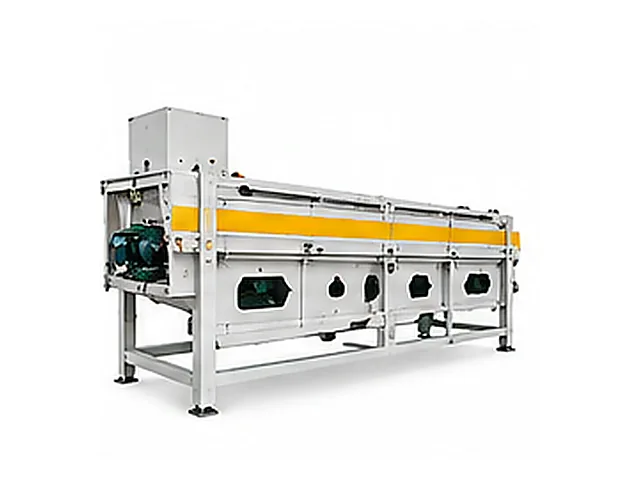
The Weighing Belt Conveyor measures continuous mass flow rate and cumulative tonnage while gently transporting bulk seed, grain, pulses, or agricultural substrates along a horizontal or slightly inclined belt path. By combining a precision load-cell weighbridge section with a digital belt-speed encoder, the unit functions either as an inline throughput totalizer or as a variable-speed gravimetric weigh-belt feeder.

Machines ↗

Overview

Inside a Weighing Belt Conveyor, product enters through a profiled inlet skirt onto an endless synthetic or rubber conveyor belt traveling over precision-aligned idler rollers. A dedicated floating weigh-span frame situated along the conveyor carries one or more weighing idlers supported on high-sensitivity shear-beam or single-point load cells that measure instantaneous mass per unit belt length. Simultaneously, a shaft encoder coupled to a non-driven pulley tracks exact linear belt velocity, allowing the integrating processor to multiply belt loading by belt speed continuously to compute real-time mass flow and totalized weight.

Technical Specifications

Technical ParameterWBC-25WBC-50WBC-100WBC-150
Filling / Weighing Capacity10 – 25 t/h30 – 50 t/h60 – 100 t/h110 – 150 t/h
Bagging Output (10 – 50 kg Bags)150 – 240 bags/hour250 – 360 bags/hour380 – 480 bags/hour500 – 600 bags/hour
Drive Motor Power1.5 kW4.0 kW11.0 kW18.5 kW
Weighing Accuracy (Load Cell)± 0.1% – 0.2%± 0.1% – 0.2%± 0.1% – 0.2%± 0.1% – 0.2%
Compressed Air Supply0.5 – 0.6 MPa0.5 – 0.6 MPa0.6 – 0.7 MPa0.6 – 0.7 MPa

The capacity and power ranges indicated in the table may vary depending on the crop type to be processed, initial foreign matter rate, moisture level, and machine configuration. Exact performance and actual measurement values are finalized following the engineering design and process detailing of the plant to be installed.

Selection and integration

Selecting a Weighing Belt Conveyor is particularly advantageous when headroom is too low for a tall vertical Hopper Scale or when fragile seeds, pulses, or moist substrates require continuous, zero-impact horizontal metering. When equipped with a variable-frequency drive and shear gate, the conveyor actively regulates its belt speed in closed loop to hold a constant tonnes-per-hour feed rate into downstream cleaners or mixers.

Key points to specify

  • Confirm the crop, variety and incoming condition for Weighing Belt Conveyor.
  • For the “Weighing Belt Conveyor” unit, check the operating choices against these factors: discharge arrangement, package format, target weight and product flow.
  • When setting up the “Weighing Belt Conveyor” unit, record discharge arrangement, package format, target weight and product flow and assess both accepted output and unwanted product loss during the sample trial.
  • Request written connection and maintenance details for the “Weighing Belt Conveyor” unit, then check them against the site layout and cleaning access; include discharge arrangement, package format, target weight and product flow in the selection record.

GUIDE · TECHNICAL SELECTION

What is this machine used for?

Engineered for gentle continuous transport and in-motion gravimetric measurement, the Weighing Belt Conveyor weighs bulk agricultural material on the move without interrupting line flow. Whether used for silo extraction dosing, proportional multi-variety seed blending, or continuous process yield monitoring, it delivers steady feeding and reliable mass totalization.

01

The role in the process

Placed beneath holding bins or ahead of continuous seed treaters, cleaners, or blending lines, the Weighing Belt Conveyor acts as both a gentle extractor and an accurate flow meter. In proportional blending systems, multiple weigh-belt conveyors situated under separate variety silos lock their mass flow rates to a master recipe ratio in the central PLC.

Unlike volumetric screw or rotary feeders whose mass output drifts whenever bulk density or moisture changes, a closed-loop gravimetric Weighing Belt Conveyor senses actual belt loading and adjusts belt speed automatically. This guarantees that downstream gravity tables, optical sorters, or liquid chemical dosing pumps receive an unwavering mass flow per minute.

02

Material and application suitability

Large-seeded legumes (beans, peas, chickpeas, soybeans), hybrid corn, delinted or coated cottonseed, and fragile oilseeds suffer zero sliding friction on a flat or troughed Weighing Belt Conveyor. Because the kernels ride passively atop the moving belt from inlet skirt to head pulley, mechanical crackage and seed-coat loss are virtually eliminated.

Fibrous, cohesive, or damp materials—such as kibbled pods, herbal botanicals, or peat and substrate mixtures—also move reliably on a belt weigher where hopper scales might bridge or hang up. Adjustable polyurethane skirtboards at the loading zone form a uniform ribbon profile across the belt width without pinching kernels. Cleanout doors simplify variety changeovers.

03

Selection checklist

To specify a Weighing Belt Conveyor, define the minimum and maximum mass flow rate, material bulk density and repose angle, particle size, required conveyor center-to-center length, and whether constant-speed monitoring or VFD closed-loop dosing is needed. Confirm whether an open frame or fully enclosed dust-hooded housing is required.

Confirm surge bin capacity above the scale, bag clamp ergonomics, and sewing or sealing conveyor elevation. Include coarse-and-fine dribble feed control, dust extraction collars, and checkweigher feedback for certified weight accuracy. Dry-cycle and live material calibration runs verify repeatability across the full package weight range. All contact zones support fast inspection.

Integration into a processing line

Plant layout and interface planning

For optimal belt-scale accuracy, install the Weighing Belt Conveyor on a rigid, vibration-free structural support at a horizontal or shallow incline angle so product never rolls backward over the weigh span. The inlet feed chute should deposit material centrally onto the belt well ahead of the weighbridge idlers so vertical impact forces dissipate before the product crosses the load cells.

Gravity or precision spring-loaded belt tensioning maintains constant belt tension across ambient temperature shifts, preventing belt-stretch errors from skewing the load-cell reading. A dedicated tail-pulley tachometer rather than a drive-motor estimate ensures true belt travel measurement even if minor drive-pulley slip occurs.

Factors that affect operating performance

Metrological repeatability depends on keeping the weighbridge idlers coplanar with the adjacent approach and retreat idlers and performing periodic empty-belt zero calibrations. The digital integrator stores the full-revolution tare profile of the splice and belt carcass so belt thickness variations are subtracted out automatically.

Process quality and line integration

Analog current outputs, pulse totalizer relays, and industrial Ethernet/Modbus links transmit live tonnes-per-hour flow rate and accumulated batch totals directly to the plant SCADA or chemical treater pump controller. Zero-speed and belt-wander switches protect the belt edges and halt upstream bin gates if a mechanical jam occurs.

Frequently asked questions

How does a Weighing Belt Conveyor compensate for changes in product bulk density?

As product passes through the adjustable inlet profile gate, the load cells beneath the weighbridge idlers measure the actual weight of material resting on that section of the belt. If bulk density drops, the integrator detects the lighter belt loading immediately and—in closed-loop feeder mode—increases VFD belt speed proportionally to maintain the exact target mass flow rate.

Why is the speed encoder mounted on a non-driven pulley rather than the drive motor?

Measuring rotation on the tail or snub pulley captures the true linear travel of the conveyor belt itself. If the encoder were mounted on the drive motor or head pulley, any slight belt slippage under heavy load would cause the integrator to over-report both speed and totalized tonnage.

How is the Weighing Belt Conveyor calibrated and verified on site?

First, an automated empty-belt zero cycle runs the belt for several complete revolutions to cancel out belt splice and idler tare variations. Second, span calibration is verified either by hanging certified static calibration weights on the weighbridge frame or by running a material test batch into a reference check scale.

REQUEST A TECHNICAL REVIEW

Weighing Belt Conveyor

Share your crop list, bulk density range, target hourly mass flow, and installation length so our engineers can configure a precision Weighing Belt Conveyor for your dosing or totalizing duty.