Home›Machines›Abrasive Roller Huller
Abrasive Roller Huller
MACHINERY CATALOGUE

Abrasive Roller Huller

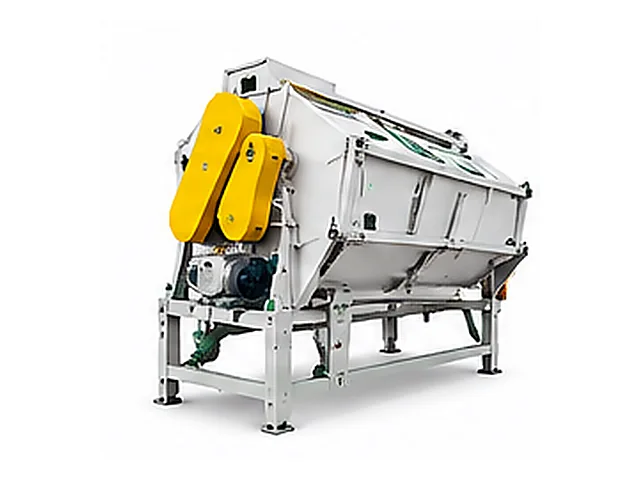
The Abrasive Roller Huller decorticates pulses, cereal grains, and specialty seeds by drawing the product stream through an annular gap between rotating carborundum stones and a perforated steel screen jacket. Because seed coat adherence and cotyledon brittleness shift significantly across lentil, pea, sorghum, and barley cultivars, operating parameters such as grit grade, shaft speed, and outlet retarding weight must be established through pilot testing on representative lots.

Machines ↗

Overview

Inside the decorticating barrel of the Abrasive Roller Huller, vitrified silicon-carbide rings mounted on a balanced shaft apply uniform tangential friction that strips away the fibrous outer pericarp while leaving the inner endosperm or split cotyledons intact. An adjustable back-pressure gate at the discharge spout governs residence time and fill density inside the working cylinder, while continuous negative-pressure aspiration draws detached bran powder through the slotted mantle before it can cushion the abrasive surfaces.

Technical Specifications

Technical ParameterARH-05ARH-10ARH-15ARH-25
Processing Capacity3 – 6 t/h7 – 12 t/h13 – 18 t/h19 – 25 t/h
Hulling / De-Awning / Conditioning Uniformity98.0% – 99.0% homogeneous processing98.5% – 99.2% homogeneous processing99.0% – 99.5% homogeneous processing99.2% – 99.5% homogeneous processing
Total Motor Power2.2 kW4.0 kW7.5 kW11.0 kW
Rotor / Drum Working Diameter400 mm500 mm600 mm750 mm
Aspiration / Husk Extraction Airflow2,500 m³/h4,200 m³/h6,000 m³/h8,500 m³/h

The capacity and power ranges indicated in the table may vary depending on the crop type to be processed, initial foreign matter rate, moisture level, and machine configuration. Exact performance and actual measurement values are finalized following the engineering design and process detailing of the plant to be installed.

Selection and integration

Specifying an Abrasive Roller Huller requires balancing target decortication degree against acceptable cotyledon breakage, Taking into account kernel moisture, seed coat thickness, and feed rate stability. Pre-installation bench trials on customer grain samples establish the optimal stone grit coarseness, screen slot width, and aspiration air volume required to achieve clean pearling or dehulling without excessive meal loss.

Key points to specify

  • Confirm the crop, variety and incoming condition for Abrasive Roller Huller.
  • Use a product sample to set the acceptance target for the “Abrasive Roller Huller” unit; factors to review: crop variety, acceptable kernel damage, hull structure and moisture.
  • Document the intended result for the “Abrasive Roller Huller” unit against actual feed and line conditions; review: crop variety, acceptable kernel damage, hull structure and moisture.
  • Request written connection and maintenance details for the “Abrasive Roller Huller” unit, then check them against the site layout and cleaning access; verify crop variety, acceptable kernel damage, hull structure and moisture for the intended crop and target.

GUIDE · TECHNICAL SELECTION

What is this machine used for?

An Abrasive Roller Huller mechanically peels the outer testa, hull, or bran layers from pulses, millets, sorghum, and barley by controlled surface abrasion inside a ventilated screen cylinder. Engineering layouts must account for steady gravity feeding above the inlet, sufficient floor space for rotor maintenance, and direct pneumatic take-off to convey abraded husk fines to a cyclone or baghouse filter.

01

The role in the process

Within a pulse splitting or grain pearling plant, the Abrasive Roller Huller sits downstream of stone and metal removal as well as moisture conditioning bins that loosen the seed coat from the cotyledon. Plant layouts must provide unobstructed side access around the hulling cylinder so technicians can gauge stone wear and verify screen aperture integrity during scheduled maintenance shifts.

Because abrasive decortication generates fine pericarp dust and frictional heat, the machine relies on a dedicated suction connection that cools the working zone and prevents sticky bran buildup on the screen slots. Electrical proposals separate the main rotor drive power from the auxiliary aspiration blower and rotary valve motors so site utility loads can be balanced accurately.

02

Material and application suitability

Suitability for abrasive decortication depends on whether the kernel possesses a sufficiently firm core to withstand surface rubbing while its outer husk is progressively abraded away. Crops such as red and yellow lentils, kabuli and desi chickpeas, yellow peas, pearl millet, sorghum, and hulless or hulled barley respond well when graded into uniform size fractions prior to entering the machine.

Variations in harvest moisture, tempering time, and testa adhesion directly alter both throughput and the percentage of broken or powdered kernels leaving the discharge weir. Running representative material through a test stand lets process engineers document the exact counter-weight setting and abrasive stone specification that satisfy downstream color sorting and packaging tolerances.

03

Selection checklist

Before finalizing procurement of an Abrasive Roller Huller, review the technical schedule to confirm drive kilowatt ratings, aspiration airflow volumes, replacement stone grit grades, and screen perforation geometries. Acceptance protocols should link measured decortication efficiency and maximum allowable kernel chipping directly to the conditioned feed sample agreed between plant engineering and the equipment manufacturer.

Calibrate rotor peripheral speed, working gap clearance, and screen or concave perforation to balance hulling efficiency against breakage. Sample test runs at target grain moisture establish the optimal feed rate and husk separation settings. Controlled aspiration immediately strips detached hulls and fines to prevent over-processing and heat buildup.

Integration into a processing line

Plant layout and interface planning

In a complete processing flowsheet, the Abrasive Roller Huller is positioned after pre-cleaning, destoning, and tempering, and immediately ahead of closed-circuit aspirators or plansifters that separate residual bran from polished kernels. Elevation drawings must preserve smooth gravity spouting angles at the discharge to avoid choking on warm, freshly peeled grain.

Maintaining a log of stone grit numbers, screen slot dimensions, and ammeter load readings during commissioning gives plant operators a repeatable baseline whenever switching between different pulse or cereal varieties. Routine service plans should also designate floor space around the housing doors for safe handling of heavy carborundum roll segments.

Factors that affect operating performance

Decortication consistency hinges on keeping the annular grinding chamber uniformly full via a regulated inlet slide gate and a properly weighted discharge flap. If incoming grain fluctuates in moisture or contains ungraded undersized seeds, residence time shifts and either leaves patches of unpeeled skin on small kernels or over-abrades larger grains.

Process quality and line integration

Integrating an ammeter-linked feed gate with the Abrasive Roller Huller ensures that motor load and chamber pressure remain steady even when upstream bin flow varies slightly. Clear access doors and quick-clamp screen frames further shorten cleanout intervals between batches, preventing cross-contamination in multi-crop pulse and cereal mills.

Frequently asked questions

Which grains and pulses are best suited for processing in an Abrasive Roller Huller?

This machine excels on spherical or oval seeds with tightly bound outer coats and firm endosperms or cotyledons, including lentils, peas, chickpeas, mung beans, sorghum, pearl millet, and barley destined for pearling. Pre-grading the incoming lot by thickness ensures every kernel experiences uniform contact against the carborundum rings.

How do operators minimize cotyledon breakage and flour loss during abrasive dehulling?

Breakage is controlled by matching the silicon-carbide grit coarseness to the crop, tempering the seed coat to optimal moisture, and fine-tuning the outlet back-pressure weight so kernels exit as soon as the hull is stripped. Continuous aspiration across the screen cage also cools the chamber and removes abrasive dust immediately.

What downstream separation stages should follow an Abrasive Roller Huller in the line?

Freshly decorticated product typically passes through an aspiration channel or air-recycling aspirator to lift off adhering bran dust, followed by a sifter or grader to separate whole kernels, splits, and fine meal. In commercial pulse plants, a polishing brush or optical sorter often completes the finishing sequence.

REQUEST A TECHNICAL REVIEW

Abrasive Roller Huller

To configure an Abrasive Roller Huller for your pulse splitting or grain pearling line, share your target crop varieties, incoming moisture range, desired hourly throughput, and maximum allowable breakage limits with our process engineering team. We can validate stone grit selection, screen perforation geometry, and aspiration requirements through sample testing and provide complete layout dimensions and utility specifications for your plant.