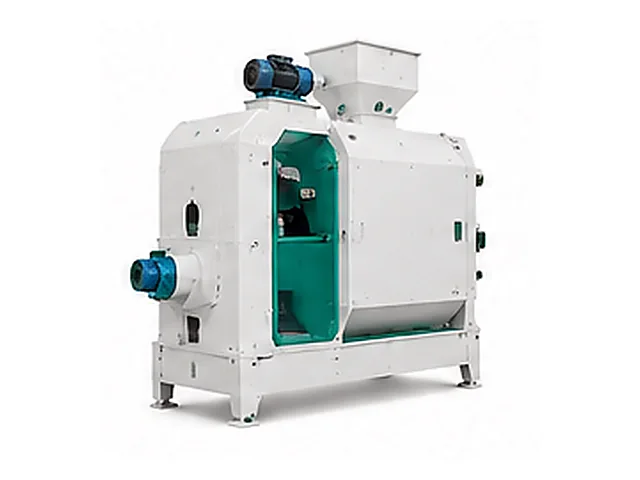
Overview
Product entering the central vertical feed tube of the Impact Dehuller drops onto a high-speed vaned rotor that flings individual seeds outward along guided channels at a controlled trajectory and velocity. Upon striking the angled hardened steel or elastomer baffle ring encircling the rotor, the brittle pericarp fractures cleanly so the mixed stream of free kernels and split hulls can exit downward into an aspiration and separating circuit.
Technical Specifications
The capacity and power ranges indicated in the table may vary depending on the crop type to be processed, initial foreign matter rate, moisture level, and machine configuration. Exact performance and actual measurement values are finalized following the engineering design and process detailing of the plant to be installed.
Selection and integration
Optimizing an Impact Dehuller hinges on matching impeller tip speed and target ring material to the kinetic energy threshold where the seed coat splits without shattering the internal kernel. Pre-installation test runs on graded customer seed fractions establish the exact inverter frequency, feed rate, and moisture window required to maximize whole-kernel turnout.
Key points to specify
- Confirm the crop, variety and incoming condition for Impact Dehuller.
- For the “Impact Dehuller” unit, check the operating choices against these factors: acceptable kernel damage, crop variety, hull structure and moisture.
- When setting up the “Impact Dehuller” unit, record acceptable kernel damage, crop variety, hull structure and moisture and assess both accepted output and unwanted product loss during the sample trial.
- Place the “Impact Dehuller” unit in the line drawing with its handoff elevations and cleaning access; record acceptable kernel damage, crop variety, hull structure and moisture against the intended product.