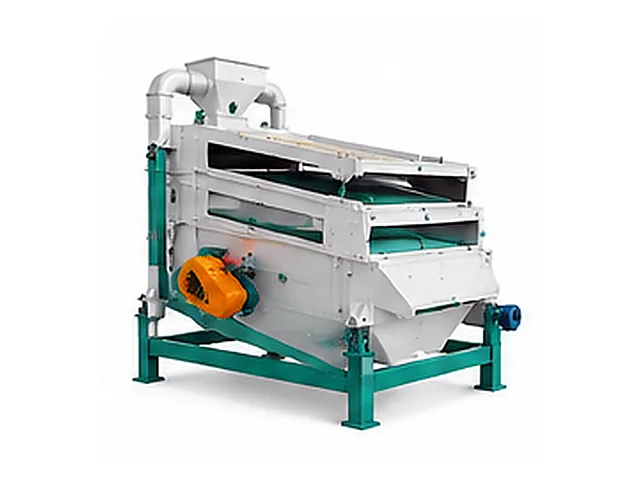
Overview
Within the cylindrical de-husking chamber of the Spelt Huller, incoming spikelets are drawn through a calibrated radial gap where resilient food-grade rubber beaters or friction rings roll the tough outer husks against a textured steel mantle. This shearing rub pops open the spikelet structure without shattering the soft endosperm, discharging a loose mixture of naked berries and detached glumes ready for external air-screen and gravity separation.
Technical Specifications
The capacity and power ranges indicated in the table may vary depending on the crop type to be processed, initial foreign matter rate, moisture level, and machine configuration. Exact performance and actual measurement values are finalized following the engineering design and process detailing of the plant to be installed.
Selection and integration
Specifying a dedicated Spelt Huller involves matching rotor peripheral velocity, rubber durometer hardness, and mantle aperture profile to the end use—whether producing viable sowing seed or de-husked berries for flour milling. Sample trials on actual harvest spikelets establish the exact gap and feed rate that detach stubborn glumes while keeping pericarp micro-fissures and broken berries within strict limits.
Key points to specify
- Confirm the crop, variety and incoming condition for Spelt Huller.
- Do not assume a standard setting for the “Spelt Huller” unit; test acceptable kernel damage, moisture, crop variety and hull structure on the intended material and document the accepted result in the technical offer.
- The fit of the “Spelt Huller” unit should be checked on a representative sample, with acceptable kernel damage, moisture, crop variety and hull structure matched to the planned line duty.
- Show the infeed, discharge, transfer points and service clearances for the “Spelt Huller” unit on the plant layout; evaluate acceptable kernel damage, moisture, crop variety and hull structure alongside the actual feed condition.