Home›Machines›Air Bag Filters
Air Bag Filters
MACHINERY CATALOGUE

Air Bag Filters

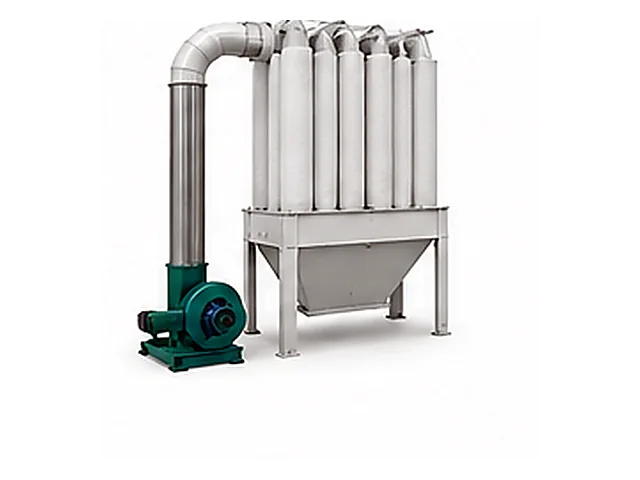
Air Bag Filters provide high-efficiency particulate capture for central aspiration trunks, cleaner exhausts, and mechanical conveying transfer hoods across seed and grain processing plants. By passing dust-laden air through arrays of permeable fabric filter sleeves, the housing traps fine husk fragments, soil dust, and seed coat fibres before discharging clean air. Properly sized filtration area keeps negative pressure stable at every connected hood and prevents fugitive dust from escaping into working areas.

Machines ↗

Overview

Inside the Air Bag Filters collector, incoming dusty air enters an expansion plenum where reduced velocity allows coarse hulls and heavy grit to drop directly into the collection hopper. Finer airborne particulates are arrested on the surface of vertically suspended needle-felt or woven filter bags supported by rigid internal wire cages. Periodic bag cleaning dislodges the accumulated dust cake into the lower trough or conical hopper, where a rotary airlock valve discharges the waste stream without breaking the system vacuum.

Technical Specifications

Technical ParameterABF-25ABF-50ABF-100ABF-150
Matched Line Processing Capacity10 – 25 t/h30 – 50 t/h60 – 100 t/h110 – 150 t/h
Airflow Volume Capacity3,000 – 7,500 m³/h8,000 – 16,000 m³/h18,000 – 30,000 m³/h32,000 – 45,000 m³/h
Fan / Drive Motor Power1.5 – 4.0 kW5.5 – 7.5 kW11.0 – 15.0 kW15.0 – 18.5 kW
Dust Separation Efficiency≥ 99.5%≥ 99.5%≥ 99.5%≥ 99.5%

The capacity and power ranges indicated in the table may vary depending on the crop type to be processed, initial foreign matter rate, moisture level, and machine configuration. Exact performance and actual measurement values are finalized following the engineering design and process detailing of the plant to be installed.

Selection and integration

Selecting an Air Bag Filters unit requires balancing total aspiration volume, air-to-cloth filtration velocity, inlet dust concentration, and particle size distribution. Fibrous chaff or sticky oilseed dust demands a more conservative filtration velocity than dry cereal dust to prevent premature blinding of the fabric pores. Engineers should also verify whether indoor recirculation or outdoor exhaust is planned so thermal losses and environmental emission limits are addressed together.

Key points to specify

  • Confirm the crop, variety and incoming condition for Air Bag Filters.
  • For the “Air Bag Filters” unit, check the operating choices against these factors: airflow demand, dust loading, duct route and filter service access.
  • When setting up the “Air Bag Filters” unit, record airflow demand, dust loading, duct route and filter service access and assess both accepted output and unwanted product loss during the sample trial.
  • Place the “Air Bag Filters” unit in the line drawing with its handoff elevations and cleaning access; record airflow demand, dust loading, duct route and filter service access against the intended product.

GUIDE · TECHNICAL SELECTION

What is this machine used for?

In grain intake, pre-cleaning, and seed conditioning facilities, Air Bag Filters serve as the primary barrier separating airborne dust from exhaust air streams. Positioned downstream of aspiration channels, screen cleaners, or primary cyclones, the baghouse captures fine suspended particles that would otherwise coat plant structures or violate workplace air quality standards. Maintaining consistent pressure drop across the filter sleeves ensures that upstream air separators receive steady, repeatable airflow for accurate density and aerodynamic sorting.

01

The role in the process

Whereas a primary cyclone removes coarse husks and heavy chaff by centrifugal force, Air Bag Filters capture the fine micrometer-scale dust fraction that remains entrained in the airstream. Without reliable fabric filtration, fine mineral and organic dust would pass through the exhaust fan and settle across electrical panels, optical sorters, and bagging stations.

Stable operation of every aspirated cleaner in the line depends on the baghouse maintaining a predictable static pressure drop throughout the production shift. If filter sleeves blind due to undersized cloth area or poor hopper evacuation, aspiration velocity drops at the grain cleaners and light impurities remain in the good seed.

02

Material and application suitability

Different crops generate vastly different dust profiles: barley and oats release prickly awns and fibrous trichomes, whereas maize, pulses, and oilseeds produce fine starch or oil-bearing particulates. Choosing the correct surface finish and pore density on the filter sleeves prevents fibrous particles from embedding permanently into the felt structure.

Ambient humidity and seed moisture content strongly influence how dust cake releases from the fabric bags during cleaning cycles. When damp harvest lots are aspirated, insulated hopper walls and hydrophobic filter media help prevent condensation and caking inside the lower collection cone. Cleanout doors simplify variety changeovers.

03

Selection checklist

Technical specifications for an Air Bag Filters package should define total cloth area, sleeve count, maximum allowable differential pressure, and rotary airlock capacity. Confirming hopper valley angles and explosion venting requirements early in layout planning avoids structural modifications during site erection.

Size airflow volume, static pressure drop, and filtration media area to maintain stable capture velocity across all suction points. Verify ductwork routing, rotary airlock discharge height, and compressed-air header requirements for pulse-jet cleaning. Adjustable airflow velocity and balanced static pressure accommodate varying dust loads and husk densities across crop runs.

Integration into a processing line

Plant layout and interface planning

Positioning the Air Bag Filters assembly near the main aspiration trunk minimizes horizontal duct runs where heavy dust could settle out and restrict airflow. Adequate vertical headroom above or beside the clean-air plenum must be reserved so maintenance technicians can withdraw full-length wire cages without hitting roof purlins.

Discharge hoppers beneath the baghouse require sufficient ground clearance to accommodate a rotary airlock valve, screw conveyor, or dust collection bin. Duct transitions entering the dirty-air chamber should be angled smoothly to distribute incoming dust across all bag rows rather than blasting the nearest sleeves with abrasive grit.

Factors that affect operating performance

Filtration performance hinges on maintaining an appropriate air-to-cloth ratio and ensuring the hopper empties continuously without bridging. Air leaks at the bottom rotary airlock or inspection doors allow upward false air to re-entrain settled fines, artificially inflating pressure drop and accelerating sleeve wear.

Process quality and line integration

Integrating differential pressure monitoring into the central plant control panel alerts operators before excessive dust cake restricts aspiration at the seed cleaners. Interlocking the baghouse discharge airlock and dust screw with the main exhaust fan prevents hopper overfilling during extended continuous runs.

Frequently asked questions

What types of agricultural dust are captured by Air Bag Filters?

Air Bag Filters trap fine mineral soil dust, broken seed coat particles, glume fibres, and powdery hull fragments exhausted from grain cleaners, elevators, and conveyors. When preceded by a primary cyclone, the fabric sleeves focus on arresting the finest suspended particulates that escape centrifugal separation.

How is the filtration area of Air Bag Filters determined for a processing line?

Engineers sum the required airflow volumes from all connected aspiration hoods and cleaners, then divide by a target air-to-cloth velocity suited to the crop dust profile. Light, fibrous, or slightly moist dust streams require a larger cloth surface area to keep differential pressure stable over long shifts.

What routine maintenance keeps Air Bag Filters operating at peak efficiency?

Operators should monitor the differential pressure gauge daily, verify that the bottom rotary airlock discharges freely without air bypass, and inspect sleeves periodically for abrasion or pinholes. Keeping door gaskets tight and replacing fatigued filter bags on schedule preserves suction across the entire aspiration network.

REQUEST A TECHNICAL REVIEW

Air Bag Filters

Share your aspiration layout, connected machine list, and crop dust characteristics with our engineering team to size the right Air Bag Filters configuration. We help match filter cloth area, hopper discharge hardware, and fan interfaces to your plant's exact airflow and environmental requirements.