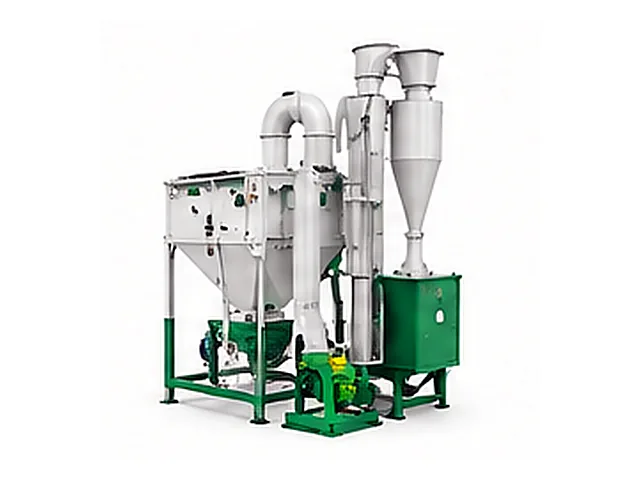
Overview
Dust-laden air enters the upper cylindrical barrel of the Cyclone tangentially, creating a high-speed downward spiral along the interior wall. Centrifugal force flings denser particles—such as seed coats, straw nodes, glumes, and coarse meal—outward against the shell while losing axial momentum down the long tapered cone. At the bottom apex, a rotary airlock valve or double-flap seal discharges the collected solids while the cleaned inner air vortex reverses direction and exits upward through the central vortex finder tube.
Technical Specifications
The capacity and power ranges indicated in the table may vary depending on the crop type to be processed, initial foreign matter rate, moisture level, and machine configuration. Exact performance and actual measurement values are finalized following the engineering design and process detailing of the plant to be installed.
Selection and integration
Engineering a Cyclone for seed and grain aspiration requires matching barrel diameter and cone length to the exact cubic airflow so inlet entry velocity stays within the optimal centrifugal window. If air velocity is too low, centrifugal force weakens and fine chaff escapes through the top vortex finder; if velocity is excessive, static pressure loss rises sharply and kernels or husks suffer abrasive attrition. Sealing the bottom discharge apex with a tight rotary airlock is mandatory because any upward air leakage destroys the lower vortex core and carries settled dust straight out the exhaust.
Key points to specify
- Confirm the crop, variety and incoming condition for Cyclone.
- Use a product trial to define where the “Cyclone” unit fits; record airflow demand, filter service access, dust loading and duct route and the output expected by the following stage.
- Agree the crop condition and target for the “Cyclone” unit before installation, then verify airflow demand, filter service access, dust loading and duct route against the actual sample.
- Show the infeed, discharge, transfer points and service clearances for the “Cyclone” unit on the plant layout; evaluate airflow demand, filter service access, dust loading and duct route alongside the actual feed condition.