Overview
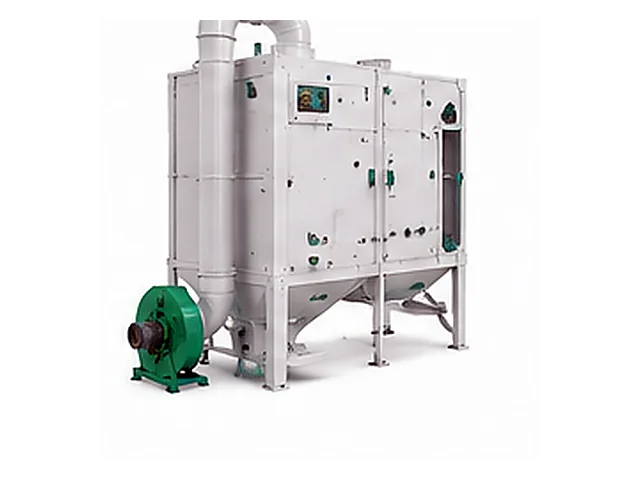
Incoming dusty air enters the Reverse Pulse Jet Air Filter housing through a baffled expansion zone or tangential pre-separation entry that drops coarse hulls directly into the lower hopper. Fine suspended dust collects on the outer surface of vertically suspended filter sleeves supported by rigid internal wire cages, while filtered air rises through venturi throats into the clean-air plenum. An electronic sequential timer or differential-pressure controller triggers fast-acting diaphragm valves on the compressed-air manifold, sending a shockwave through overhead blow tubes that flexes each bag row momentarily and drops the released dust cake through a rotary airlock.
Technical Specifications
The capacity and power ranges indicated in the table may vary depending on the crop type to be processed, initial foreign matter rate, moisture level, and machine configuration. Exact performance and actual measurement values are finalized following the engineering design and process detailing of the plant to be installed.
Selection and integration
Engineering a Reverse Pulse Jet Air Filter requires matching total filter cloth surface area to the combined aspiration airflow and dust characteristics of every connected machine. Differential-pressure-controlled pulsing (cleaning on demand rather than fixed timed firing) minimizes compressed-air consumption and preserves a light conditioning layer on the sleeves while preventing excessive pressure drop. Supplying dry, oil-free compressed air is critical; moisture or compressor oil in the pulse header will bind agricultural dust into an impermeable paste on the needle felt.
Key points to specify
- Confirm the crop, variety and incoming condition for Reverse Pulse Jet Air Filter.
- Use a product sample to set the acceptance target for the “Reverse Pulse Jet Air Filter” unit; factors to review: filter service access, duct route, dust loading and airflow demand.
- Document the intended result for the “Reverse Pulse Jet Air Filter” unit against actual feed and line conditions; review: filter service access, duct route, dust loading and airflow demand.
- Place the “Reverse Pulse Jet Air Filter” unit in the line drawing with its handoff elevations and cleaning access; set the acceptance basis with filter service access, duct route, dust loading and airflow demand.