Home›Machines›Batch Seed Treater & Coater Machine
Batch Seed Treater & Coater Machine
MACHINERY CATALOGUE

Batch Seed Treater & Coater Machine

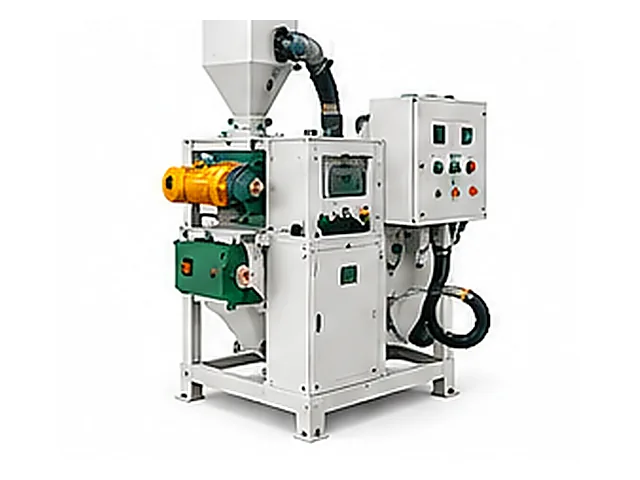
The Batch Seed Treater & Coater Machine executes discrete, recipe-controlled seed dressing and film-coating cycles where exact chemical-to-seed mass ratios are mandatory. Each pre-weighed seed charge enters a contoured mixing chamber in which a high-speed spinning atomizer disc and optional powder feeders build uniform multi-layer coatings before the pneumatic discharge gate opens.

Machines ↗

Overview

Inside the Batch Seed Treater & Coater Machine, an upper weigh hopper captures a fixed seed mass while peristaltic dosing pumps or volumetric cups meter liquid protectants, polymers, and biological inoculants. As the batch drops into the rotor-stator bowl, deflectors lift the kernels into a toroidal rolling curtain that passes repeatedly through the radial mist zone until the programmed dwell timer expires.

Technical Specifications

Technical ParameterBST-05BST-10BST-15BST-25
Processing Capacity3 – 6 t/h7 – 12 t/h13 – 18 t/h19 – 25 t/h
Dosing Accuracy / Liquid Application98.0% – 99.0% homogeneous coating98.5% – 99.2% homogeneous coating99.0% – 99.5% homogeneous coating99.2% – 99.5% homogeneous coating
Total Motor Power2.2 kW4.0 kW7.5 kW11.0 kW
Peristaltic Pump Liquid Dosing Range15 – 180 L/h30 – 360 L/h50 – 540 L/h80 – 750 L/h
Coating / Mixing Drum Diameter600 mm750 mm900 mm1,100 mm

The capacity and power ranges indicated in the table may vary depending on the crop type to be processed, initial foreign matter rate, moisture level, and machine configuration. Exact performance and actual measurement values are finalized following the engineering design and process detailing of the plant to be installed.

Selection and integration

Specifying a Batch Seed Treater & Coater Machine hinges on batch cycle duration, the number of sequential liquid or dry-powder additions per recipe, and slurry viscosity. High-value vegetable, sunflower, and hybrid maize lots benefit from discrete batching because every gram of seed receives its full chemical and talcum dose without start-up or tail-out under-dosing.

Key points to specify

  • Confirm the crop, variety and incoming condition for Batch Seed Treater & Coater Machine.
  • Document the intended result for the “Batch Seed Treater & Coater Machine” unit against actual feed and line conditions; review: seed condition, feed arrangement, treatment objective and the following process.
  • For the “Batch Seed Treater & Coater Machine” unit, check the operating choices against these factors: seed condition, feed arrangement, treatment objective and the following process.
  • Request written connection and maintenance details for the “Batch Seed Treater & Coater Machine” unit, then check them against the site layout and cleaning access; keep seed condition, feed arrangement, treatment objective and the following process tied to the next process step.

GUIDE · TECHNICAL SELECTION

What is this machine used for?

A Batch Seed Treater & Coater Machine applies fungicides, insecticides, micronutrients, film polymers, and pelleting powders to discrete weighed charges of seed with laboratory-grade repeatability. By isolating each cycle inside a self-contained rotor-stator chamber, the machine allows multi-component sequential layering and complete discharge before the next seed lot arrives.

01

The role in the process

Positioned at the end of the conditioning tower after gravity grading and optical sorting, the Batch Seed Treater & Coater Machine bridges bulk clean-seed storage and final packaging or fluid-bed drying. Because batching decouples continuous upstream cleaning from intermittent downstream small-lot bagging, operators can switch chemical formulations or seed calibres without draining long transfer augers.

During each cycle, the automation controller verifies that the overhead weigh hopper has stabilized, triggers the rotor drive, and sequences liquid misting followed by talcum or polymer binding powder to eliminate seed stickiness. Once the mixing timer finishes, the bottom discharge valve dumps the treated charge cleanly into a surge hopper or belt conveyor.

02

Material and application suitability

Small-seeded vegetables, hybrid corn, canola, sugar beet, and specialty pulses with delicate seed coats require low-shear tumbling so pericarp integrity and germination energy remain intact. The smooth toroidal motion inside the mixing bowl prevents kernel pinching while giving high-viscosity slurries and encrusting powders enough residence time to bond evenly across every seed surface.

When recipes call for heavy film build-up or multi-stage biological and chemical dressings, operator-adjustable spin speeds and split-injection intervals prevent premature clumping or wet bridging. Trial batches on representative seed calibres establish the exact misting window and drying-powder addition needed to achieve free-flowing, dust-free seeds at discharge.

03

Selection checklist

Before finalizing the machine specification, document target hourly throughput across the full batch cycle, the count of independent liquid pumps and dry powder dosers, and local vapour-extraction requirements. Confirm whether treated seeds can pass directly to bagging scales or require an intermediate fluid-bed dryer to remove added water from heavy encrusting coats.

Match liquid dosing pump range, atomizer disc speed, and mixing chamber retention time to the chemical recipe and seed fragility. Check chemical tank agitation, exhaust ventilation connections, and gentle discharge transfer into downstream bagging bins. Coating uniformity tests confirm even active-ingredient distribution without pericarp abrasion. All contact zones support fast inspection.

Integration into a processing line

Plant layout and interface planning

Install the Batch Seed Treater & Coater Machine above the packaging surge bin or gentle belt transfer so freshly coated seeds experience minimal drop height and zero screw-auger abrasion. Provide dedicated floor space beside the frame for chemical IBC totes, calibration cylinders, and operator wash stations.

Connect the mixing chamber vent port to a dedicated wet-scrubbing or filtered aspiration line sized to maintain slight negative pressure without pulling fine talcum powder away from the seed curtain. Verify that overhead structural beams support the dynamic load of a filled weigh hopper and spinning rotor assembly.

Factors that affect operating performance

Coating uniformity depends on matching seed batch volume to the active curvature of the rotor wall so the rolling collar neither stalls nor splashes slurry onto bare metal. Regular calibration of peristaltic tubing or flowmeters against slurry density changes keeps active-ingredient loading within strict seed-certification tolerances.

Process quality and line integration

Closed-loop recipe logging records actual seed weight, individual pump flow totals, and mixing time for every discharged batch, providing full audit traceability for certified seed lots. Interlocked cleanout cycles prevent cross-contamination when transitioning from insecticide-dressed industrial hybrids to organic or untreated varieties.

Frequently asked questions

When is a batch coater preferred over a continuous seed treater?

Batch systems excel when applying multi-layer film coatings, encrusting powders, or high-value biological recipes to small or medium seed lots. Because residence time is freely programmable per cycle, seeds can receive sequential liquid and dry additions that a single-pass continuous tube cannot accommodate.

How does the mixing chamber prevent seed coat damage during coating?

A contoured rotor plate and smooth stainless-steel or polymer-lined stator wall lift the seeds into a self-cushioning rolling ring rather than striking them with rigid paddles. This gentle cascading curtain exposes every kernel to the central atomizer mist while keeping mechanical impact well below embryo-damage thresholds.

How are recipe changeovers and chamber cleanouts handled between seed lots?

The pneumatic bottom discharge door opens across the full perimeter of the rotor base so no dead zones trap residual kernels at the end of a cycle. Hinged inspection doors and quick-disconnect liquid manifolds allow operators to wipe or rinse the bowl and swap pump lines in minutes.

REQUEST A TECHNICAL REVIEW

Batch Seed Treater & Coater Machine

Provide your seed species, target batch charge weight, liquid and powder recipe components, and downstream drying or packaging floorplan so our coating specialists can specify the ideal Batch Seed Treater & Coater Machine.