Home›Machines›Bulgur Cooking Tower
Bulgur Cooking Tower
MACHINERY CATALOGUE

Bulgur Cooking Tower

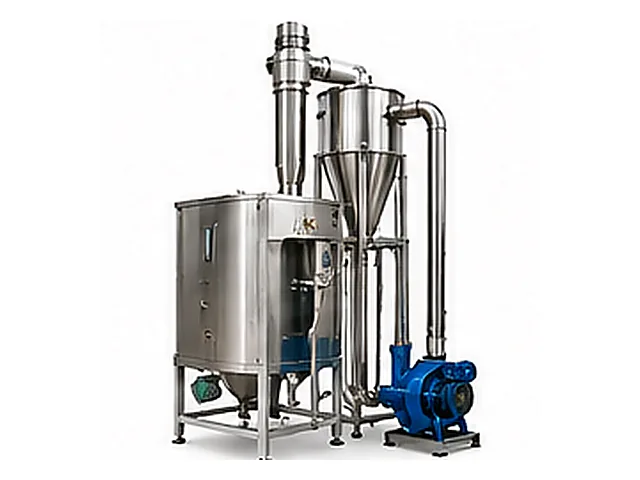
The Bulgur Cooking Tower is a vertical hydrothermal parboiling vessel engineered to gelatinize the starch endosperm of cleaned durum wheat under precisely controlled steam and hydration profiles. By maintaining uniform kernel temperature and residence time from top inlet to bottom extraction, the column eliminates chalky uncooked centers and pericarp bursting.

Machines ↗

Overview

Pre-cleaned and hydrated wheat enters the top of the Bulgur Cooking Tower and descends slowly in plug-flow fashion through insulated stainless-steel heating zones. Radial steam injection manifolds and internal distribution cones expose every layer of the grain column to regulated thermal energy until full starch gelatinization is achieved prior to rotary bottom discharge.

Technical Specifications

Technical ParameterBCT-25BCT-50BCT-100BCT-150
Drying / Cooling / Processing Capacity10 – 25 t/h30 – 50 t/h60 – 100 t/h110 – 150 t/h
Drive & Fan Motor Power1.5 – 4.0 kW5.5 – 7.5 kW11.0 – 15.0 kW15.0 – 18.5 kW
Operating Temperature Control (PID)35 – 110 °C (Seed ≤ 42 °C)35 – 110 °C (Seed ≤ 42 °C)35 – 110 °C (Seed ≤ 42 °C)35 – 110 °C (Seed ≤ 42 °C)
Active Airflow Volume8,000 m³/h18,000 m³/h32,000 m³/h48,000 m³/h

The capacity and power ranges indicated in the table may vary depending on the crop type to be processed, initial foreign matter rate, moisture level, and machine configuration. Exact performance and actual measurement values are finalized following the engineering design and process detailing of the plant to be installed.

Selection and integration

Sizing a Bulgur Cooking Tower depends on durum wheat variety, vitreousness, incoming moisture after soaking, required gelatinization dwell time, and the continuous hourly capacity of the downstream drying and de-branning line. Plug-flow internal geometry is critical so kernels near the vessel wall descend at the same rate as the central core.

Key points to specify

  • Confirm the crop, variety and incoming condition for Bulgur Cooking Tower.
  • Define the target output and the acceptance criteria for the bulgur cooking stage.
  • When setting up the “Bulgur Cooking Tower” unit, record residence needs, initial product condition, heat or air services and target condition and assess both accepted output and unwanted product loss during the sample trial.
  • Show the infeed, discharge, required connections and cleaning or service access for the “Bulgur Cooking Tower” unit on the layout, then confirm handoff with adjacent stages; confirm residence needs, initial product condition, heat or air services and target condition in a representative trial.

GUIDE · TECHNICAL SELECTION

What is this machine used for?

A Bulgur Cooking Tower performs continuous hydrothermal parboiling of wheat to transform raw brittle starch into a translucent, gelatinized matrix ready for drying, tempering, and cracking. Uniform steam penetration across the vertical column preserves natural golden colour, locks micronutrients into the kernel, and maximizes coarse-bulgur milling yield.

01

The role in the process

Situated between the wheat washing-and-soaking section and the primary thermal drying stage, the Bulgur Cooking Tower is the core reactor of an industrial bulgur plant. Incomplete cooking leaves opaque white starch spots that shatter into flour during milling, whereas over-cooking splits the outer bran and causes sticky bridging inside transfer chutes.

By modulating the bottom extraction rate in coordination with top level sensors and zone steam valves, the tower maintains a constant hydrostatic grain column and steady thermal residence time. Cooked kernels exit at a consistent moisture and temperature directly onto a fluid-bed pre-dryer or column dryer feed conveyor.

02

Material and application suitability

Hard durum wheat cultivars with high protein and carotene levels require carefully staged hydration and thermal ramping so moisture diffuses to the center of the kernel before peak cooking temperature is reached. The tower can also be tuned for specialty parboiled cereal products such as whole-wheat pilaf fractions, barley, or ancient grains.

Steam pressure, water-to-grain ratio in the preceding soaking tanks, and column retention time interact directly to determine final kernel hardness and colour index. Commissioning trials verify kernel translucency via cross-section cutting tests and calibrate the zone temperature controllers for each wheat harvest lot.

03

Selection checklist

When planning a Bulgur Cooking Tower installation, confirm boiler steam capacity and dryness fraction, water treatment quality, structural bay height, and thermal insulation specs. Ensure the automation system links the cooking tower discharge drive with upstream soaking bins and downstream dryer capacity so the column never empties during continuous runs.

Include multi-point temperature sensors, modulated burner controls, and cleanout plenum doors for fire-safe operation. Uniform airflow distribution across the grain column prevents localized overheating and stress cracking. All contact zones support fast inspection. Cleanout doors simplify variety changeovers.

Integration into a processing line

Plant layout and interface planning

Position the Bulgur Cooking Tower inside a structural steel bay with staircase access to upper level transmitters, steam manifold valves, and top rotary feeders. Keep the transfer path from the bottom extractor to the wet-product dryer as short and self-scouring as possible to prevent gelatinized wheat from cooling and sticking.

Pipe all steam supply headers with condensate separators and modulating control valves per heating zone, and vent flash vapour from the discharge transition to an outside exhaust stack. Provide floor drains beneath the tower base to handle washdown water during scheduled sanitation shutdowns.

Factors that affect operating performance

Variations in incoming wheat moisture or ambient water temperature alter the thermal load inside the upper heating zone. Automated PID loops reading multi-level temperature probes adjust steam injection rates in real time so every batch layer reaches target gelatinization temperature without localized scorching.

Process quality and line integration

Consistent hydrothermal cooking directly governs downstream milling efficiency: properly gelatinized wheat dries evenly without stress fissures and fractures cleanly into uniform coarse or fine bulgur grits with minimal fine-flour loss. Recipe parameters are stored in the plant SCADA system for instant recall across different wheat grades.

Frequently asked questions

How does the Bulgur Cooking Tower ensure every wheat kernel cooks evenly?

Internal conical baffles and multi-level radial steam diffusers promote mass-flow descent so grain moves downward as a uniform column rather than funnelling through the center. Zone-controlled steam valves maintain an even radial temperature profile across the entire vessel cross-section.

Why must soaking and steam temperature be balanced carefully during bulgur cooking?

Starch gelatinization requires both adequate intracellular water and thermal energy; if steam is applied too aggressively before moisture reaches the kernel core, the outer pericarp bursts while the center stays chalky. Staged pre-hydration followed by regulated column steaming produces a glassy, golden kernel that resists breakage during milling.

What construction materials and hygiene features are used inside the cooking tower?

All grain-contact shells, cones, and steam nozzles are fabricated from corrosion-resistant stainless steel with smooth internal welds to prevent wet starch build-up. Insulated cladding minimizes heat loss to the work floor, while manholes and CIP spray ports allow thorough periodic sanitation.

REQUEST A TECHNICAL REVIEW

Bulgur Cooking Tower

Provide your hourly wheat intake capacity, available steam boiler parameters, and building elevation limits so our process engineers can size your Bulgur Cooking Tower and integrated drying line.