Home›Machines›Conveyor Bottom Silo
Conveyor Bottom Silo
MACHINERY CATALOGUE

Conveyor Bottom Silo

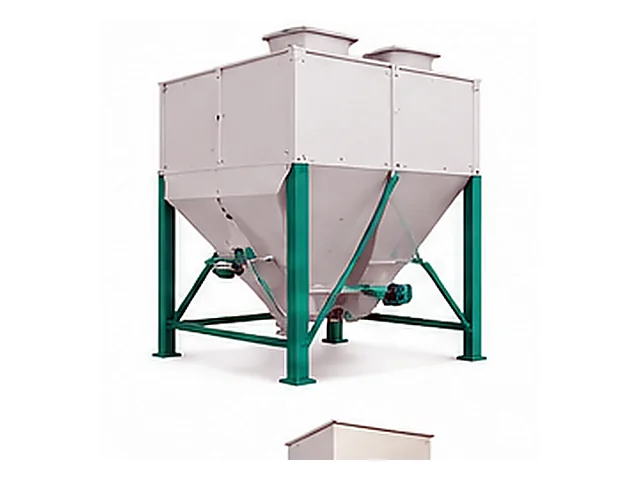
A Conveyor Bottom Silo combines bulk buffer storage with positive, full-width mechanical extraction to handle seed, uncleaned intake grain, or fibrous crops that resist flowing through narrow conical hoppers. By integrating a heavy-duty belt, apron, or drag chain conveyor directly beneath an elongated discharge slot, the bin unloads evenly across its base without bridging or rat-holing.

Machines ↗

Overview

When damp, chaffy, or long-awned seed lots are stored in conventional steep-cone bins, internal friction often causes the mass to arch over the outlet. In a Conveyor Bottom Silo, wide hopper walls converge onto a long horizontal extraction trough equipped with adjustable relief baffles and a variable-speed discharge conveyor. As the bottom conveyor advances, it shears and draws material uniformly from the active slot, delivering a steady, metered volumetric stream to downstream pre-cleaners or dryers.

Technical Specifications

Technical ParameterCBS-25CBS-50CBS-100CBS-150
Flow / Transfer & Discharge Capacity10 – 25 t/h30 – 50 t/h60 – 100 t/h110 – 150 t/h
Drive / Discharge Motor Power1.5 – 3.0 kW4.0 – 7.5 kW7.5 – 11.0 kW15.0 – 18.5 kW
Modular Cell Volume10 – 50 m³60 – 150 m³160 – 300 m³320 – 500 m³
Modular Spouting Pipe DiameterØ 150 – 200 mmØ 200 – 250 mmØ 250 – 300 mmØ 350 – 400 mm

The capacity and power ranges indicated in the table may vary depending on the crop type to be processed, initial foreign matter rate, moisture level, and machine configuration. Exact performance and actual measurement values are finalized following the engineering design and process detailing of the plant to be installed.

Selection and integration

Sizing a Conveyor Bottom Silo involves matching the holding volume to truck reception batches or dryer buffer cycles while engineering the internal pressure-relief baffles to support the vertical column weight above the extraction conveyor. Inverter speed control on the bottom drive allows the silo to act simultaneously as a surge bin and a primary volumetric feeder.

Key points to specify

  • Confirm the crop, variety and incoming condition for Conveyor Bottom Silo.
  • The line drawing for the “Conveyor Bottom Silo” unit should identify product transfer, service space and interfaces with upstream and downstream equipment; align crop flow, intended discharge, inlet arrangement and site layout with the agreed output criterion.

  • Document the intended result for the “Conveyor Bottom Silo” unit against actual feed and line conditions; review: crop flow, intended discharge, inlet arrangement and site layout.
  • Request written connection and maintenance details for the “Conveyor Bottom Silo” unit, then check them against the site layout and cleaning access; align crop flow, intended discharge, inlet arrangement and site layout with the agreed output criterion.
GUIDE · TECHNICAL SELECTION

What is this machine used for?

The Conveyor Bottom Silo solves bridging and erratic discharge problems when buffering freshly harvested, high-moisture, or chaff-laden seed and grain lots. By replacing a constricted point outlet with a full-length mechanical extraction conveyor at the base, it guarantees reliable mass flow and controlled metering into the processing line. It is widely deployed at plant intake stations, ahead of seed dryers, and in chaff/by-product load-out bays.

01

The role in the process

Placed at the front end of a seed conditioning plant or drying facility, the conveyor-bottom bin decouples intermittent truck tipping from the steady, continuous feed rate required by pre-cleaners and thermal dryers.

Because the integrated bottom conveyor meters product directly at a programmable speed, plants eliminate the need for a separate vibrating pan feeder or rotary valve beneath the surge bin. Air and feed controls lock repeatably.

02

Material and application suitability

Grass seeds, uncleaned sunflower lots with stem fragments, damp paddy rice, cottonseed, and chaff-heavy field runs that notoriously arch inside standard hoppers discharge reliably from a conveyor-bottom geometry.

Even with free-flowing cereal grains, the shallow transition height of a conveyor-bottom trough saves valuable vertical elevation in shallow intake pits or low-headroom buildings where a deep sixty-degree hopper cone cannot fit.

03

Selection checklist

Specify the required holding volume in cubic meters, maximum crop bulk density, moisture and trash profile, target extraction rate range, and available pit depth or floor height when requesting a Conveyor Bottom Silo proposal.

Determine belt or chain speed, bucket or trough fill factor, and drive torque for the maximum hourly tonnage and bulk density. All contact zones support fast inspection. Cleanout doors simplify variety changeovers.

Integration into a processing line

Plant layout and interface planning

Structural foundation design must account for both the concentrated leg loads of a full bin and the lateral access space required at one end to pull and service the extraction conveyor shaft and gearmotor.

Internal shed-plate baffles mounted above the conveyor slot are essential: they carry the static head pressure of the stored grain column so the bottom belt or chain does not stall on startup when the silo is full.

Factors that affect operating performance

Discharge uniformity depends on setting the front regulating slide gate height and pairing it with the VFD speed of the bottom conveyor; downstream load sensors on the Pre-Cleaner can automatically trim conveyor rpm in closed loop.

Process quality and line integration

High-level bin switches interlock with the upstream intake elevator to prevent overfilling, while low-level sensors alert operators or pause downstream machines before the surge bed runs dry.

Frequently asked questions

Why choose a Conveyor Bottom Silo instead of a conventional gravity hopper bin?

Conventional conical hoppers rely solely on gravity and often bridge when holding damp, trashy, or fibrous seeds; a conveyor-bottom bin actively draws material across an elongated slot while requiring much less vertical height.

What keeps the full weight of the stored grain from stalling the bottom conveyor at startup?

Engineered inverted-V relief baffles inside the lower bin section transfer the vertical static pressure of the grain column onto the silo walls, allowing the conveyor beneath to draw product smoothly with low starting torque.

Can the discharge rate of the Conveyor Bottom Silo be adjusted during operation?

Yes; combining an adjustable vertical regulating gate at the discharge throat with a variable-frequency drive on the extraction conveyor allows precise, stepless flow control into the next machine.

REQUEST A TECHNICAL REVIEW

Conveyor Bottom Silo

Discuss your raw intake characteristics, buffer volume needs, and pit dimensions with our engineering team to design a Conveyor Bottom Silo that guarantees uninterrupted line feeding.