Home›Machines›Square Silos
Square Silos
MACHINERY CATALOGUE

Square Silos

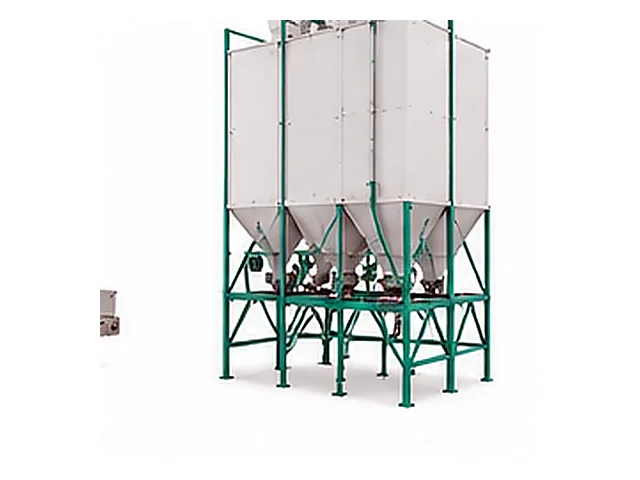
Square Silos—modular rectangular or square steel storage cells—maximize holding capacity inside indoor processing buildings, cleaning towers, and load-out bays by eliminating the dead corner voids left between round cylindrical bins. Assembled from precision-formed bolted wall panels above steep mass-flow hopper cones, they organize multi-variety seed, pulse, and grain storage into a compact structural footprint.

Machines ↗

Overview

In a modular square silo bank, adjacent cells share common internal partition walls tied together by internal or external structural bracing rods and corner columns. Whether fabricated with smooth flat-sheet walls for hygiene-critical seed plants or horizontally profiled corrugated panels for high-tonnage grain holding, the vertical cell walls transition cleanly into sixty- or forty-five-degree pyramidal hoppers that feed downstream scales, baggers, or conveyors.

Technical Specifications

Technical ParameterSQS-25SQS-50SQS-100SQS-150
Flow / Transfer & Discharge Capacity10 – 25 t/h30 – 50 t/h60 – 100 t/h110 – 150 t/h
Drive / Discharge Motor Power1.5 – 3.0 kW4.0 – 7.5 kW7.5 – 11.0 kW15.0 – 18.5 kW
Modular Cell Volume10 – 50 m³60 – 150 m³160 – 300 m³320 – 500 m³
Modular Spouting Pipe DiameterØ 150 – 200 mmØ 200 – 250 mmØ 250 – 300 mmØ 350 – 400 mm

The capacity and power ranges indicated in the table may vary depending on the crop type to be processed, initial foreign matter rate, moisture level, and machine configuration. Exact performance and actual measurement values are finalized following the engineering design and process detailing of the plant to be installed.

Selection and integration

Engineering a bank of Square Silos centers on choosing between smooth flat walls—which shed every kernel cleanly during seed variety switches—and profiled corrugated panels, which offer high bending stiffness for large bulk cereal volumes. Hopper cone angle must be matched to the internal angle of friction of the stored crop.

Key points to specify

  • Confirm the crop, variety and incoming condition for Square Silos.
  • Request written connection and maintenance details for the “Square Silos” unit, then check them against the site layout and cleaning access; include crop flow, site layout, inlet arrangement and intended discharge in the selection record.

  • For the “Square Silos” unit, check the operating choices against these factors: crop flow, site layout, inlet arrangement and intended discharge.
  • Show the infeed, discharge, transfer points and service clearances for the “Square Silos” unit on the plant layout; include crop flow, site layout, inlet arrangement and intended discharge in the selection record.
GUIDE · TECHNICAL SELECTION

What is this machine used for?

Modular Square Silos deliver roughly twenty-five percent more storage volume than cylindrical bins within the same rectangular floor area, making them the standard choice for indoor seed plants, pulse lines, and packing buffers. Shared partition walls and bolt-together panel construction allow rapid erection inside existing buildings without crane roof removal. Engineered hopper cones and optional let-down ladders preserve crop flowability and seed integrity.

01

The role in the process

Inside a seed conditioning or pulse sorting plant, dozens of intermediate holding bins are needed to buffer pre-cleaned lots, hold middlings for re-run, and stage finished product ahead of treating and bagging. Nesting Square Silos into a tight honeycomb matrix consolidates all these buffer points under one compact overhead distribution gallery.

Because the modular steel panels are brought into the building on pallets and bolted together floor by floor, square cells can be installed inside existing warehouses where prefabricated round tanks could never pass through the doors.

02

Material and application suitability

Certified seeds, pulses, tree nuts, and specialty grains that require strict lot segregation should be stored in flat smooth-wall square cells with corner chamfer plates so no horizontal ledges can trap kernels.

When filling tall square bins with brittle soybeans, peas, or hybrid corn, installing an internal spiral or cascade let-down chute decelerates the falling stream and prevents shattering against the bottom hopper cone. Self-cleaning profiles and tight clearances prevent residual kernel holdover between different crop varieties. All contact zones support fast inspection.

03

Selection checklist

Define the number of individual cells, storage volume per cell in cubic meters, maximum crop bulk density, flat-wall versus profiled-wall preference, and available building height when specifying Square Silos.

Determine belt or chain speed, bucket or trough fill factor, and drive torque for the maximum hourly tonnage and bulk density. Specify zero-speed motion sensors, belt alignment switches, and bottom cleanout slides for zero-admixture seed handling. Food-grade contact surfaces and low-velocity transfer points suit fragile pulses, coated seeds, and high-purity parent lines.

Integration into a processing line

Plant layout and interface planning

Structural slab and column design must account for full vertical bin loads plus dynamic discharge pressures; common-wall cell banks concentrate high point loads onto the supporting steel columns around the hopper perimeter.

Above the silo roof deck, sufficient headroom must be reserved for the filling Chain Conveyor, Belt Conveyor, or Modular Pipework System diverter valves as well as walkway access to top level probes and manways.

Factors that affect operating performance

Pyramidal hopper valleys have a slightly shallower effective slope than their four flat side plates; designing valley angles steep enough for the most cohesive crop prevents corner build-up during gravity discharge.

Process quality and line integration

Interlocking each cell's high-level sensor with the overhead filling conveyor and rotary diverter valves prevents bin overfilling and cross-mixing between adjacent seed varieties.

Frequently asked questions

How much floor space do Square Silos save compared with round storage bins?

Because square cells fit flush against one another in a continuous grid without interstitial gaps, they provide roughly twenty-five percent more cubic storage capacity inside a given rectangular building footprint.

Should a seed plant specify flat smooth walls or corrugated panels for Square Silos?

Seed houses and pulse packers that switch varieties frequently should specify smooth flat-wall panels with flush bolts and corner fillets so zero kernels can lodge on horizontal ribs during emptying.

How is seed breakage prevented when filling tall indoor Square Silos?

Fitting an internal cascade let-down ladder or spiral slide inside the cell guides incoming kernels downward in short, cushioned steps instead of allowing a high-velocity free fall onto the steel hopper cone.

REQUEST A TECHNICAL REVIEW

Square Silos

Send us your available floor footprint, ceiling height, and required number of storage cells to engineer a modular Square Silos bank tailored to your facility.