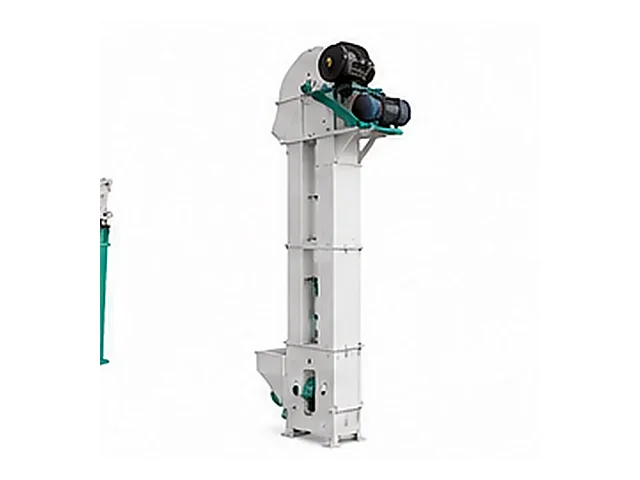
Overview
Standard centrifugal elevators rely on high belt speed to fling kernels outward at the top pulley, which can crack dry seed coats and damage embryonic axes. By contrast, the Easy Dump Bucket Elevator runs at a reduced belt speed and uses a contoured dual-pulley or snub-guided head path that tips the buckets smoothly upside down above an internal collecting chute. Kernels glide out gently along a cushioned transition slide, while controlled up-leg feeding at the boot eliminates bottom scooping damage.
Technical Specifications
The capacity and power ranges indicated in the table may vary depending on the crop type to be processed, initial foreign matter rate, moisture level, and machine configuration. Exact performance and actual measurement values are finalized following the engineering design and process detailing of the plant to be installed.
Selection and integration
Configuring an Easy Dump Bucket Elevator involves balancing bucket volume, spacing, and slow linear belt speed to achieve the required tonnage without resorting to centrifugal throw. The inlet spout should be positioned to feed rising buckets directly on the up-leg so delicate seeds never undergo crushing in the boot bottom.
Key points to specify
- Confirm the crop, variety and incoming condition for Easy Dump Bucket Elevator.
- Use a product sample to set the acceptance target for the “Easy Dump Bucket Elevator” unit; factors to review: inlet/discharge alignment, the route, transfer elevations and product fragility.
- Document the intended result for the “Easy Dump Bucket Elevator” unit against actual feed and line conditions; review: inlet/discharge alignment, the route, transfer elevations and product fragility.
- Show the infeed, discharge, transfer points and service clearances for the “Easy Dump Bucket Elevator” unit on the plant layout; include inlet/discharge alignment, the route, transfer elevations and product fragility in the selection record.