Home›Machines›Grain Bucket Elevator for Seeds & Cereals
Grain Bucket Elevator for Seeds & Cereals
MACHINERY CATALOGUE

Grain Bucket Elevator for Seeds & Cereals

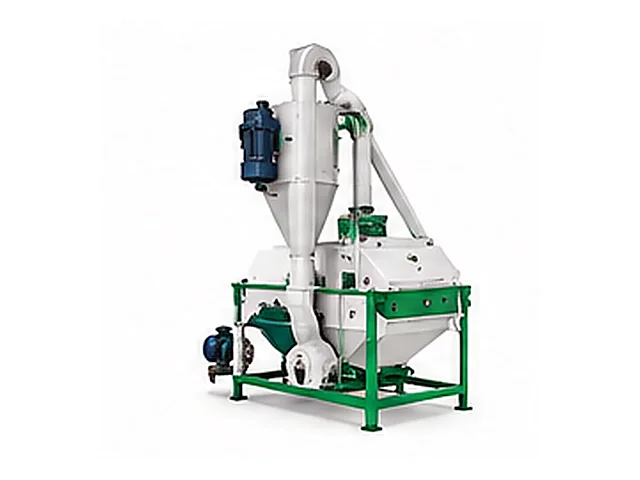
The Grain Bucket Elevator for Seeds & Cereals is a versatile vertical transport unit designed for facilities that process both commercial cereal harvests and conditioned seed lots. Combining heavy-gauge modular galvanized leg casings with configurable drive speeds and replaceable wear liners, it bridges the gap between high-throughput grain intake legs and gentle seed-house elevators.

Machines ↗

Overview

Bulk cereal or seed enters the reinforced boot housing through a baffled inlet chute designed to stabilize turbulence and distribute flow evenly across the bucket width. A multi-ply, low-stretch rubber-canvas belt carries the loaded buckets vertically inside twin dust-tight steel trunks to the head section, where a contoured hood lined with impact-absorbing polyurethane plates directs the discharged stream smoothly into the downstream spouting network.

Technical Specifications

Technical ParameterGBE-25GBE-50GBE-100GBE-150
Conveying Capacity10 – 25 t/h30 – 50 t/h60 – 100 t/h110 – 150 t/h
Drive Motor Power1.5 – 3.0 kW4.0 – 7.5 kW7.5 – 11.0 kW15.0 – 18.5 kW
Operating / Conveying Speed0.6 – 1.2 m/s0.8 – 1.5 m/s1.0 – 1.8 m/s1.2 – 2.2 m/s
Trough / Trunking Section Width200 mm300 mm400 mm500 mm

The capacity and power ranges indicated in the table may vary depending on the crop type to be processed, initial foreign matter rate, moisture level, and machine configuration. Exact performance and actual measurement values are finalized following the engineering design and process detailing of the plant to be installed.

Selection and integration

Specifying the Grain Bucket Elevator for Seeds & Cereals starts with defining whether the leg will serve dirty intake grain, wet dryer loading, or cleaned seed elevation. Adding a variable-frequency inverter allows operators to run full centrifugal speed for high-tonnage wheat or barley intake and dial back belt velocity when elevating fragile certified seed.

Key points to specify

  • Confirm the crop, variety and incoming condition for Grain Bucket Elevator for Seeds & Cereals.
  • Document the intended result for the “Grain Bucket Elevator for Seeds & Cereals” unit against actual feed and line conditions; review: product fragility, the route, inlet/discharge alignment and transfer elevations.
  • For the “Grain Bucket Elevator for Seeds & Cereals” unit, check the operating choices against these factors: product fragility, the route, inlet/discharge alignment and transfer elevations.
  • Show the infeed, discharge, transfer points and service clearances for the “Grain Bucket Elevator for Seeds & Cereals” unit on the plant layout; evaluate product fragility, the route, inlet/discharge alignment and transfer elevations alongside the actual feed condition.

GUIDE · TECHNICAL SELECTION

What is this machine used for?

Engineered for dual-purpose reliability in cereal mills, storage terminals, and seed plants, the Grain Bucket Elevator for Seeds & Cereals delivers dependable vertical lifting with low mechanical damage. Cushioned head impact zones, precision throat baffles, and configurable boot inlets keep kernel breakage and back-legging to a minimum across diverse cereal and seed crops. Modular galvanized construction ensures rapid erection and long-term corrosion resistance indoors or outdoors.

01

The role in the process

In plants that clean commercial wheat, barley, oats, and maize alongside seasonal seed lots, installing a dual-duty vertical leg avoids duplicating elevation equipment while protecting seed vigor when required.

By fitting both an upper up-leg inlet for delicate seeds and a lower down-leg inlet for high-rate cereal reception, a single elevator can adapt to contrasting process duties within the same tower.

02

Material and application suitability

Hulled and awned cereals such as barley, oats, and paddy rice cause rapid frictional wear on bare sheet metal; replaceable polyurethane or hardened alloy liners in the head hood and outlet throat absorb this abrasion.

When elevating cleaned cereal seed or pulses, vented polymer buckets with smooth, non-cutting front lips prevent kernel slicing during pickup and release air pockets cleanly during filling.

03

Selection checklist

Include the full list of cereal and seed crops, moisture extremes, target hourly tonnage, vertical center-to-center height, and dust-hazard classification when requesting a technical quotation.

Food-grade contact surfaces and low-velocity transfer points suit fragile pulses, coated seeds, and high-purity parent lines. All contact zones support fast inspection. Cleanout doors simplify variety changeovers.

Integration into a processing line

Plant layout and interface planning

Tower and pit planning must provide sufficient vertical drop both into the boot inlet and out of the head discharge spout so gravity chutes maintain self-cleaning angles without sharp elbows.

Lateral wall ties or structural tower brackets should anchor the vertical leg trunks at regular intervals to eliminate wind-induced sway and keep the belt tracking dead-center over the crowned pulleys.

Factors that affect operating performance

Keeping the adjustable head throat plate set close to the bucket path and maintaining uniform belt tension via the screw or gravity take-up are the two primary adjustments that sustain peak lifting efficiency.

Process quality and line integration

Connecting the boot aspiration port and head vent to the central baghouse maintains slight negative pressure inside the leg casings, preventing chaff and dust from escaping into the work area.

Frequently asked questions

Can one Grain Bucket Elevator handle both high-rate commercial grain and delicate seed lots?

Yes; pairing a variable-frequency drive with cushioned polyurethane head liners and an up-leg seed inlet lets operators switch between high-output cereal mode and gentle low-impact seed elevation.

Which wear parts protect the elevator when elevating abrasive cereals like paddy or barley?

Replaceable bolt-in polyurethane or hardened steel wear plates line the curved head hood and discharge throat where exiting grain strikes the housing, preserving the structural shell indefinitely.

How is belt tracking maintained over tall vertical lift heights?

Crowned, rubber-lagged head and slatted self-cleaning tail pulleys work together with twin screw or gravity boot tensioners and electronic rub-block alignment sensors to keep the belt centered.

REQUEST A TECHNICAL REVIEW

Grain Bucket Elevator for Seeds & Cereals

Send us your cereal and seed throughput targets, building elevations, and layout drawings to receive a customized Grain Bucket Elevator for Seeds & Cereals specification.