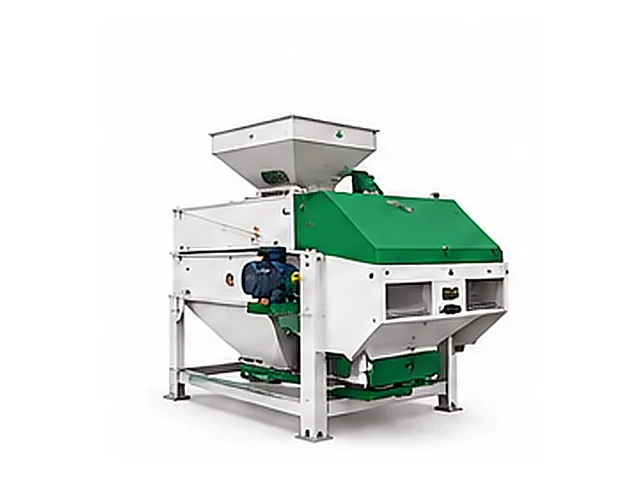
Overview
As grain enters the cylindrical casing of the Grain Clipper, staggered steel clipping blades and paddles propel the bed along an internal screen jacket while an adjustable outlet slide gate maintains controlled back-pressure. The resulting grain-on-grain friction and blade shearing action clip off protruding oat tips, barley beards, and carrot seed spines, while fine detached whiskers pass outward through the mantle apertures or into the discharge aspiration hood.
Technical Specifications
The capacity and power ranges indicated in the table may vary depending on the crop type to be processed, initial foreign matter rate, moisture level, and machine configuration. Exact performance and actual measurement values are finalized following the engineering design and process detailing of the plant to be installed.
Selection and integration
Configuring a Grain Clipper involves balancing clipping thoroughness against pericarp skinning and embryo safety, especially when conditioning high-value seed oats, malting barley, or delicate umbelliferous vegetable seeds. Pilot testing on representative unclipped samples defines the optimal screen perforation size, blade pitch, rotor peripheral speed, and outlet gate restriction before full-scale operation.
Key points to specify
- Confirm the crop, variety and incoming condition for Grain Clipper.
- Document the intended result for the “Grain Clipper” unit against actual feed and line conditions; review: incoming condition, adjacent equipment, outlet target and defined operation.
- For the “Grain Clipper” unit, check the operating choices against these factors: incoming condition, adjacent equipment, outlet target and defined operation.
- Place the “Grain Clipper” unit in the line drawing with its handoff elevations and cleaning access; set the acceptance basis with incoming condition, adjacent equipment, outlet target and defined operation.