Home›Machines›Hand Pick Selection Belt Conveyor
Hand Pick Selection Belt Conveyor
MACHINERY CATALOGUE

Hand Pick Selection Belt Conveyor

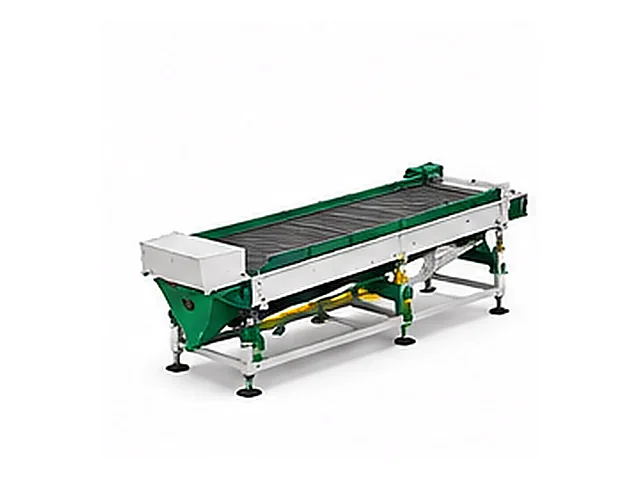
The Hand Pick Selection Belt Conveyor provides an ergonomic, variable-speed visual inspection table where operators manually remove off-grade kernels, foreign pods, splits, and surface-blemished pieces from high-value seed, pulse, and nut lots. Designed for gentle monolayer presentation, it delivers damage-free horizontal transport and final quality assurance ahead of packaging.

Machines ↗

Overview

Product enters through an adjustable metering hopper gate that spreads the kernels into a thin, even layer across a wide, food-grade endless belt. Driven by a frequency-controlled gearmotor, the flat belt glides smoothly past seated or standing inspection stations illuminated by glare-free overhead lighting. Personnel pick out visible defects by hand and drop them into integrated side reject chutes or central divider troughs, while the inspected prime product discharges gently over the head pulley into the downstream packing bin.

Technical Specifications

Technical ParameterHPS-25HPS-50HPS-100HPS-150
Conveying Capacity10 – 25 t/h30 – 50 t/h60 – 100 t/h110 – 150 t/h
Drive Motor Power1.5 – 3.0 kW4.0 – 7.5 kW7.5 – 11.0 kW15.0 – 18.5 kW
Operating / Conveying Speed0.6 – 1.2 m/s0.8 – 1.5 m/s1.0 – 1.8 m/s1.2 – 2.2 m/s
Trough / Trunking Section Width200 mm300 mm400 mm500 mm

The capacity and power ranges indicated in the table may vary depending on the crop type to be processed, initial foreign matter rate, moisture level, and machine configuration. Exact performance and actual measurement values are finalized following the engineering design and process detailing of the plant to be installed.

Selection and integration

Configuring a Hand Pick Selection Belt Conveyor centers on belt width, picking length, number of operator stations, and belt color contrast against the product. A matte white, green, or blue belt surface is chosen to maximize visual contrast against dark stains, pale splits, or foreign seeds while minimizing eye fatigue over long shifts.

Key points to specify

  • Confirm the crop, variety and incoming condition for Hand Pick Selection Belt Conveyor.
  • For the “Hand Pick Selection Belt Conveyor” unit, check the operating choices against these factors: transfer elevations, product fragility, the route and inlet/discharge alignment.
  • When setting up the “Hand Pick Selection Belt Conveyor” unit, record transfer elevations, product fragility, the route and inlet/discharge alignment and assess both accepted output and unwanted product loss during the sample trial.
  • Show the infeed, discharge, required connections and cleaning or service access for the “Hand Pick Selection Belt Conveyor” unit on the layout, then confirm handoff with adjacent stages; set the acceptance basis with transfer elevations, product fragility, the route and inlet/discharge alignment.

GUIDE · TECHNICAL SELECTION

What is this machine used for?

Built for gentle monolayer presentation and manual quality control, the Hand Pick Selection Belt Conveyor lets operators visually inspect and hand-sort high-value seeds, pulses, and nuts on a variable-speed table.

01

The role in the process

Even in highly automated plants, specialty foundation seed lots, jumbo confectionery pulses, in-shell nuts, and hand-harvested vegetable seeds often require a final human visual check before bagging. Mechanical or optical systems may leave occasional misshapen pods, twinned kernels, or subtle hull cracks that discerning buyers reject.

By spreading the flow into a calm, non-rolling single layer at adjustable belt speeds, the selection conveyor gives quality-control personnel complete control over final lot appearance. Zero tumbling or impact occurs on the flat belt, preserving fragile seed coats and treated or large-seeded legumes.

02

Material and application suitability

Manual picking throughput is governed by incoming defect density and kernel size rather than motor power alone. When defect counts rise in a difficult harvest lot, operators simply dial down the inverter speed or lower the inlet gate height so every square centimeter of belt receives thorough visual scrutiny.

Round seeds like peas or soybeans require level belt tracking and side containment strips so kernels do not roll toward the edges, while flat lentils, beans, and nuts benefit from wide, brightly lit picking zones and conveniently angled waste drop pockets. All contact zones support fast inspection. Air and feed controls lock repeatably.

03

Selection checklist

When ordering a Hand Pick Selection Belt Conveyor, specify the number of operators per shift, the desired table elevation, belt color, and whether side waste chutes should discharge into floor totes or a takeaway conveyor.

Determine belt or chain speed, bucket or trough fill factor, and drive torque for the maximum hourly tonnage and bulk density. Specify zero-speed motion sensors, belt alignment switches, and bottom cleanout slides for zero-admixture seed handling. Food-grade contact surfaces and low-velocity transfer points suit fragile pulses, coated seeds, and high-purity parent lines. Cleanout doors simplify variety changeovers.

Integration into a processing line

Plant layout and interface planning

Locate the selection belt in a well-ventilated, low-noise area near the packing room, isolated from heavy dust and floor vibration so sorting staff can work comfortably. Provide a small buffer hopper above the inlet gate with a shutoff slide to stop product flow whenever the belt pauses.

Align the head pulley discharge at a low drop height into the receiving bin or scale hopper, using a cushioned slide to protect brittle beans and nuts from splitting after inspection. Ensure adequate aisle clearance on both flanks of the frame.

Factors that affect operating performance

Sorting consistency depends on uniform monolayer spreading, flicker-free daylight-spectrum lighting, belt speed regulation, and ergonomic posture. Overloading the belt into a multi-kernel pile hides underlying defects and forces operators to rake through the bed by hand.

Process quality and line integration

In a complete handling system, the Hand Pick Selection Belt Conveyor connects smoothly with a gentle Bucket Elevator at the infeed and transfers inspected product or collected rejects via a Belt Conveyor or Screw Conveyor.

Frequently asked questions

How is the conveying speed adjusted for lots with different defect levels?

An integrated variable-frequency drive allows operators to smoothly slow down the belt when inspecting heavily blemished lots or speed it up when performing a final check on clean, pre-sorted seed.

What prevents fragile pulses or coated seeds from being damaged on the selection table?

Kernels rest stationary relative to the smooth, food-grade belt surface with no mechanical agitation, augers, or high-velocity impact points between the metered feed gate and the cushioned head chute.

How are hand-picked defects separated from the clean product stream?

Ergonomic side troughs or flush-mounted drop chutes positioned along both edges of the frame let operators flick rejected kernels directly into under-table collection bins without reaching across the belt.

REQUEST A TECHNICAL REVIEW

Hand Pick Selection Belt Conveyor

Reach out to our layout specialists with your crop type, number of sorting operators, and packing-room dimensions to configure a custom Hand Pick Selection Belt Conveyor.