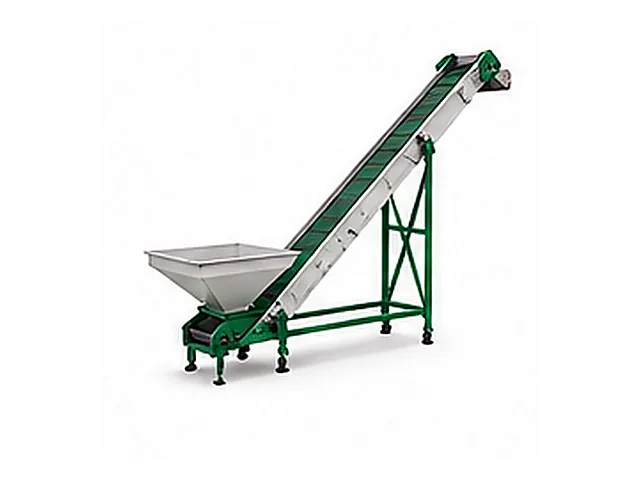
Overview
The conveying trough is supported on flexible leaf springs, coil springs, or rubber suspension links and driven by an eccentric crankshaft or paired counter-rotating vibratory motors. Each forward-and-upward micro-stroke tosses the kernel layer slightly ahead while the trough retracts underneath, producing smooth, uniform forward migration without flight contact. Because the pan floor is a completely flat, uninterrupted sheet with zero internal bearings or crevices, the unit wipes itself completely clean at the end of every batch.
Technical Specifications
The capacity and power ranges indicated in the table may vary depending on the crop type to be processed, initial foreign matter rate, moisture level, and machine configuration. Exact performance and actual measurement values are finalized following the engineering design and process detailing of the plant to be installed.
Selection and integration
Selecting a Jog Conveyor centers on matching pan width and stroke frequency to the receiving geometry of the downstream machine—whether spreading seed across an optical sorter chute or metering grain into a cleaner. Isolation dampers must be properly sized so dynamic oscillatory forces are absorbed before reaching the supporting steel platform.
Key points to specify
- Confirm the crop, variety and incoming condition for Jog Conveyor.
- Define the target output and the acceptance criteria for the controlled product distribution stage.
- When setting up the “Jog Conveyor” unit, record the route, product fragility, inlet/discharge alignment and transfer elevations and assess both accepted output and unwanted product loss during the sample trial.
- The line drawing for the “Jog Conveyor” unit should identify product transfer, service space and interfaces with upstream and downstream equipment; check the route, product fragility, inlet/discharge alignment and transfer elevations before fixing the configuration.