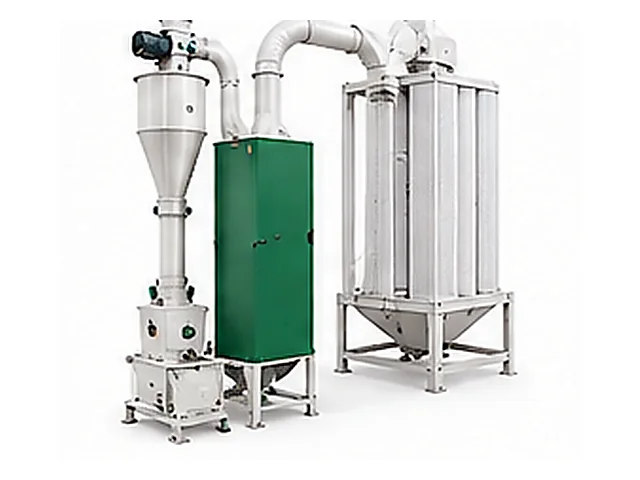
Overview
Whenever grain is lifted by a bucket elevator, it relies on inclined gravity spouting to reach cleaners, graders, scales, and silos below. A Modular Pipework System provides pre-engineered straight tubes, angled bends, cushioned dead-boxes, two-way and multi-way diverter valves, adjustable flow retarders, and transitions that bolt or clamp together rapidly. By controlling sliding angles and cushioning directional changes, the pipework prevents both choke-ups on slow crops and impact shattering on fast-moving seeds.
Technical Specifications
The capacity and power ranges indicated in the table may vary depending on the crop type to be processed, initial foreign matter rate, moisture level, and machine configuration. Exact performance and actual measurement values are finalized following the engineering design and process detailing of the plant to be installed.
Selection and integration
Designing a Modular Pipework System requires balancing two opposing physical risks: slopes that are too shallow cause damp or light seeds to stall and plug the pipe, whereas steep, long vertical drops accelerate kernels to velocities that crack seed coats at the next elbow. Strategic placement of grain decelerators and rock-box cushions keeps velocity within safe limits.
Key points to specify
- Confirm the crop, variety and incoming condition for Modular Pipework System.
- Define the target output and the acceptance criteria for the material transfer interfaces stage.
- Use a product trial to define where the “Modular Pipework System” unit fits; record inlet/discharge alignment, product fragility, the route and transfer elevations and the output expected by the following stage.
- The line drawing for the “Modular Pipework System” unit should identify product transfer, service space and interfaces with upstream and downstream equipment; document inlet/discharge alignment, product fragility, the route and transfer elevations with the tested operating arrangement.