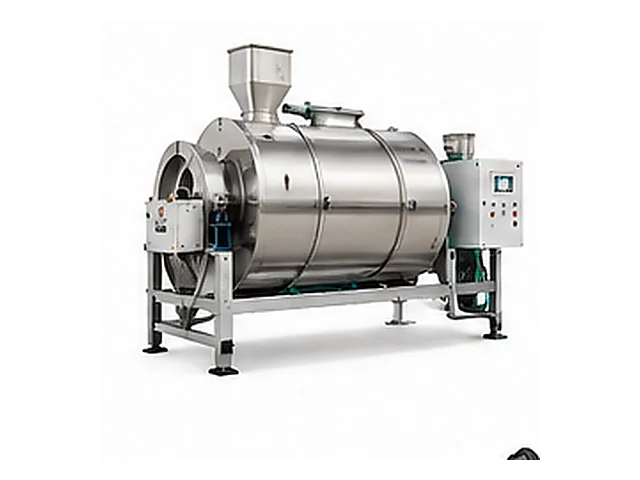
Overview
In a complete Nut Blancher process, shelled and graded nuts first pass through a temperature-controlled conditioning zone that creates differential expansion between the thin outer skin and the firm kernel beneath, followed by a cooling section that stabilizes kernel texture. The conditioned nuts then travel through counter-rotating resilient rubber rollers or soft rubbing belts that peel away the loosened pellicle, while an integrated suction hood lifts the detached skins into a cyclone collector.
Technical Specifications
The capacity and power ranges indicated in the table may vary depending on the crop type to be processed, initial foreign matter rate, moisture level, and machine configuration. Exact performance and actual measurement values are finalized following the engineering design and process detailing of the plant to be installed.
Selection and integration
Selecting the proper Nut Blancher configuration depends on nut species—whether dry-blanching peanuts and hazelnuts or wet/steam-blanching almonds—along with incoming kernel moisture, caliber uniformity, and split-kernel tolerance. Pilot trials on customer nut lots establish the precise conditioning temperature, residence time, and roller gap needed to achieve complete skin removal without heat-browning or cotyledon splitting.
Key points to specify
- Confirm the crop, variety and incoming condition for Nut Blancher.
- Define the target output and the acceptance criteria for the nut blanching stage.
- Document the intended result for the “Nut Blancher” unit against actual feed and line conditions; review: moisture, crop variety, acceptable kernel damage and hull structure.
- Show the infeed, discharge, required connections and cleaning or service access for the “Nut Blancher” unit on the layout, then confirm handoff with adjacent stages; confirm moisture, crop variety, acceptable kernel damage and hull structure in a representative trial.