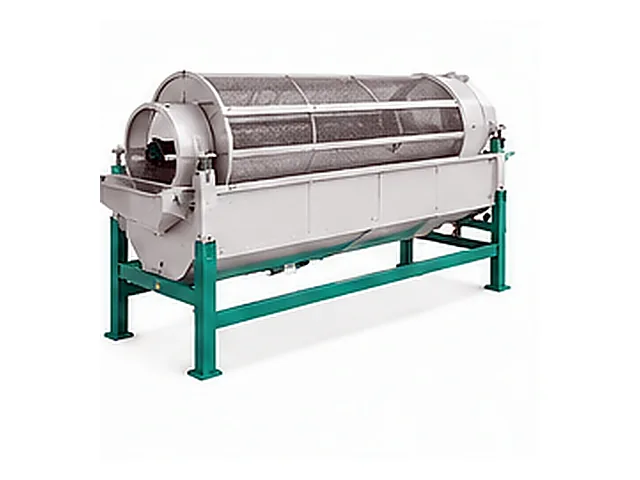
Home›Machines›Rotary Fine Seed Cleaners
Rotary Fine Seed Cleaners
MACHINERY CATALOGUE

Rotary Fine Seed Cleaners

Designed for pre-cleaning and removal of unwanted material in seed, grain and food-ingredient processing lines. The final configuration is selected around the incoming crop, target product quality, required throughput and connection to upstream and downstream equipment. Request a technical quotation based on your actual product and operating conditions.

Machines ↗

For a useful quotation, provide the crop and variety, moisture range, incoming condition, target quality, required capacity, hours per day, site power and air supply, available footprint, dust-control requirements and the machines before and after this unit.

Overview

This equipment performs pre-cleaning and removal of unwanted material. Selection should be based on the crop and its physical characteristics, impurity or defect profile, required output, operating hours and available plant utilities. A suitable configuration is confirmed after the application and process flow are defined.

Technical Specifications

For a useful quotation, provide the crop and variety, moisture range, incoming condition, target quality, required capacity, hours per day, site power and air supply, available footprint, dust-control requirements and the machines before and after this unit.

Required throughputRequired throughput (t/h) — to be defined for the selected application for the specified crop, moisture, impurity profile and quality target.
Installed power / utilitiesInstalled power and utility demand — selected configuration to specify for the proposed configuration.
Dimensions and clearancesOverall dimensions, operating height and service clearances — provide in the final layout drawing.
Product-contact materialsProduct-contact materials and wear parts — specify according to crop, hygiene and abrasion requirements.
Controls and safetyControl panel, sensors, automation and safety interlocks — list included and optional items separately.
Options and accessoriesCrop-specific screens, rollers, sensors, aspiration, feeders or accessories — only where applicable to this machine type.
Line interfacesInlet/outlet sizes, conveying interfaces, aspiration connections and signal protocols — confirm against the line layout.
Cleaning and maintenanceAccess doors, cleaning method, routine service points and recommended spare parts — include in the offer.

Selection and integration

For a useful quotation, provide the crop and variety, moisture range, incoming condition, target quality, required capacity, hours per day, site power and air supply, available footprint, dust-control requirements and the machines before and after this unit.

Key points to specify

  • Crop-specific configuration
  • Defined inlet and outlet interfaces
  • Access for cleaning and maintenance
  • Documented controls, guarding and safety requirements

GUIDE · TECHNICAL SELECTION

What is this machine used for?

This equipment is selected for the defined process task in the line. Final performance depends on the actual crop, incoming condition, required output and confirmed selected configuration configuration.

01

The role in the process

Rotary Fine Seed Cleaners should be specified against a real process need rather than selected by name alone. This equipment group may be placed near the start of a process to address dust, chaff, plant fragments or similar unwanted material in the incoming crop. The result depends on machine design, crop properties and feed condition. Define whether the main goal is to protect downstream machines or prepare a more consistent product stream before ordering.

Define whether the main goal is to protect downstream machines or prepare a more consistent product stream before ordering.

02

Material and application suitability

When preparing an enquiry for Rotary Fine Seed Cleaners, document the crop or variety, incoming condition, required output quality, operating schedule and upstream/downstream equipment. Moisture, impurity profile, product fragility or packaging may be important depending on the application. Suitability should be checked using a representative sample and measurable acceptance criteria.

This equipment group may be placed near the start of a process to address dust, chaff, plant fragments or similar unwanted material in the incoming crop. The result depends on machine design, crop properties and feed condition.

03

Selection checklist

This equipment is selected for the defined process task in the line. Final performance depends on the actual crop, incoming condition, required output and confirmed selected configuration configuration.

  • Crop or variety and incoming condition
  • Target quality and acceptance criteria
  • Target throughput and operating schedule
  • Layout, transfer elevations and utilities
  • Cleaning, maintenance, safety and changeover

Integration into a processing line

Plant layout and interface planning

Plan Rotary Fine Seed Cleaners as part of the complete process rather than as an isolated item. Review infeed and discharge points, elevations, floor space, service clearances, cleaning access, guarding and control interfaces. Define dust extraction, air, water, heat or other utility connections before ordering where they apply.

This equipment group may be placed near the start of a process to address dust, chaff, plant fragments or similar unwanted material in the incoming crop. The result depends on machine design, crop properties and feed condition. Define whether the main goal is to protect downstream machines or prepare a more consistent product stream before ordering.

Factors that affect operating performance

Conveying capacity depends on bulk density, distance, lift height, incline, speed and inlet/outlet interfaces. For fragile crops, drop height and transfer points also matter.

Process quality and line integration

Steady feeding, suitable transfer chutes and correct speed help reduce blockages, spillage and kernel damage. Conveyors should match upstream and downstream capacity.

Frequently asked questions

Which impurities can Rotary Fine Seed Cleaners remove?

The result depends on the crop, particle-size distribution and incoming impurity profile. Typical targets include dust, chaff and material that differs in size or aerodynamic behaviour.

How are the screens and airflow set on Rotary Fine Seed Cleaners?

Screen openings and airflow should be selected for the actual crop, moisture and required cleaning level. A representative sample helps establish suitable settings.

Where should Rotary Fine Seed Cleaners be installed in a processing line?

It is commonly placed at the cleaning stage before equipment that needs a more uniform, cleaner feed. Final placement depends on the process flow and the next operation.

REQUEST A TECHNICAL REVIEW

Rotary Fine Seed Cleaners

This equipment is selected for the defined process task in the line. Final performance depends on the actual crop, incoming condition, required output and confirmed selected configuration configuration.