Overview
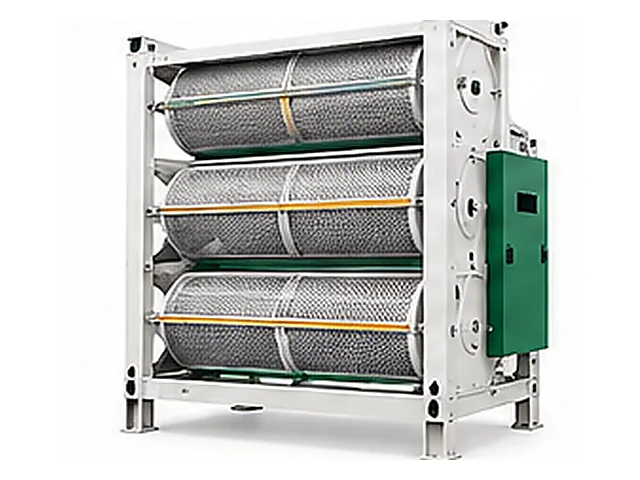
Unprocessed harvest grain enters the head of the rotating perforated trommel drum where internal flights and gentle tumbling immediately drop sound kernels through the screen openings into the clean collection hopper. Oversized straw, cobs, pods, and clods cannot pass through the apertures and travel axially out the open tail end of the cylinder, while external rotary brushes keep the perforations clear.
Technical Specifications
The capacity and power ranges indicated in the table may vary depending on the crop type to be processed, initial foreign matter rate, moisture level, and machine configuration. Exact performance and actual measurement values are finalized following the engineering design and process detailing of the plant to be installed.
Selection and integration
Sizing Rotary Pre-Cleaner Seed Separators depends on peak receiving pit tonnage, crop bulk density, moisture content, and the volume of long straw or green trash in the harvest stream. Operators can adapt the drum to different seasons by swapping perforated cylinder segments and adjusting drum rotational speed or inclination angle.
Key points to specify
- Confirm the crop, variety and incoming condition for Rotary Pre-Cleaner Seed Separators.
- Record cleaning access, service points and replaceable parts for the “Rotary Pre-Cleaner Seed Separators” unit with the supplier; record feed uniformity, screen choice, the required outlet and incoming impurity mix against the intended product.
- Use a product sample to set the acceptance target for the “Rotary Pre-Cleaner Seed Separators” unit; factors to review: feed uniformity, screen choice, the required outlet and incoming impurity mix.
- Place the “Rotary Pre-Cleaner Seed Separators” unit in the line drawing with its handoff elevations and cleaning access; record feed uniformity, screen choice, the required outlet and incoming impurity mix against the intended product.