Home›Machines›Sesame Roaster – Continuous Type
Sesame Roaster – Continuous Type
MACHINERY CATALOGUE

Sesame Roaster – Continuous Type

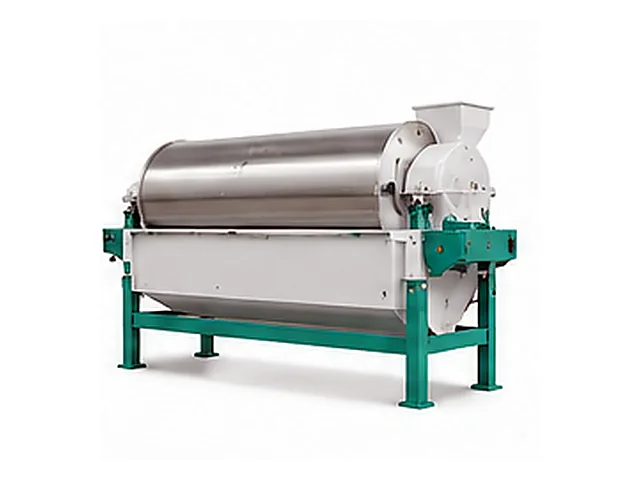
The Sesame Roaster – Continuous Type delivers uninterrupted, high-tonnage thermal roasting for industrial tahini, sesame oil, and bakery ingredient lines. By conveying a metered sesame layer through independently controlled heating and moisture-evaporation zones, the system maintains rock-steady roast colour and oil-release characteristics hour after hour.

Machines ↗

Overview

Conditioned or hulled sesame enters the Sesame Roaster – Continuous Type via a variable-speed rotary feeder and advances steadily through an insulated multi-zone roasting tunnel or revolving cylinder. Modulated hot-air circulation and gentle mechanical or aerodynamic bed turnover roast every kernel uniformly before discharging the continuous stream into an inline cooling stage.

Technical Specifications

Technical ParameterSRC-25SRC-50SRC-100SRC-150
Drying / Cooling / Processing Capacity10 – 25 t/h30 – 50 t/h60 – 100 t/h110 – 150 t/h
Drive & Fan Motor Power1.5 – 4.0 kW5.5 – 7.5 kW11.0 – 15.0 kW15.0 – 18.5 kW
Operating Temperature Control (PID)35 – 110 °C (Seed ≤ 42 °C)35 – 110 °C (Seed ≤ 42 °C)35 – 110 °C (Seed ≤ 42 °C)35 – 110 °C (Seed ≤ 42 °C)
Active Airflow Volume8,000 m³/h18,000 m³/h32,000 m³/h48,000 m³/h

The capacity and power ranges indicated in the table may vary depending on the crop type to be processed, initial foreign matter rate, moisture level, and machine configuration. Exact performance and actual measurement values are finalized following the engineering design and process detailing of the plant to be installed.

Selection and integration

Engineering a Sesame Roaster – Continuous Type centers on hourly mass throughput, incoming moisture content (dry-cleaned versus wet-hulled sesame), number of independent thermal zones, and target outlet colour and moisture. Staged zone temperatures let operators flash off surface water gently in the entry zone before developing Maillard roast notes in the finishing zone.

Key points to specify

  • Confirm the crop, variety and incoming condition for Sesame Roaster – Continuous Type.
  • Document the intended result for the “Sesame Roaster – Continuous Type” unit against actual feed and line conditions; review: heat or air services, initial product condition, residence needs and target condition.
  • For the “Sesame Roaster – Continuous Type” unit, check the operating choices against these factors: heat or air services, initial product condition, residence needs and target condition.
  • The line drawing for the “Sesame Roaster – Continuous Type” unit should identify product transfer, service space and interfaces with upstream and downstream equipment; document heat or air services, initial product condition, residence needs and target condition with the tested operating arrangement.

GUIDE · TECHNICAL SELECTION

What is this machine used for?

A Sesame Roaster – Continuous Type processes an uninterrupted stream of sesame seeds through multi-stage temperature-controlled roasting chambers to produce uniform tahini, halva, or oil-pressing feedstock. Continuous inline flow eliminates batch loading pauses and stabilizes downstream stone-mill or expeller feed rates.

01

The role in the process

In high-capacity automated tahini and sesame processing plants, the Sesame Roaster – Continuous Type bridges continuous wet peeling/predrying and continuous stone milling. Eliminating batch cycles reduces operator labour, smooths out peak fuel or power demand, and keeps downstream mills fed at a constant rate.

As sesame travels from the inlet to the outlet, independent zone controllers regulate burner output and air circulation velocity to match the changing moisture and temperature of the seed bed. An integrated or direct-coupled cooling zone at the exit drops kernel temperature rapidly before conveyor transfer.

02

Material and application suitability

Both wet-dehulled white sesame for premium tahini and natural unhulled sesame for toasted sesame oil require tight control over kernel temperature to prevent bitter char notes or free fatty acid rise. Gentle continuous agitation exposes every seed equally to convective and conductive heat without crushing fragile kernels.

By adjusting the VFD transport speed and individual zone temperature setpoints on the HMI touchscreen, plant operators can shift smoothly from a pale, low-moisture halva roast to a deep amber bakery or oil-pressing roast. Recipe settings are stored digitally for repeatable quality across seasonal sesame origins.

03

Selection checklist

Before specifying a Sesame Roaster – Continuous Type, establish your continuous hourly capacity, incoming sesame moisture after washing or hulling, target outlet moisture and colour range, and available fuel or thermal-oil utility. Verify building length and exhaust duct routing to the exterior cyclone collector.

Modulated air temperature and controlled bed depth protect heat-sensitive embryos in high-moisture seed and food grains. Uniform airflow distribution across the grain column prevents localized overheating and stress cracking. All contact zones support fast inspection. Cleanout doors simplify variety changeovers.

Integration into a processing line

Plant layout and interface planning

Position the Sesame Roaster – Continuous Type in a straight line between the upstream pre-dryer or hulling centrifuge and the downstream cooling and milling section. Feed the inlet via a level-controlled surge hopper so the roaster always receives an uninterrupted, uniform mass flow of seed.

Connect the multi-zone vapour exhaust hoods to a stainless-steel cyclone and fan system that captures detached pellicles and vents humid roasting fumes safely outside. Provide clear walkway access along both sides of the tunnel or drum for opening insulated service doors and inspecting burner trains.

Factors that affect operating performance

Fluctuations in incoming seed moisture or feed rate will shift the final roast colour if residence time and burner output remain static. Linking inlet feed metering with multi-zone temperature feedback keeps the thermal profile locked onto the target outlet specification.

Process quality and line integration

Continuous roasting followed immediately by inline air cooling delivers stabilized, crisp sesame kernels at constant temperature to the tahini mills, preventing paste separation and stabilizing oil viscosity. Under-bed cleanout trays allow operators to remove sifted fines without stopping the production line.

Frequently asked questions

What are the main advantages of a continuous sesame roaster over a batch roaster?

A continuous roaster eliminates the filling and discharging downtime of batch vessels, delivering a steady, uninterrupted flow of roasted sesame directly to downstream coolers and stone mills. Multi-zone heating also improves thermal efficiency and keeps roast colour uniform across high hourly tonnages.

How does multi-zone temperature control improve sesame roasting quality?

Dividing the roaster into sequential thermal zones allows the entry section to evaporate residual washing moisture at moderate kernel temperatures while subsequent zones apply controlled roasting heat to develop aroma and colour. This staged profile prevents outer skin scorching while drying the kernel core completely.

How is the roasted sesame cooled after leaving the heating zones?

The continuous roaster either incorporates a dedicated ambient-air cooling zone at the discharge end or transfers hot sesame directly onto a coupled Fluid Bed Air Cooler. Rapidly dropping seed temperature halts carry-over darkening and prepares the crisp kernels for immediate milling or packaging.

REQUEST A TECHNICAL REVIEW

Sesame Roaster – Continuous Type

Contact our process engineering team with your hourly sesame throughput, upstream peeling or washing moisture levels, and available heating utility to size a Sesame Roaster – Continuous Type.