
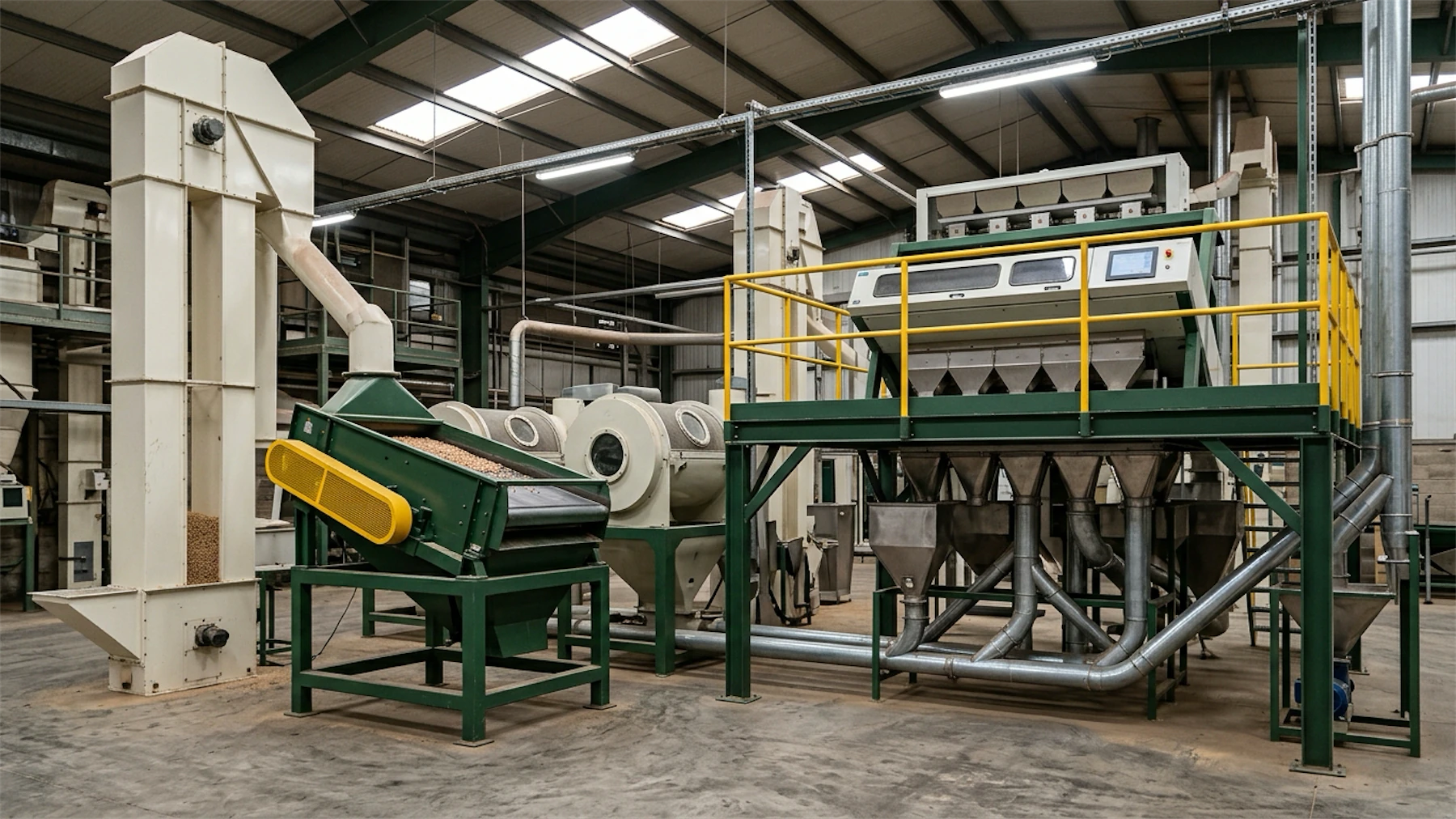
Pulse Cleaning and Grading Project
Send your pulse varieties, required hourly capacity, and export grade tolerances to start engineering a low-impact legume cleaning and grading line.
Pulse Cleaning & Grading Project Overview
This pulse cleaning and grading project encompasses gentle foreign-matter extraction, specific-gravity stone and mud-ball separation, precision millimeter size calibration, and pre-packing quality control. Exact machine sequencing and conveyor selection depend on the legume species, seed-coat fragility, and required commercial caliber distribution.
- Pre-Cleaner
- Air Screen Cleaner
- Destoner
- Gravity Separator
- Seed Grader
- Optical Color Sorter
- Bagging & Packaging Line
Core Legume Processing Machinery in This Concept
Review Your Pulse Processing Project With Our Engineers
Share your pulse crops, target hourly output, and facility dimensions so we can evaluate the optimal low-breakage cleaning and grading layout together.
Request a quote ↗Gentle Process Flow Concept for Commercial Pulses
Because dry legumes are prone to cotyledon splitting and testa cracking when subjected to high-velocity impact, a pulse conditioning flow pairs high-precision separation with cushioned material transfers. Typical configurations combine aspiration, multi-deck screening, destoning, gravity separation, and rotary or flat-screen size grading confirmed through sample testing.
Legume processing lines emphasize low-velocity conveying, thorough soil and stone removal, and multi-caliber size classification with minimal seed damage.
Project Engineering Scope & Handling Checkpoints
- Evaluating incoming harvest moisture, split-seed percentages, soil clods, and field stones across pulse deliveries
- Configuring gentle air-screen cleaners, destoners, gravity tables, and caliber graders around sample analysis and export standards
- Verifying low-speed bucket or Z-type elevators, cushioned drop chutes, and service clearances to prevent seed coat damage
Engineering Planning Guidelines for Pulse Lines
Prior to specifying pulse processing equipment, define all legume species and market classes, harvest moisture ranges, stone and dirt loads, maximum allowable splits, required millimeter size fractions, shift schedules, building clear height, power utilities, dust collection needs, and bulk tote or retail bagging interfaces. Addressing these factors upfront eliminates seed breakage hotspots and undersized grading decks.
Any throughput figure referenced on this project page serves as a preliminary planning estimate rather than a guaranteed production rate. Actual hourly output varies with pulse variety, incoming dirt and split content, screen slot or round-hole sizes, and gravity deck adjustments, which must be verified using physical crop samples.
Engineer a Low-Breakage Pulse Line Around Your Export Standards
Provide your legume varieties, hourly tonnage targets, and grading specifications to initiate a practical project engineering consultation.
Pulse Cleaning & Grading Project FAQs
What information is required to evaluate a pulse processing project?
Please share the pulse crops (such as lentils, chickpeas, or dry beans), target hourly capacity, raw impurity and split profile, required caliber grades, building layout, and any existing machinery.
Are preliminary capacity figures guaranteed across all legume varieties?
No; preliminary figures are reference baselines, whereas actual throughput depends on whether the line runs small red lentils, large kabuli chickpeas, or fragile kidney beans and is confirmed after sample testing.
Can new pulse graders and destoners integrate into an existing plant?
Yes, once existing elevators, surge bins, optical sorters, and bagging scales are checked for drop heights, gentle transfer velocities, throughput balance, and electrical interlocks.