
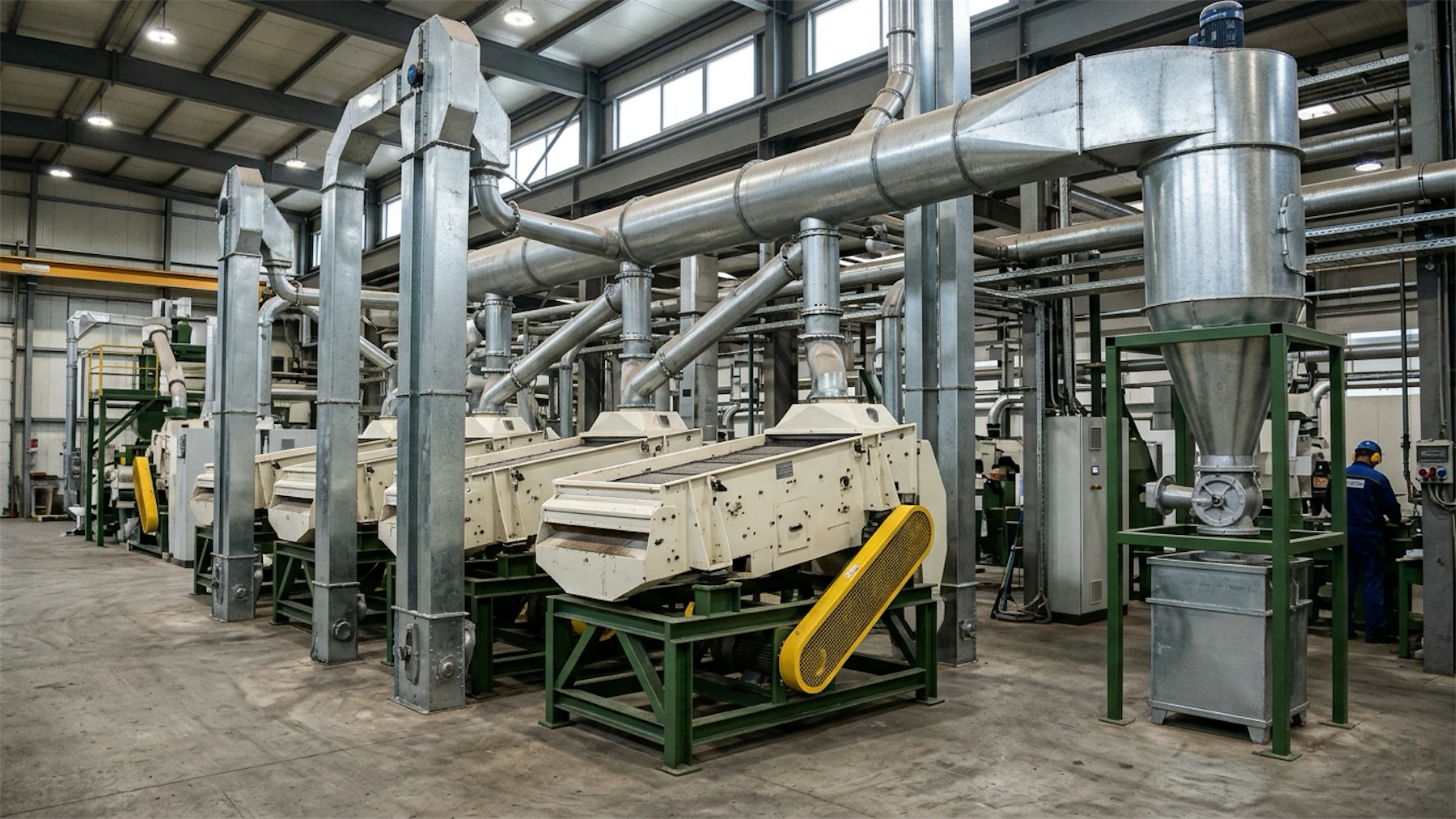
Sunflower Seed Processing Project
Share your sunflower market segment, hourly tonnage requirements, and final purity benchmarks to start engineering a complete sunflower seed processing plant.
Industrial Sunflower Seed Conditioning & Sorting Scope
This industrial sunflower seed processing project integrates front-end stalk and head-fragment scalping, multi-deck air-screen cleaning, specific-gravity separation, precision caliber grading, and optical sorting where required. Final machine models and volumetric handling capacities are determined by sample testing, target commercial grades, and site building geometry.
- Pre-Cleaner
- Air Screen Cleaner
- Destoner
- Gravity Separator
- Optical Color Sorter
- Bucket Elevator
- Bagging & Packaging Line
Core Sunflower Conditioning & Sorting Machinery
Consult Our Project Team on Your Sunflower Processing Line
Send us your sunflower crop specifications, target hourly capacity, and plant layout drawings so we can review the optimal process configuration together.
Request a quote ↗End-to-End Process Concept for Sunflower Conditioning
Designing an end-to-end sunflower processing line requires staged removal of coarse field stalks, lightweight empty hulls, same-size woody sticks or sclerotia, and discolored kernels without cracking the thin achene pericarp. Depending on whether the output feeds in-shell snack roasting, kernel dehulling, or hybrid seed bagging, the flow combines scalping, aspiration, screening, gravity separation, and optical sorting verified by sample trials.
Industrial sunflower projects combine heavy-trash pre-cleaning, multi-fraction screen calibration, density upgrading, and optional color sorting.
Technical Scope & Volumetric Design Checkpoints
- Evaluating incoming sunflower bulk density, harvest moisture, woody stem fragments, and hollow-achene percentages at intake
- Selecting non-blinding scalpers, air-screen cleaners, caliber sizers, and gravity decks matched to sample analysis and buyer tolerances
- Coordinating high-volume bucket elevators, steep self-clearing transfer chutes, and maintenance walkways across the facility
Facility Planning Notes for Sunflower Processors
Before locking in equipment specifications, document the sunflower varieties (in-shell confectionery, bakery kernel, or oilseed), moisture ranges, initial trash and sclerotia profile, required millimeter caliber splits, shift schedules, available floor-to-truss height, power supply, central cyclone/baghouse filtration, and downstream roasting, dehulling, or packaging interfaces. Resolving these details upfront prevents volumetric bottlenecks and hull buildup.
Any hourly capacity cited on this project page is a preliminary planning reference rather than an unconditional production guarantee. Real-world throughput in sunflower installations depends on achene bulk density, stalk load, screen slot widths, and gravity table deck tuning, which must be verified through physical sample testing and a formal process specification.
Engineer a Sunflower Processing Line Around Your Commercial Grades
Provide your sunflower product specs, desired hourly tonnage, and quality goals to initiate a practical plant engineering discussion.
Frequently Asked Questions on Industrial Sunflower Projects
Which project parameters are needed to evaluate a sunflower processing line?
Please supply the sunflower type, required hourly input and graded output rates, bulk density, raw impurity breakdown, target millimeter grades, available building dimensions, and details of any existing equipment.
Are preliminary capacity figures guaranteed across all sunflower lots?
No; preliminary ratings serve as initial engineering baselines, whereas actual tonnage must be verified against your specific sunflower sample, bulk density, and required grading precision.
Can new sunflower cleaners and gravity tables integrate into an existing facility?
Yes, provided existing intake pits, elevators, buffer bins, and optical sorters are audited for volumetric capacity, steep chute angles, dust collection, and electrical interlocks.