Home›Machines›Centrifugal Fan
Centrifugal Fan
MACHINERY CATALOGUE

Centrifugal Fan

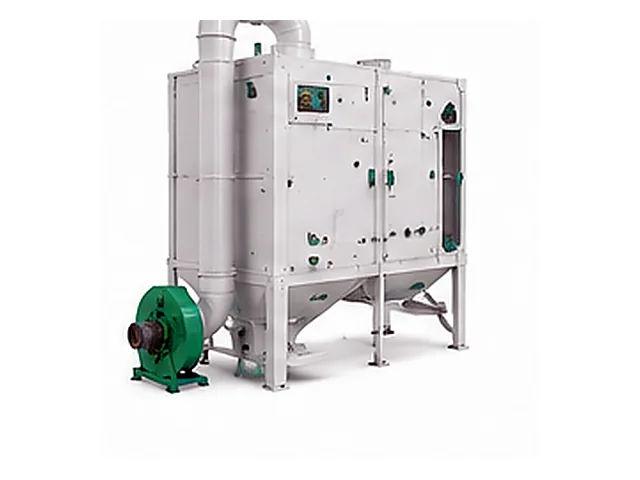
A Centrifugal Fan supplies the volumetric airflow and static pressure required to drive aspiration channels, cyclones, bag filters, gravity separators, and pneumatic dust extraction trunks across seed and grain plants. By accelerating air radially through a dynamically balanced impeller rotating inside a spiral scroll housing, the fan overcomes duct friction and equipment pressure drops reliably. Selecting the right impeller geometry and drive arrangement ensures stable air velocity at every connected separation point.

Machines ↗

Overview

Air enters the Centrifugal Fan axially through the suction eye and is turned ninety degrees by the rotating impeller blades, gaining kinetic energy and radial velocity. The surrounding volute scroll casing progressively expands in cross-section, converting high velocity head into usable static pressure at the discharge flange. Depending on whether the fan is installed on the clean-air side of a bag filter or on the dirty-air side ahead of a cyclone, engineers specify backward-curved high-efficiency blades or self-cleaning radial paddle wheels.

Technical Specifications

Technical ParameterCNF-25CNF-50CNF-100CNF-150
Matched Line Processing Capacity10 – 25 t/h30 – 50 t/h60 – 100 t/h110 – 150 t/h
Airflow Volume Capacity3,000 – 7,500 m³/h8,000 – 16,000 m³/h18,000 – 30,000 m³/h32,000 – 45,000 m³/h
Fan / Drive Motor Power1.5 – 4.0 kW5.5 – 7.5 kW11.0 – 15.0 kW15.0 – 18.5 kW
Dust Separation Efficiency≥ 99.5%≥ 99.5%≥ 99.5%≥ 99.5%

The capacity and power ranges indicated in the table may vary depending on the crop type to be processed, initial foreign matter rate, moisture level, and machine configuration. Exact performance and actual measurement values are finalized following the engineering design and process detailing of the plant to be installed.

Selection and integration

Sizing a Centrifugal Fan requires calculating the total system resistance curve—including hood entry losses, duct bends, cyclone vortex drop, and filter sleeve differential pressure—alongside the total cubic airflow demand. Placing the fan on the clean-air discharge side of a baghouse allows the use of high-efficiency backward-inclined impellers that resist dust build-up and consume less electrical power. Where a fan must convey chaff or shells directly into a cyclone, an open radial paddle impeller prevents fibrous material from hooking onto the blades and causing rotor imbalance.

Key points to specify

  • Confirm the crop, variety and incoming condition for Centrifugal Fan.
  • The fit of the “Centrifugal Fan” unit should be checked on a representative sample, with dust loading, duct route, filter service access and airflow demand matched to the planned line duty.
  • Use a product trial to define where the “Centrifugal Fan” unit fits; record dust loading, duct route, filter service access and airflow demand and the output expected by the following stage.
  • Request written connection and maintenance details for the “Centrifugal Fan” unit, then check them against the site layout and cleaning access; include dust loading, duct route, filter service access and airflow demand in the selection record.

GUIDE · TECHNICAL SELECTION

What is this machine used for?

Every aerodynamic separation and dust control stage in a grain or seed facility relies on a properly matched Centrifugal Fan to maintain steady air velocity. Whether pulling air through an aspiration channel, pressurizing the plenum of a gravity separator or de-stoner, or exhausting a central reverse pulse jet air filter, the fan's pressure-volume curve governs process stability. Pairing rugged industrial scroll construction with variable frequency speed control lets operators trim airflow precisely for delicate small seeds or heavy cereal grains.

01

The role in the process

In an aspiration or filtration network, the Centrifugal Fan acts as the prime mover that establishes negative pressure at dust pickup hoods and controlled upward velocity inside air separators. If the fan curve is too flat or undersized for the static pressure of the ductwork, slight increases in filter dust cake will cause airflow at the cleaners to collapse.

Direct-driven fans mount the impeller directly on the motor shaft for compact, low-maintenance operation, whereas belt-driven arrangements allow pulley ratio changes if plant aspiration duty is modified later. Coupling either drive style with a frequency inverter provides smooth soft-starting and stepless airflow regulation.

02

Material and application suitability

Clean-air duties downstream of fabric baghouses handle filtered air free of abrasive hulls, permitting aerofoil or backward-curved impellers with high mechanical efficiency. Material-handling duties—such as blowing sunflower hulls, oat husks, or pre-cleaner screenings to a cyclone—require thick-plate radial blades that resist erosion and self-clean under centrifugal force.

Air density changes with ambient temperature and site altitude, which directly affects the static pressure developed by a Centrifugal Fan at a fixed rotational speed. Cold winter commissioning air draws higher motor current than warm summer air, so motor sizing and damper settings must account for seasonal air density variations.

03

Selection checklist

Before ordering a Centrifugal Fan, specify the required volumetric flow rate, total static pressure at the operating point, air cleanliness (clean vs. dust-laden), scroll rotation/discharge angle, and acoustic limits. Verifying duct velocities ahead of the suction eye prevents swirl and turbulence that would degrade impeller performance.

Size airflow volume, static pressure drop, and filtration media area to maintain stable capture velocity across all suction points. Commissioning pitot traverses balance branch damper settings and confirm emission compliance. Adjustable airflow velocity and balanced static pressure accommodate varying dust loads and husk densities across crop runs.

Integration into a processing line

Plant layout and interface planning

Install at least a straight duct run ahead of the Centrifugal Fan suction inlet so air enters the impeller eye axially without pre-rotation caused by sharp upstream elbows. Flexible canvas or elastomer sleeves at both the inlet and outlet flanges isolate fan vibration from the rigid plant ductwork and structural steel.

Heavy fans mounted on upper plant floors should sit on spring or rubber anti-vibration isolators with sufficient clearance around the scroll casing for bearing service and impeller inspection. When exhausting outdoors, angle the discharge hood or fit a weather cowl and bird screen that do not impose excessive backpressure.

Factors that affect operating performance

Accumulation of sticky dust or moisture on impeller blades upsets dynamic balance, leading to bearing vibration, noise, and premature mechanical failure. Inspecting the rotor through the casing cleanout door and keeping upstream filter bags intact prevents dust build-up on high-speed clean-air impellers.

Process quality and line integration

Integrating a Variable Frequency Drive (VFD) controlled by a duct static pressure sensor allows the Centrifugal Fan to modulate speed automatically as filter bag resistance fluctuates. This closed-loop pressure control keeps air velocity constant inside upstream aspiration channels and screen cleaners.

Frequently asked questions

When should a Centrifugal Fan use a backward-curved impeller versus a radial blade impeller?

Backward-curved impellers offer higher energy efficiency and lower noise, making them ideal when the fan is positioned on the clean-air side downstream of a bag filter. Radial paddle-blade impellers are chosen when dust, chaff, or husks pass directly through the fan housing on their way to a cyclone.

Why does a Centrifugal Fan need a straight duct section before the suction eye?

An elbow placed immediately against the fan inlet forces air to crowd one side of the impeller and induces spin, reducing both static pressure and airflow capacity. Providing a straight approach duct or fitting inlet turning vanes ensures symmetrical loading across all impeller blades.

What routine checks protect a Centrifugal Fan during continuous plant operation?

Maintenance teams should monitor bearing temperature and vibration levels, inspect V-belt tension and alignment on belt-driven models, and check the impeller blades for dust build-up or erosion. Intact flexible duct connectors and clean upstream filter bags prevent mechanical strain and rotor imbalance.

REQUEST A TECHNICAL REVIEW

Centrifugal Fan

Provide your duct network schematics, required static pressure, and particulate load conditions so our airflow specialists can size the optimal Centrifugal Fan. We assist with impeller geometry, scroll discharge angle, drive power, and VFD integration for reliable plant aspiration.